

Types of Industrial Saws
Industrial saws are purpose-built cutting machines that drive output in fabrication shops, woodworking facilities, and construction sites. From the workhorse band saw to circular saws, miter saws, chop saws, and hacksaws, every type fills a different role. This guide covers the complete types of saw list — what each machine does, what it cuts, and how to match the right saw to your work.

Quick Answer
Types of industrial saws include band saws (vertical, horizontal, portable), circular saws, miter saws, chop saws, reciprocating saws, scroll saws, and hacksaws. The three basic types of saws in any industrial shop are band saws, circular-blade saws, and reciprocating saws — each built for a different cut geometry and material.
Example model: Baileigh Horizontal Band Saw BS-916M — $6,645.27. View more >
In This Guide
- What Are Industrial Saws?
- Industrial Band Saws (Vertical, Horizontal, Portable)
- Circular Saws in Industrial Settings
- Miter Saws and Chop Saws
- Reciprocating Saws
- Scroll Saws
- Industrial Hacksaws
- Types of Industrial Saws Compared
- Top Industrial Saw Picks
- How to Choose the Right Industrial Saw
- Industrial Saw Safety Tips
- Frequently Asked Questions
- Conclusion
What Are Industrial Saws?
Industrial saws are powered cutting machines built for sustained professional use in manufacturing plants, fabrication shops, construction sites, and large woodworking facilities. They differ from residential tools in motor power, build quality, cutting capacity, and duty cycle. Many are built on cast-iron or heavy-gauge steel frames, accept coolant to extend blade life, and are made to hold tolerance across a full production shift.
The three basic types of saws you will find in any industrial shop are band saws (continuous-loop blade), circular saws (spinning disc blade), and reciprocating saws (push-pull blade). Every other saw type fits somewhere within those three families. Among the types of small saws used in shops, scroll saws and compact miter saws handle finishing, decorative cutting, and trim work where a large production machine is impractical.

Industrial Band Saws
Band saws use a continuous loop of toothed blade stretched between two or more wheels. The blade travels in one direction at a consistent speed, producing a clean cut with far less heat than an abrasive saw. Types of industrial band saw designs fall into three major groups: vertical, horizontal, and portable — each built for a different cut orientation and production requirement.
Vertical Band Saws
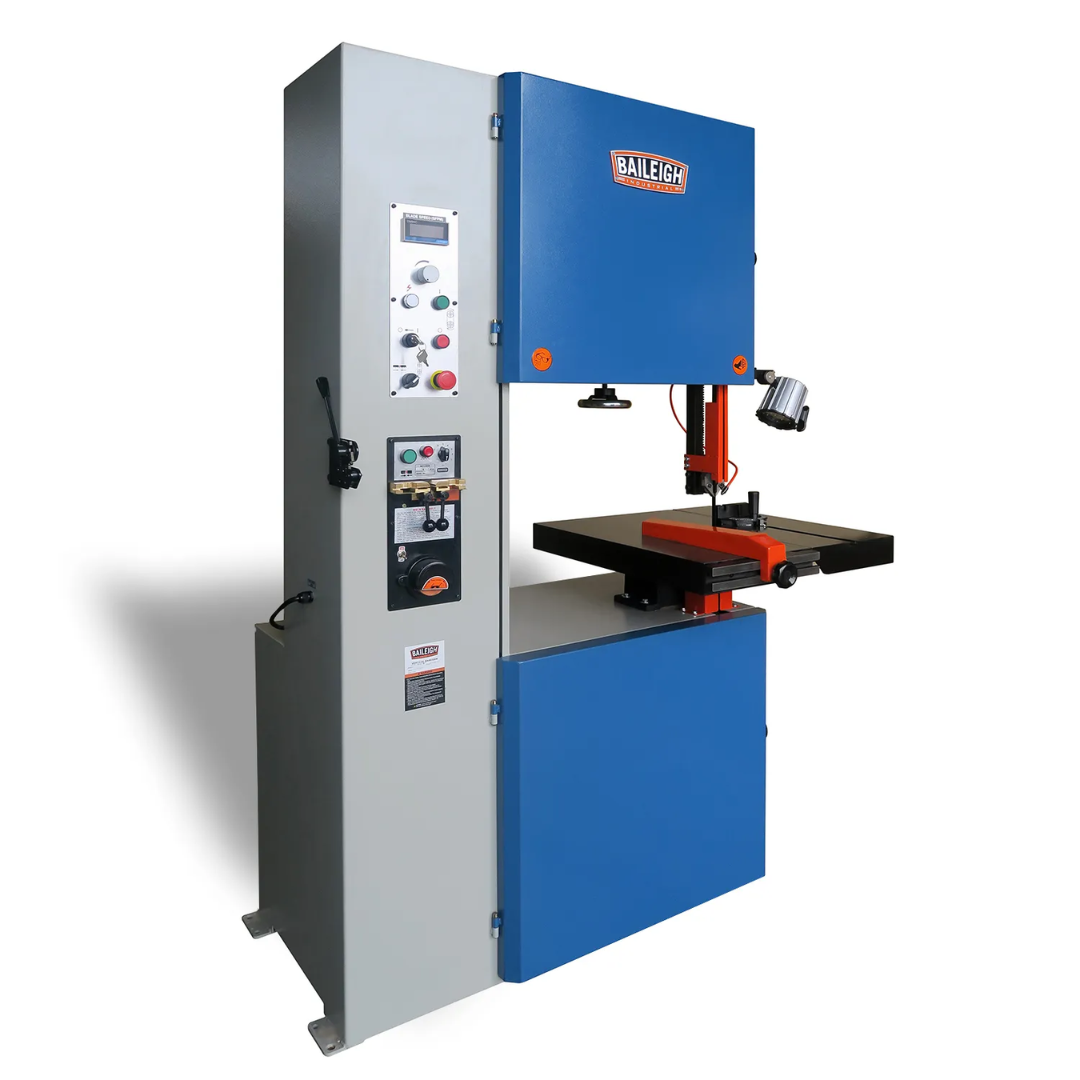
A vertical band saw orients the blade in a vertical plane, with the workpiece moving across a fixed worktable. The blade cuts downward, which presses the workpiece against the table. Vertical band saws excel at resawing wide lumber, cutting curves and contours, and making intricate profiles in both wood and metal. For metal fabrication shops, they cut structural sections, angle iron, and bar stock to complex shapes that horizontal saws cannot follow. Variable-speed models, such as the Baileigh BSV-14VS-V2, handle aluminum, mild steel, and stainless when you dial the blade speed to the material.

Horizontal Band Saws
Horizontal band saws mount the blade in a horizontal plane and pivot the head down onto the workpiece, which is clamped in a vise below. These are cutoff saws. Their primary job is slicing bar stock, pipe, tubing, and structural shapes to length. Manual horizontal band saws use gravity or a spring-loaded arm for feed control. Hydraulic models apply controlled downfeed pressure for consistent cuts on hard or variable-density material. Mitering models let you swivel the head or vise to an angle, commonly up to 45°, so you can cut angles without repositioning the stock. The Baileigh BS-916M, for example, miters from 0° to 45° through its vise.


Portable and Dual-Mitering Band Saws
Portable band saws are built for tight shop spaces and job-site work. They sit on a wheeled stand and can be repositioned quickly between cuts. Many models switch between horizontal and vertical orientations, so one station handles both cutoff and contour work. Dual-mitering band saws swivel the saw head both left and right for angle cuts in steel without repositioning the workpiece. The Baileigh BS-10VS, for example, cuts 45° left and 45° right. These are among the most efficient types of industrial saws on a busy structural steel or pipe fabrication line where angle cuts are routine.


Circular Saws in Industrial Settings
Circular saws spin a toothed disc blade at high RPM to rip, crosscut, or score material. Industrial circular saws in a shop setting include table saws (for ripping sheet goods and dimensional lumber, as covered in our guide on how to use a table saw), panel saws (for breaking down full 4×8 and 5×10 sheets), cold saws (for cutting metal with a slow-turning carbide-tipped or HSS circular blade), and industrial chop saws with abrasive discs. These saws are most common in wood fabrication shops, sign shops, millwork operations, and metal cutting stations where cut quality matters.
Cold saws deserve special mention. A cold saw is a circular saw with a toothed blade that shears metal away in chips. Those chips carry the heat out of the cut, so the blade and workpiece stay cool, and flood coolant cuts sparks and discoloration further. An abrasive chop saw grinds the metal and builds heat in the work. A cold saw leaves a clean cut with minimal burrs, so parts often need little deburring before welding. That makes it one of the most productive types of industrial saws for shops that run repetitive cutoff operations on structural steel and tube. Examples include manual models like the Baileigh Manual Cold Saw CS-250EU and semi-automatic models like the Baileigh Semi-Automatic Cold Saw CS-C485SA.

Miter Saws and Chop Saws
Miter saws and chop saws are both fixed-station machines where the blade descends onto a stationary workpiece clamped against a fence. What separates them is the blade and the motion range. Miter saws use a toothed circular blade that pivots for miter angles and tilts for bevel cuts. Chop saws are built mainly for straight crosscuts in metal, using an abrasive disc or a metal-cutting toothed blade, though many add a swiveling vise or fence for miters. Both are common types of saws in shops, from trim carpentry to steel fabrication.
Shopping for band saws? See the full selection or call 888-308-5580.
Shop Band SawsSliding Compound Miter Saws
Sliding compound miter saws add a rail system that lets the blade travel forward as it descends, which greatly increases crosscut width. The 10-inch Evolution R255SMS+, for example, cuts boards up to 11¾ inches wide, and 12-inch sliding saws cut wider still. These are the miter saws most wood shops choose for trim, furniture parts, and framing. A multi-material carbide-tipped blade, like the one on the R255SMS+, also lets the same saw cut aluminum, plastics, and mild steel.

Compact Miter Saws
Compact miter saws sacrifice blade diameter for portability. A 7¼-inch sliding miter saw, such as the Evolution R185SMS+, fits on a job-site bench without needing a dedicated station. It cuts boards up to 8¼ inches wide and 2¼ inches high, enough for trim and molding. For shops that cut wood, aluminum, plastics, and mild steel, a compact multi-material miter saw handles all four with a single TCT blade. These are among the most versatile small saws for shops where a full-size machine is overkill.

Abrasive Chop Saws
Abrasive chop saws grind through steel with a bonded abrasive disc. They cut rebar, angle iron, and black pipe quickly, but they throw sparks and put a lot of heat into the work. The machine must have a safety guard, and the disc must never run faster than the maximum speed marked on it, as OSHA's abrasive wheel machinery standard requires. The Baileigh Abrasive Chop Saw AS-350M, for example, turns a 14-inch disc at 4,300 RPM with a 7.5 HP three-phase motor and miters 45° left and right. Choose a cold saw (above) when you need a clean, ready-to-weld cut, and an abrasive saw for field or demolition work where cut finish matters less.
Reciprocating Saws
Reciprocating saws drive a straight blade back and forth in a rapid push-pull stroke. They are used in demolition, HVAC rough-in, plumbing, and structural work where access limits fixed-station tools. (Sawzall is Milwaukee Tool's brand name for the type, and many people use it as a generic term.) Blades range from fine-tooth bimetal blades for thin metal and pipe to coarse demolition blades for wood with embedded nails. That makes them one of the most versatile types of saws for multi-material work, because one tool body cuts wood, metal, and plastic just by changing the blade. Examples include saws like the corded Evolution R230RCP, a 7 Amp saw that runs up to 2,800 strokes per minute and ships with four blades, and, for compressed-air shops, the CS Unitec JP901 Air Reciprocating Saw.
Industrial reciprocating saws differ from consumer tools in motor size, variable speed range, and stroke length. Longer strokes generally cut faster, while shorter strokes tend to leave cleaner cuts on thin-wall tube and sheet metal. For shops that do rough plumbing, pipe demo, or structural steel removal, a heavy-duty reciprocating saw is an essential secondary cutting tool alongside the main machine saws.

Scroll Saws
Scroll saws use a fine, short blade held between two arms that move it up and down rapidly. The blade is thin enough to follow tight curves and intricate profiles in wood, plastic, and thin non-ferrous sheet. In professional shops, scroll saws are used for sign making, decorative woodworking, inlay cutting, and prototype parts. They are not a production-volume machine, but they fill a niche for detailed interior cutouts, such as ornamental shapes, lettering, and lattice patterns. You can thread the blade through a drilled hole and turn the workpiece freely in tight arcs.
Throat depth, the distance from the blade to the rear of the saw's arm, limits how far from the edge of a panel you can cut. The RIKON 10-600VS is a 16-inch model, and the RIKON 10-622VS has a 22-inch throat for extra access on large projects. Speed control matters too. The 10-622VS runs from 550 to 1,550 strokes per minute, so you can slow the blade for plastics and hardwoods and speed it up for thin softwood.

Industrial Hacksaws
Power hacksaws use a straight, fine-tooth blade in a frame that strokes back and forth. The blade cuts only on the cutting stroke, and the machine lifts it clear of the work on the return stroke. They are simple, low-cost cutoff machines for bar stock, pipe, and tubing, and the feed can be mechanical, hydraulic, or gravity-driven, according to a Navy steelworker training manual.
In most production shops, the horizontal band saw has replaced the power hacksaw. The same manual credits the band saw's continuous blade motion with greater speed, accuracy, and versatility. That is why the hacksaw comes last in this guide. Powered hacksaws are still available for jobs where a simple reciprocating cut is enough. Examples include CS Unitec powered hacksaws, including the CS Unitec Air Hacksaws for Cutting Pipe and the CS Unitec Hydraulic Hacksaws. Whichever saw you run, match the blade's tooth pitch to the material's hardness and the thickness of the workpiece. Our metal band saw blade selection guide walks through that choice.
Types of Industrial Saws Compared
Matching the right saw to the job starts with material type, cut geometry, and production volume. This types of saw list covers the most common machines found in industrial and professional shop environments, with each one's primary material, cut type, best application, and an example model.
| Saw Type | Primary Material | Cut Type | Best For | Example Model |
|---|---|---|---|---|
| Vertical Band Saw | Metal, Wood | Contour, Resaw | Fabrication, Woodworking | Baileigh Vertical Bandsaw BSV-14VS-V2 |
| Horizontal Band Saw | Metal | Length cutoff | Bar stock, Pipe, Tubing | Baileigh Horizontal Band Saw BS-916M |
| Portable Band Saw | Metal | Cutoff, Miter | Job site, Small shops | Baileigh Portable Metal Cutting Band Saw BS-128M |
| Table Saw (Circular) | Wood, Plywood | Rip, Crosscut | Lumber, Sheet goods | SawStop Compact Table Saw |
| Miter Saw | Wood, Aluminum | Miter, Bevel | Trim, Framing, Extrusions | Evolution Single Bevel Sliding Miter Saw R255SMS+ |
| Chop Saw (Abrasive) | Steel, Rebar | Cutoff, Miter | Construction, Steel fab | Baileigh Abrasive Chop Saw AS-350M |
| Cold Saw (Circular) | Steel, Stainless | Precision cutoff | Weld-ready cuts, Tube | Baileigh Manual Cold Saw CS-250EU |
| Reciprocating Saw | Multi-material | Demo, Plunge | Demolition, HVAC, Plumbing | Evolution Reciprocating Saw R230RCP |
| Scroll Saw | Wood, Plastic | Fine curves, Intricate | Signs, Decorative cutting | RIKON 10-622VS 22" VS Scroll Saw |
| Industrial Hacksaw | Steel, Pipe | Straight cutoff | Bar stock, Pipe, Tubing | CS Unitec Hydraulic Hacksaws |
In short, band saws cover the widest range of metal cutting, cold saws deliver the cleanest cuts in steel, and miter and table saws handle wood and trim. If you are weighing two metal-cutting options, read our band saw vs cold saw comparison or our guide to metal band saw vs chop saw.


Top Industrial Saw Picks
For shops that need a reliable industrial band saw, these three machines represent the best balance of capacity, durability, and value across horizontal, vertical, and portable types of industrial band saw designs.
1. Baileigh Horizontal Band Saw BS-916M — $6,645.27
The BS-916M is a full-size floor-standing horizontal band saw with hydraulic feed and built-in miter capability. It handles round stock up to 8.75 inches in diameter and miters from 0° to 45° through its vise, making it one of the most capable types of horizontal saws in its price class. The hydraulic downfeed keeps pressure controlled from first contact to breakthrough, which helps reduce blade deflection on hard materials like stainless and thick-wall pipe. View more >
2. Baileigh Vertical Bandsaw BSV-14VS-V2 — $7,225.21
The BSV-14VS-V2 is a variable-speed vertical band saw with a 14.17-inch throat, built for metal fabrication, with a cast iron worktable, a heavy-duty steel cabinet, and an adjustable variable-speed pulley system. It handles aluminum, plastics, and mild steel with correct blade and speed selection, and its tilting table bevels 45° right and 15° left. View more >
3. Baileigh Portable Metal Cutting Band Saw BS-128M — $2,114.40
The BS-128M is a portable horizontal/vertical band saw that ships with a heavy-duty stand. At less than a third of the cost of the BS-916M, it handles pipe, angle, flat bar, and tubing up to 5 inches round. This is the right pick for shops that need a small, job-site-ready metal cutting saw without committing floor space to a dedicated cutoff machine. View more >
How to Choose the Right Industrial Saw
The right saw type depends on four factors: material, cut geometry, production volume, and floor space. Work through them in order to narrow from the full types of saw list to the one or two machines your shop actually needs.
- Material type: Metal requires bi-metal or carbide-tooth blades and slower blade speeds. Wood requires hook-tooth blades with more set and higher blade speeds. If you cut both, choose a variable-speed machine designed for multi-material work rather than buying separate saws. Our metal band saw blade selection guide and bandsaw blade selection guide for woodworking show how to match tooth pitch and width to the cut.
- Cut geometry: Straight cutoffs go to a horizontal band saw or chop saw. Contours and curves require a vertical band saw or scroll saw. Angle cuts need a mitering horizontal band saw or miter saw. Complex profiles in sheet metal require a vertical band saw with a narrow blade.
- Production volume: High-volume repetitive cuts justify a semi-automatic saw that clamps, feeds, and returns the head automatically, such as the Baileigh BS-330SA. Low-volume occasional cuts allow a manual machine that costs significantly less and takes up less space.
- Floor space: Portable band saws and compact miter saws need minimal dedicated space. Floor-standing vertical band saws and large horizontal saws need a fixed station with adequate clearance for infeed and outfeed stock.
For most industrial shops starting with band saws, a horizontal band saw handles the cutoff work while a vertical band saw handles fabrication cuts. That two-machine combination covers the majority of types of saws in shop environments without overlap between the two machines. Our guide to vertical vs horizontal band saws walks through that choice in detail.
Industrial Saw Safety Tips
All industrial saw types share the same core safety principles. Follow these practices every time regardless of machine type.
- PPE every cut: Wear safety glasses and hearing protection, and add steel-toe footwear and a face shield where the job's hazards call for them. Abrasive chop saws throw sparks and debris, so a face shield is a smart addition there.
- Secure the workpiece: Always clamp or vise material before starting the cut. Never hold metal stock freehand under or against a saw blade under power.
- Inspect blades before use: Check band saw blades for missing or damaged teeth, cracks, and proper tension. Inspect circular and chop saw blades for cracks and missing carbide. Replace immediately if damaged.
- Match blade to material: A wood blade on metal will grab and kick. A metal blade on wood wastes material with excessive kerf. Correct TPI and tooth geometry for the material is not optional — it is a safety requirement.
- Respect abrasive wheel limits: On an abrasive chop saw, confirm the machine's spindle speed does not exceed the maximum speed marked on the disc, and never run it without its guard. See OSHA 1910.215 for the rules on abrasive wheel machinery.
- Keep blade guards in place: Industrial saws ship with blade guards designed for their specific cut envelope. Remove guards only for blade changes and immediately reinstall before restarting the machine.
Frequently Asked Questions
What are the three basic types of saws?
The three basic types of saws are band saws (continuous-loop blade), circular saws (spinning disc blade), and reciprocating saws (back-and-forth blade). Every other saw type falls under one of these three families. Band saws split into vertical and horizontal designs; circular saws include table saws, miter saws, panel saws, and cold saws; reciprocating saws include industrial hacksaws and demolition tools.
What types of industrial wood saw machines are found in professional shops?
The most common types of industrial wood saw in a professional shop are band saws for resawing and contour cuts, table saws for ripping sheet goods and dimensional lumber, panel saws for large-format sheet processing, and miter saws for precision crosscuts and angle cuts. Each handles a different stage of the woodworking production process and they typically work as a system, not as individual standalone tools.
What is the difference between a miter saw and a chop saw?
A miter saw uses a toothed circular blade that pivots for miter cuts and tilts for bevel cuts, mainly in wood. Multi-material models like the Evolution R255SMS+ also cut aluminum and plastics. A chop saw is a metal-cutting cutoff saw, usually with an abrasive disc, built for fast straight cuts in steel, rebar, and pipe. Many add a swiveling vise for miters, like the 45° left and right miter range on the Baileigh AS-350M. A cold saw is a related but separate machine with a toothed circular blade. Choose a miter saw for precise angle cuts in softer materials, and a chop saw for rapid, high-volume cuts in metal where cut finish matters less than cycle time.
What types of saws are used for cutting metal in an industrial setting?
Industrial saws used for metal cutting include horizontal band saws (bar stock and pipe cutoff), vertical band saws (contour and profile cutting), cold saws (precise cuts with minimal burrs in steel and stainless), abrasive chop saws (fast straight cuts in rebar and structural sections), and reciprocating saws (demolition and plumbing rough-in). For high-precision metal work, industrial band saws are the most versatile because a blade change allows switching between material types — steel, aluminum, stainless — without replacing the machine.
What types of small saws are used in industrial shop settings?
Types of small saws used in industrial and professional shop settings include portable band saws (for cutoffs in tight spaces or on-site work), compact miter saws (for trim, extrusions, and angle cuts), scroll saws (for decorative curves and inlay work), and bench-top hacksaws (for small bar stock). For metal cutting in a compact footprint, a portable band saw on a stand handles most cutoff work without the floor-space commitment of a full-size floor-standing machine.
What is the difference between a band saw and a cold saw?
A band saw cuts with a continuous loop blade. Vertical models can follow curves and contours, and horizontal models cut stock to length. A cold saw uses a slow-turning circular blade that shears metal away in chips, which leaves a clean cut with minimal burrs on straight cutoffs. Band saws are the more versatile machine across shapes and materials, while cold saws are the specialist for clean, repeatable cutoffs. See our band saw vs cold saw comparison for a full breakdown.
Which industrial saw is best for cutting pipe and tubing?
A horizontal band saw is the common choice for pipe and tubing cutoff, because the vise holds the stock steady while the blade feeds down through it. The Baileigh BS-916M handles round stock up to 8.75 inches, and the Baileigh BS-128M handles up to 5 inches. A cold saw gives the cleanest square cut when weld-ready ends matter most.
Conclusion
The right saw type depends on your material, cut geometry, and production demands. For most professional metal fabrication shops, the core types of industrial saws are a horizontal band saw for cutoff work and a vertical band saw for profile and contour cuts — that combination covers the majority of operations without overlap. Wood shops lean on table saws and miter saws, with a band saw for resawing. Whatever your application, every saw type covered here fills a defined role that no other machine can fully replace. Explore our full line of industrial band saws to find the right machine for your shop.
Explore the category: Power Tools and Power Saws.
Related Reading
Talk to an Industrial Saw Specialist
Not sure which type of saw is right for your shop? Our specialists will help you match the machine to your material and production requirements.
Featured Industrial Band Saws


Shop All Industrial Band Saws
Explore our complete collection of industrial band saws — vertical, horizontal, portable, and dual-mitering models from Baileigh Industrial.
Shop Band SawsQuestions? Call us: 888-308-5580