

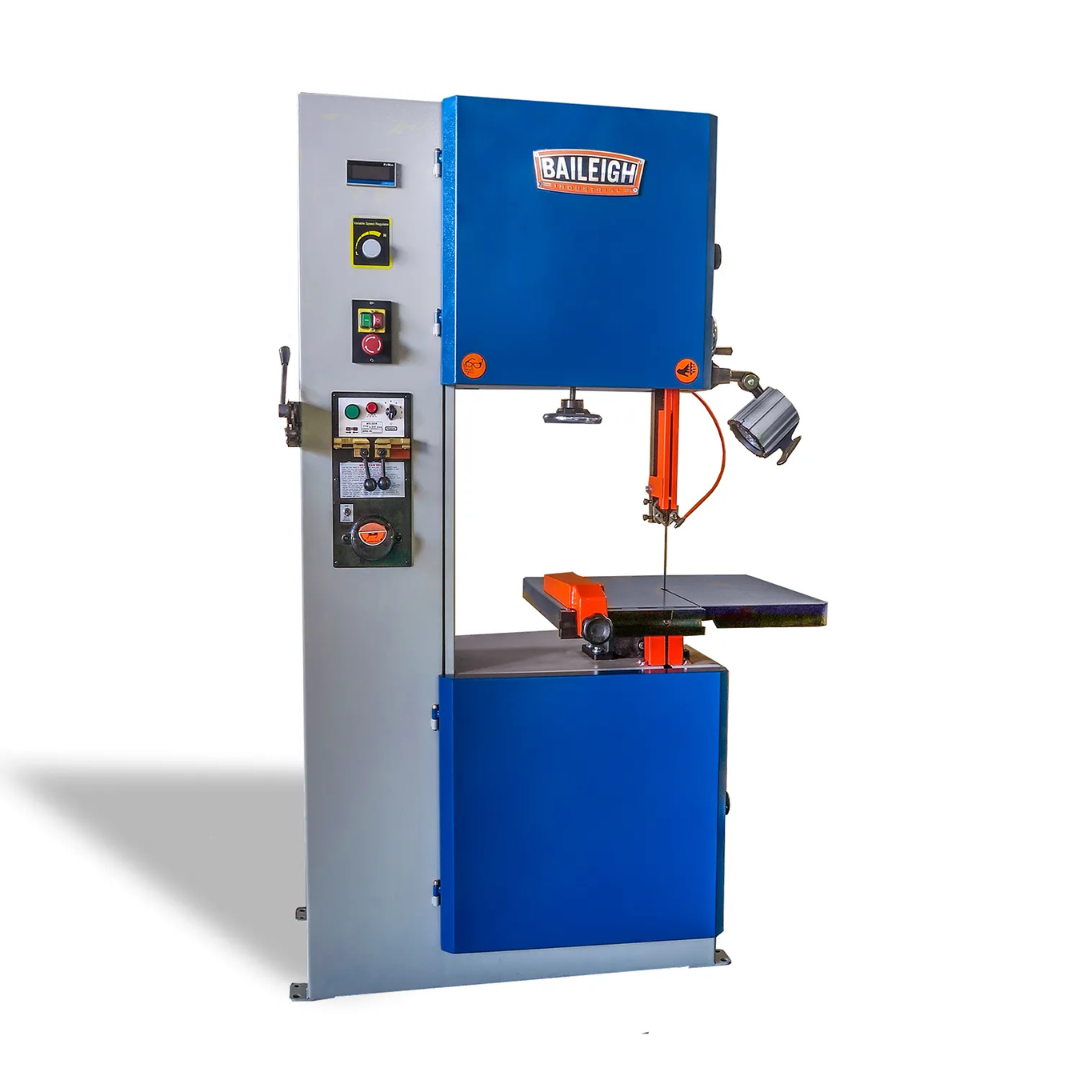
Miter Saw vs Band Saw: Which Is Right for Your Workshop?
Choosing between a miter saw vs band saw comes down to what you cut, how you cut it, and the materials you work with every day. Both are indispensable in professional shops — but they excel at completely different tasks. If you need fast, accurate crosscuts on lumber, the miter saw wins. If you need versatile cuts on curves, metal, or thick stock, the band saw is the tool for the job. This guide breaks down everything you need to know about band saw vs miter saw — capabilities, strengths, limitations, and which one belongs in your shop.

Quick Answer
A miter saw vs band saw comparison reveals two fundamentally different tools. A miter saw is a fixed-angle crosscut saw for straight cuts on wood. A band saw is a continuous-blade saw for curves, resawing, and cutting metal — with far more versatility. Most professional woodworking and metalworking shops use both.
Our pick: Baileigh Vertical Bandsaw BSV-12VS-V2 — $6,101.56. View more >
In This Guide
What Is a Miter Saw?
A miter saw — sometimes called a chop saw — is a stationary power saw designed to make fast, accurate crosscuts and angled cuts on wood and light materials. The blade is mounted on a hinged arm that pivots downward through the workpiece, with the work held flat against a fence and table.
Miter saws excel at cutting trim, molding, framing lumber, and dimensional stock to precise lengths and angles. They are built around speed and repeatability: a skilled carpenter can knock out dozens of identical angled cuts in minutes. Most models pivot left and right (miter) and tilt on the blade axis (bevel). A compound miter saw does both simultaneously, while a sliding compound miter saw adds a rail system to extend the crosscut capacity.
Typical blade diameters run 7-1/4 inch, 10 inch, and 12 inch. Larger blades cut wider stock — a 12-inch saw can crosscut a 2×14 in one pass. Miter saws work almost exclusively on wood, MDF, and thin non-ferrous stock. They are not built for curves, resawing, or heavy metal cutting.

What Is a Band Saw?
A band saw uses a continuous loop of serrated blade that travels over two or more wheels, cutting on the downstroke through the workpiece. Unlike a miter saw — which chops in a single arc of motion — a band saw guides the blade in a continuous path, allowing the operator to steer the cut in any direction.
Band saws come in two main configurations: vertical and horizontal. Vertical band saws position the blade running up-and-down with the workpiece fed across a horizontal table. Horizontal band saws lay the blade flat and feed the workpiece through on a vise — the standard configuration for metal shops cutting bar stock and structural sections.
Blade selection determines what a band saw can cut: narrow blades handle tight curves; wide blades handle straight ripping and resawing; bimetal blades cut mild steel, stainless, and aluminum. Industrial band saws from Baileigh feature variable-speed drives and heavy cast frames for precise, burr-free metal cutting that no miter saw can replicate.

Key Differences: Miter Saw vs Band Saw
The miter vs band saw distinction comes down to cut type, material range, and blade motion. These are fundamentally different tools engineered for different workflows. Here is what separates them:
- Cut type: Miter saws make straight crosscuts and miter/bevel cuts on square or rectangular stock. Band saws make straight cuts, curved cuts, resawing cuts, and metal cuts — with no limit on cut direction.
- Material range: Miter saws are designed for wood and light materials. Band saws cut wood, metal (including steel, aluminum, and stainless), plastics, composites, and non-ferrous alloys.
- Blade motion: A miter saw blade spins — a toothed disc chopping downward through the work. A band saw blade is a continuous loop moving in one direction, reducing heat buildup and blade deflection.
- Kerf and cut quality: Miter saws leave a wider kerf and can chip fine-grain wood on the back face. Band saw blades are thinner, leaving a narrower kerf with minimal tearout.
- Speed vs. versatility: Miter saws are faster for repetitive identical crosscuts on jobsites and in production carpentry. Band saws are slower per cut but vastly more versatile — they handle tasks no miter saw can do.
- Footprint: Both require floor or bench space, but miter saws are more portable and easier to set up on a jobsite. Industrial band saws are heavy stationary equipment sized for shop use.

Comparison Table: Miter Saw vs Band Saw
Here is a side-by-side breakdown of how the band saw vs miter saw stacks up across the most important performance categories:
| Feature | Miter Saw | Band Saw |
|---|---|---|
| Primary use | Crosscutting lumber, trim, and molding | Curves, resawing, metal cutting |
| Cut direction | Straight only (crosscut, miter, bevel) | Straight, curved, irregular |
| Materials | Wood, MDF, light non-ferrous | Wood, metal, plastic, composites |
| Blade type | Rotating circular blade | Continuous loop blade |
| Cut speed | Very fast (single-motion chop) | Moderate (dependent on material) |
| Resawing | Not possible | Yes — primary function on vertical band saws |
| Metal cutting | Limited (requires specialty blade) | Yes — standard on horizontal band saws |
| Portability | High (many jobsite models) | Low to moderate (mostly shop-mounted) |
| Kerf width | Wider (1/8" or more) | Narrower (1/16" to 3/32") |
| Noise level | Very high | Moderate |
| Best for | Finish carpentry, framing, trim | Metal fabrication, woodworking, production cutting |
When to Use a Miter Saw
A miter saw is the right tool when speed, repeatability, and straight-line crosscutting are the priority. These are the situations where it outperforms a band saw:
Shopping for band saws? See the full selection or call 888-308-5580.
Shop Band Saws- Framing and rough carpentry: Cutting 2x4s, 2x6s, and 2x8s to length on a jobsite is what miter saws are built for. No other saw matches the speed for repetitive dimensional lumber cuts.
- Trim and finish work: Cutting crown molding, baseboard, door casing, and chair rail at precise compound angles requires a compound miter saw. The fixed fence and angle detents deliver perfect repeatability.
- Stair stringers and rafters: Cutting consistent miter and bevel angles on framing stock is where sliding compound miter saws shine. Many carpenters use a 12-inch sliding saw as their primary crosscut tool on the floor.
- Picture frames and furniture components: Making 45-degree miter joints on square stock for frames, boxes, and furniture calls for the precision of a miter saw's detent stops.
- Jobsite portability: A miter saw on a stand can be loaded into a truck and deployed anywhere. Industrial band saws are shop equipment — they stay put.

The miter saw's key limitation: it cannot cut curves, cannot resaw, cannot handle most metals, and is restricted to stock short enough to fit under the blade guard. For anything outside a straight crosscut, it reaches its boundary fast.

When to Use a Band Saw
A band saw takes over everywhere a miter saw falls short — and then extends into territory a miter saw cannot reach at all. These are the tasks that demand a band saw:

For Woodworking
In woodworking, the band saw handles tasks no miter saw can touch:
- Resawing: Slicing thick boards into thinner slabs along the grain requires a band saw. This is essential for bookmatching figured wood, making veneers, and cutting costly hardwood efficiently.
- Curved cuts: Cutting chair legs, cabriole legs, violin scrolls, bowls, and any part with a curved profile is impossible on a miter saw. Band saws with narrow blades navigate tight radii accurately.
- Ripping wide panels: With a rip fence, a band saw rips boards parallel to the grain. The thin kerf wastes less material than a table saw — important when working with expensive hardwoods.
- Freehand pattern cuts: Cutting irregular shapes and compound curves (like cabriole legs cut on two faces) requires the band saw's ability to steer the blade in any direction.

For Metal Cutting
Metal cutting is where the band saw completely dominates over the miter saw. Industrial horizontal and vertical band saws are the standard metal-cutting tool in fabrication, manufacturing, and machine shops for critical reasons:
- Steel, stainless, and aluminum: Bimetal and carbide-tipped band saw blades cut structural steel, solid bar stock, and tube and pipe with clean, burr-free results.
- Coolant compatibility: Industrial band saws include flood coolant systems that extend blade life and improve cut quality on ferrous metals — something no standard miter saw supports.
- Automatic and semi-automatic feeding: Horizontal band saws with hydraulic downfeed allow unattended cutting through production runs. Set the vise, start the cut, and the saw feeds itself.
- Miter capability: Many industrial band saws also swivel their head for angled cuts on metal — doing what a miter saw does, but in steel rather than wood.

Can One Replace the Other?
The short answer is no. A miter saw and a band saw serve different functions that do not fully overlap. Here is why each one is irreplaceable in its own domain:
Can a band saw replace a miter saw? Partially. A band saw with a miter fence can make crosscuts and miter cuts on wood, but it is slower and less convenient for repetitive crosscutting. For high-volume identical cuts on dimensional lumber — like cutting 50 studs to length on a framing site — a miter saw is dramatically faster and more accurate. A band saw would technically do the job, but it is the wrong tool.
Can a miter saw replace a band saw? Rarely. Some abrasive miter saws can cut mild steel, but they produce sparks, rough edges, and significantly more noise than a metal-cutting band saw. For curves, resawing, or any kind of continuous contour cutting, a miter saw simply cannot do the work — there is no workaround.
Most serious woodworking shops run both. Metal fabrication shops almost universally use horizontal band saws as their primary stock-cutting equipment. The question is not "which one instead" — it is "which one first" based on your primary work.

Band Saw Examples Compared
These are the five Baileigh vertical band saws in this guide. Specs and prices come from each product page.
| Model | Key specs | Price |
|---|---|---|
| Baileigh Vertical Bandsaw BSV-12VS-V2 | 1 HP, 120V, 12.2" throat, 6.875" cutting height, 100–1000 FPM | $6,101.56 |
| Baileigh BSV-18VS-V2 Vertical Band Saw | 1 HP, 110V, 18" throat, 12.9" cutting height | $8,663 |
| Baileigh Variable Speed Vertical Band Saw BSV-18VS-220-V2 | 1 HP, 220V, 18" throat, 12.9" cutting thickness, 90–1400 FPM | $9,037.55 |
| Baileigh 24-Inch Variable-Speed Bandsaw BSV-24VS-V2 | 3 HP, 220V 3-phase, 23.6" throat, 12.2" cutting height | $13,773.83 |
| Baileigh 18-Inch Vertical Tilt Frame Bandsaw BSVT-18P | 2 HP, 220V 3-phase, tilt frame, 20" × 16-1/4" capacity | $26,639.09 |
Top Band Saw Picks for Woodworking and Metal Cutting
If you have decided the band saw is the tool your shop needs, here are the top picks from our band saw collection. All are industrial-grade Baileigh machines built for production use:

1. Baileigh Vertical Bandsaw BSV-12VS-V2 — $6,101.56
The BSV-12VS-V2 is a heavy-duty variable-speed vertical band saw built for precision metal cutting and woodworking in professional shops. The variable-speed drive lets you match blade speed to material — slow for steel, fast for wood — without changing blades. The heavy-duty steel frame and cast iron work table handle heavy stock and production demands. View more >
2. Baileigh BSV-18VS-V2 Vertical Band Saw — $8,663.00
The BSV-18VS-V2 moves up to an 18-inch throat and a 12.9-inch cutting height, making it a strong choice for resawing boards and cutting larger workpieces on a vertical band saw. Variable-speed operation, a digital speed readout, and a cast iron work table give it the flexibility to handle both metal and wood accurately. Its cutting height is nearly double the 6.875 inches of the BSV-12VS-V2. View more >

3. Baileigh Variable Speed Vertical Band Saw BSV-18VS-220-V2 — $9,037.55
Running on 220V single-phase power, the BSV-18VS-220-V2 is the 18-inch variable-speed vertical band saw for shops without three-phase power. The 220V configuration makes it accessible to smaller fabrication shops and woodworking operations while still delivering industrial-grade cutting performance on steel, aluminum, and hardwood. View more >
4. Baileigh 24-Inch Variable-Speed Bandsaw BSV-24VS-V2 — $13,773.83
The BSV-24VS-V2 steps up to a 23.6-inch throat and 3 HP motor — the professional production band saw for high-volume resawing, wide-board cutting, and heavy-gauge metal fabrication. The inverter-controlled variable-speed drive (85 to 2,200 FPM) makes it easy to dial in the right blade speed for any material, and it runs on 220V three-phase power. This is the band saw that replaces multiple single-purpose saws in a full-production shop. View more >

5. Baileigh 18-Inch Vertical Tilt Frame Bandsaw BSVT-18P — $26,639.09
The BSVT-18P is Baileigh's tilt-frame vertical band saw — a specialized machine that tilts the entire blade/frame assembly to make angular cuts through the workpiece, eliminating the need to angle the work table or use a separate miter-cutting saw. This is the production-level band saw for fabricators cutting structural shapes, pipe, and angle iron at consistent angles without manual setup. View more >
How to Choose Between a Miter Saw and a Band Saw
The right way to choose is to start with the work you do most, not the tool you think you should have. Work through these questions:

Do you cut metal?
If any percentage of your work involves cutting metal — bar stock, structural steel, tube, pipe, aluminum — a band saw is non-negotiable. A miter saw is not a metal-cutting tool in any professional sense. Buy the band saw first; add a miter saw later if your wood cutting volume demands it.
Do you need to cut curves?
If you make furniture, cabinets, instruments, signs, or any product with curved parts — a band saw is the only tool that handles it. This is a hard constraint: a miter saw physically cannot follow a curve. If curves are part of your work, the band saw is your answer regardless of anything else.
Do you resaw lumber?
Resawing — slicing boards along the grain to create thinner pieces — requires a band saw. If you work with hardwood lumber, make veneer, or want to maximize yield from expensive stock, a band saw with a wide blade and a resaw fence is essential. A Baileigh 24-inch variable-speed band saw resaws boards up to 12.2 inches tall in a single pass.
Do you need fast repetitive crosscuts?
If your primary operation is cutting dimensional lumber to length — framing, cabinet boxes, furniture parts — and you need to make dozens of identical cuts quickly, a miter saw is the more efficient tool for that specific task. A band saw can crosscut, but the miter saw is faster for high-volume identical lengths on square stock.
Do you work on a jobsite?
Miter saws are portable and jobsite-ready. Industrial band saws are shop equipment. If you need a saw that travels to construction sites, finishes work in unfinished spaces, or moves between locations, a miter saw is the practical choice. If your work happens in a fixed shop, a band saw's weight and footprint are non-issues.

Frequently Asked Questions
What cuts better curves — a miter saw or a band saw?
A band saw cuts curves; a miter saw cannot. The miter saw's rotating circular blade only moves in a single downward arc, making curved cuts physically impossible. A band saw with a narrow blade steers through tight radii and complex curved profiles. For any curved work in wood or metal, the band saw is the only option.
Can a band saw make miter cuts?
Yes. Many band saws include an adjustable miter fence and a tilting table that allows angled crosscuts similar to a miter saw. Industrial horizontal band saws often swivel their head for miter cuts in metal. The difference is that a miter saw makes these cuts faster and more conveniently for wood — the band saw's miter capability is a secondary feature, while on a miter saw it is the primary function.
Is a miter saw or band saw better for beginners?
A miter saw is generally easier to learn for beginners focused on wood crosscutting — the motion is simple and the angle stops make repeatable cuts straightforward. Band saws have a steeper learning curve because blade tension, tracking, guide adjustment, and feed rate all affect cut quality. That said, a band saw is considered the safest large shop saw because the blade moves away from the operator rather than toward them.
What is the main limitation of a miter saw?
The main limitations of a miter saw are its restriction to straight crosscuts, its inability to cut curves or resaw, and its limited material range. A miter saw cannot cut metal in any production capacity, cannot follow a curved line, and cannot slice a board thinner along the grain. Its usefulness is high within those limits, but the limits are real and hard.
What materials can a band saw cut that a miter saw cannot?
A band saw cuts steel, stainless steel, aluminum, copper, brass, cast iron, plastics, composites, foam, and other materials that a standard miter saw cannot handle. Bimetal and carbide-tipped band saw blades are designed specifically for metal cutting. Industrial horizontal band saws also include coolant systems to manage heat on ferrous metals — a capability that has no equivalent in a miter saw.
Do professional woodworking shops use both a miter saw and a band saw?
Yes — most serious woodworking shops run both. The miter saw handles fast crosscutting and angle cuts on dimensional stock. The band saw handles resawing, curves, and specialty operations. They are complementary rather than competing tools. A production cabinet shop, furniture maker, or millwork operation would be significantly limited without both. Metal fabrication shops typically rely on horizontal band saws as their primary cutting equipment and may add a miter saw specifically for occasional wood or plastic work.
Conclusion
The miter saw vs band saw debate is not about which is better — it is about which is right for your work. A miter saw is a specialist crosscut tool optimized for fast, accurate angle cuts on wood. A band saw is a versatile production tool that cuts curves, resaws lumber, and handles metal with equal capability. If your shop works in metal, needs to cut curves, or demands resawing capability, the band saw is your priority. Explore our full selection of professional band saws to find the right model for your shop's needs — or call us and we will help you choose.
Explore the category: Power Tools and Power Saws. Related collections: Wood Band Saws.
Related Reading
Talk to a Band Saw Specialist
Not sure whether a vertical or horizontal band saw fits your shop? Our team can help you match the right machine to your cutting requirements.
Featured Band Saws


Shop All Band Saws
Browse our full selection of industrial vertical and horizontal band saws for woodworking and metal cutting. Expert guidance available by phone.
Shop All Band Saws