

How to Choose a Metal Band Saw: The Complete Buyer's Guide
Choosing the right metal band saw is one of the most important equipment decisions a metalworker, fabricator, or machine shop can make. The wrong machine leads to inaccurate cuts, slow production cycles, constant blade changes, and costly downtime. The right one pays for itself within months. This guide covers every factor you need to evaluate. These are saw type, cutting capacity, blade speed, automation level, workholding, and total cost of ownership. You can then match the machine to your material and production demands with confidence.

Quick Answer
How to choose a metal band saw: Select a horizontal saw for high-volume straight cuts on bar stock and structural material. Select a vertical saw for contour cutting and irregular shapes. Match cutting capacity to your largest material cross-section. Choose blade speed (SFPM) for your primary metal type. Size the motor and frame to your production volume. For shops that cut intermittently, a manual machine is sufficient. Production environments need semi-automatic or fully automatic feed.
Our pick: Ellis 1600 Mitre Band Saw — $5,299. View more >
In This Guide
- What Is a Metal Band Saw?
- Types of Metal Band Saws
- Key Specifications to Understand
- Top Metal Band Saws at a Glance
- Our Top Picks for Metal Band Saws
- Horizontal vs. Vertical: Which Should You Choose?
- How to Match Blade Speed and TPI to Your Material
- Manual vs. Semi-Automatic vs. Fully Automatic
- Workholding, Vise Systems, and Material Support
- Total Cost of Ownership: What to Budget Beyond the Machine
- What to Check Before Buying: Shop Prep and Installation
- Frequently Asked Questions
- Conclusion
What Is a Metal Band Saw?
A metal band saw is a power tool that cuts through metal, pipe, structural steel, aluminum, and other conductive materials. It uses a continuous loop of toothed blade stretched between two or more wheels. Unlike chop saws or abrasive cut-off wheels, the band saw blade removes material gradually with minimal heat. This produces cleaner cuts with tighter tolerances and less material waste.
Metal band saws differ fundamentally from woodworking band saws in three key ways:
- Blade speed: Metal-cutting saws run at dramatically lower surface feet per minute (SFPM). This is typically 50–500 SFPM versus 2,000–5,000 SFPM for wood. Slower speeds prevent blade overheating and work hardening on tough metals.
- Coolant systems: Most industrial metal band saws include a built-in coolant pump and reservoir. This extends blade life and improves cut quality.
- Frame and vise construction: Metal saws require a heavier cast-iron or welded-steel frame. This helps them handle the feed forces and vibration created by cutting dense materials.
Understanding these distinctions is the first step. It helps you know how to choose a metal cutting band saw that will actually serve your application.

Types of Metal Band Saws
The first decision in how to choose a band saw for metal is picking the right configuration for your primary cutting tasks. Each type is optimized for a specific range of operations. Buying the wrong type means working against the machine every day.
Horizontal Band Saws
In a horizontal band saw, the saw head is positioned above the material. It swings downward through the cut under its own weight or a controlled hydraulic feed system. The workpiece is held stationary in a vise. Horizontal saws are purpose-built for cutting bar stock, structural sections, pipe, and tube to length. This is the most common task in fabrication, maintenance, and machine shop environments.
Key advantages of horizontal band saws include unattended cutting capability, minimal operator fatigue, and high throughput on repetitive cuts. For unattended cutting, the saw can feed automatically and shut off when the cut is complete. Most horizontal models can also miter. The saw head swivels left and right to cut at preset angles without repositioning the material.
Vertical Band Saws
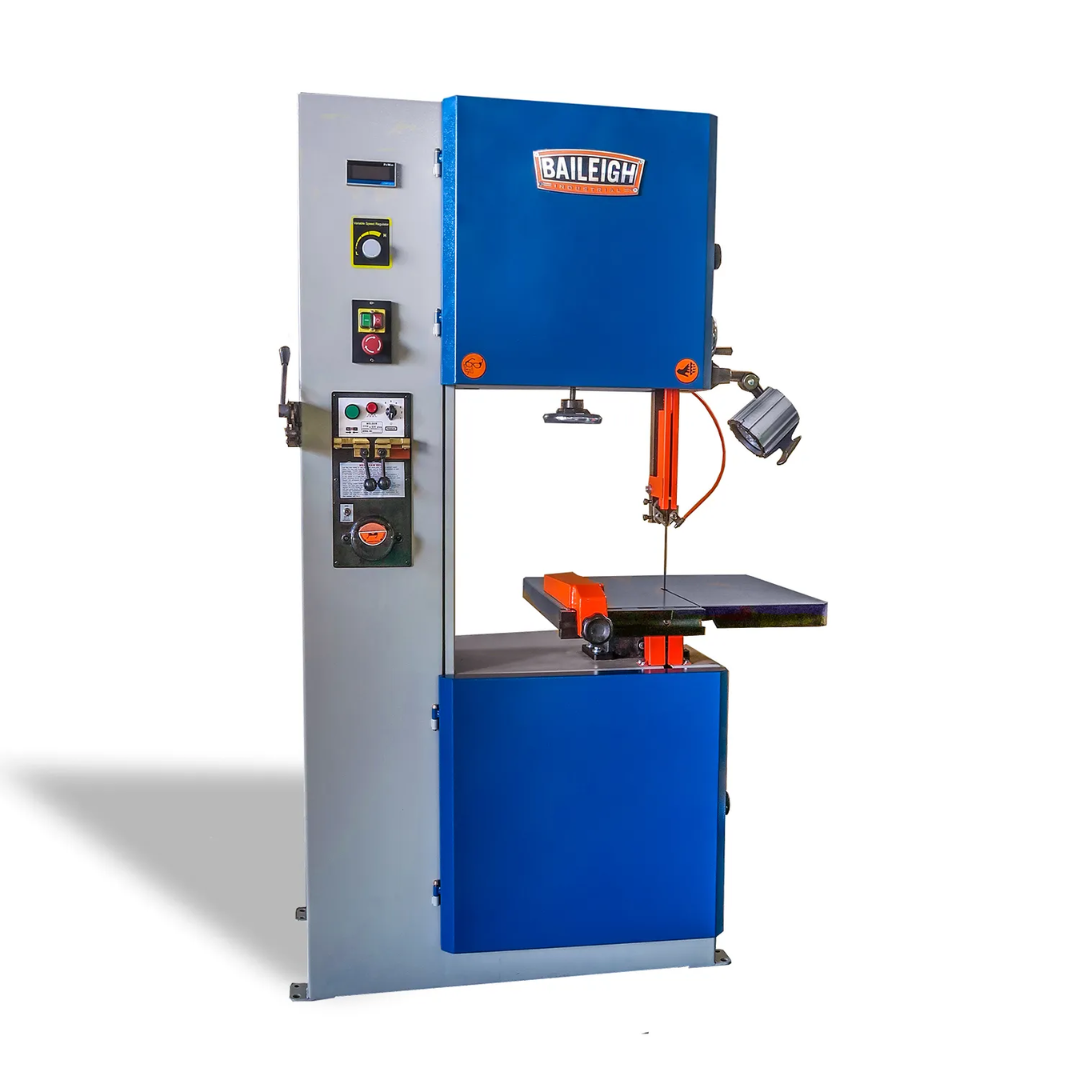
In a vertical band saw, the blade runs vertically between upper and lower wheels. The material is fed horizontally across a flat work table. This orientation is ideal for contour cutting, curved profiles, notching, and cutting irregular shapes from plate, sheet, and flat bar. The operator guides the material freehand or along a fence. The operator keeps full visual contact with the blade throughout the cut.
Vertical saws offer versatility that horizontal saws cannot match. You can follow a template and cut irregular stock. You can perform internal cuts (with a blade weld) and work with flat material easily. The tradeoff is that vertical saws are not optimized for high-volume, repetitive cutoff work.
Mitre Band Saws (Dual-Mitering)
A mitre band saw combines the horizontal cutoff function with a saw head that can swing left and right independently of the vise. This enables compound angle cuts without repositioning material. It is also called a dual-mitering or bidirectional miter band saw. Ellis Manufacturing and Baileigh Industrial produce well-regarded mitre band saws. They are used in structural steel fabrication, ornamental metalwork, and precision manufacturing.
Dual-mitering saws are essential when your work involves cutting structural angle, channel, beam, or tube at compound angles. Examples are cutting stair stringers, handrail components, or weld-fit structural frames. They cost more than standard horizontal saws. But they eliminate the fixtures and secondary operations required to hold material at odd angles.

Portable and Benchtop Band Saws
Portable band saws — both handheld and benchtop — are designed for light-duty cutting and field use where a floor-standing machine is impractical. Handheld portabands are common in plumbing, HVAC, and mechanical contracting for cutting pipe and conduit. Benchtop models are suitable for hobby shops, small repair shops, or light fabrication with modest throughput requirements.
Portable band saws are not in scope for production metalworking. If your shop produces consistent volumes of parts that need precise, repeatable cuts, you need a floor-standing industrial machine, not a benchtop or portable unit.
Key Specifications to Understand
Once you've identified the right type, the next step is understanding which specifications actually matter for your application. Many buyers focus on price and horsepower alone. They overlook the specs that determine whether the machine can actually cut your material efficiently and accurately.
Cutting Capacity
Cutting capacity is the maximum cross-section the saw can cut in a single pass. It is typically expressed as a round capacity (the largest round bar diameter) and a rectangular capacity (height × width). Always size capacity to your largest common workpiece, not the absolute maximum you might ever cut. If your largest frequent cut is 6-inch round, choose a machine rated for at least 7-inch round to leave performance headroom.
On miter models, note that the rated capacity is for square cuts. As the head swings to 45°, effective cutting capacity decreases — sometimes significantly. Confirm the rated miter capacity, not just the square capacity, before purchasing.
Blade Speed (SFPM)
Blade speed is measured in surface feet per minute (SFPM). It is the single most critical specification for matching the saw to your material. Cutting aluminum and non-ferrous metals requires much higher blade speeds (200–500 SFPM) than cutting hardened steel or stainless (50–100 SFPM). A fixed single-speed machine is acceptable if you cut one primary material. Variable speed is essential for shops that process a range of metals.
Machines with a wide variable speed range give you the flexibility to dial in optimal speed for each material type and blade pitch. One example is the Baileigh BSV-18VS with its adjustable dial. This maximizes blade life and cut quality simultaneously.
Motor Horsepower and Phase
Motor horsepower determines the machine's ability to push the blade through dense or hard materials without stalling or slowing. A 1–2 HP motor can handle light fabrication on mild steel and aluminum. Production cutting of tool steel, stainless, and thick-wall structural sections demands 3 HP or more.
Phase is equally important. Most high-performance industrial band saws require 3-phase power. If your shop runs on single-phase, confirm availability before purchasing, or budget for a phase converter. Some machines are available in both 1-phase and 3-phase configurations. Confirm which voltage and phase is stocked.

Blade Width and Length
Blade width influences two things. One is the minimum radius the saw can cut (thinner blades navigate tighter curves). The other is the blade's column strength during straight cuts (wider blades resist deflection). Most industrial horizontal band saws use blades in the 1-inch range. Vertical contour saws may use narrower blades down to 1/4 inch for intricate work.
Blade length is dictated by the wheel span. It's not a spec you choose, but a spec you need to match when re-ordering blades. Confirm blade length and width are readily available from multiple suppliers before purchasing any machine.
Feed Control System
Feed control refers to how the blade is advanced into the material. Manual feed relies on operator hand pressure. It is suitable for light cuts and intermittent use. Gravity feed uses an adjustable counterweight or tension system to let the blade descend at a controlled rate. It is simple, reliable, and common on entry-level horizontal saws. Hydraulic feed provides the most consistent, controllable descent. It can be preset for unattended operation on automatic and semi-automatic machines. For high-volume production, hydraulic feed is not optional. It's what enables operator-free cutting and consistent cut quality throughout a long production run.
Top Metal Band Saws at a Glance
Use this comparison table to quickly evaluate the top models available at Iron Line Tools. It compares cutting capacity, speed range, motor, and best use case. All prices are MSRP.

| Model | Type | Round Capacity | Blade Speed | Motor | Price |
|---|---|---|---|---|---|
| Ellis 1600 Mitre Band Saw | Horizontal Mitre | 10" | 3 speeds | 1 HP | $5,299 |
| Baileigh BS-916M | Horizontal Miter | 8.75" | 4 speeds | 1.5 HP | $6,645.27 |
| Ellis 3000 Mitre Band Saw | Horizontal Mitre | 13-1/2" | Variable | 2 HP | $6,795 |
| Ellis 4000 Industrial Mitre Band Saw | Horizontal Mitre | 13-1/2" | Variable | 2 HP | $6,999 |
| Baileigh BSV-18VS-V2 | Vertical | 18" throat | Variable | 1 HP | $8,663 |
Our Top Picks for Metal Band Saws
These five machines represent the best options at Iron Line Tools. They suit shops ranging from light fabrication to heavy production metalworking. Every pick has been selected for its build quality, cutting capacity, and real-world performance in demanding environments.

1. Ellis 1600 Mitre Band Saw — $5,299
The Ellis 1600 is a workhorse mitre band saw. It is built for shops that need accurate miter cuts on structural steel and tube without the cost of a heavy-production machine. Its 10-inch round capacity handles the vast majority of common bar and tube sizes. The mitre head swings to deliver precise angle cuts on the first pass. Ellis saws are made in the USA with a reputation for longevity and minimal maintenance. Many are still running after 30+ years of shop use. View more >
2. Baileigh Horizontal Band Saw BS-916M — $6,645.27
Baileigh's BS-916M is a heavy-duty horizontal mitering band saw designed for mid-production environments. It has an 8.75-inch round capacity, four selectable blade speeds, and hydraulic feed control. These make it capable of handling mild steel, stainless, aluminum, and exotic alloys with equal competence. The adjustable miter stop positions are preset for the most common angles. This reduces setup time between cuts. If your shop regularly processes 4–8-inch structural material and needs reliable all-day performance, the BS-916M is a compelling value. View more >
3. Ellis 3000 Mitre Band Saw — $6,795
The Ellis 3000 steps up capacity to 13-1/2-inch round. It keeps the precision miter capability that Ellis is known for. This model is a favorite in ornamental iron, structural fab shops, and steel service centers where large-diameter tube and heavy bar stock are routine. The extended vise stroke, robust cast-iron construction, and American manufacturing heritage make the 3000 a long-term asset. It is not a consumable machine. View more >
4. Ellis 4000 Industrial Mitre Band Saw — $6,999
At 13-1/2-inch round capacity (22-inch flat) and 2 HP, the Ellis 4000 is built for the most demanding structural fabrication applications. These include cutting heavy I-beams, wide-flange sections, thick-wall tubing, and large-diameter round bar. Its heavy-gauge welded steel frame resists vibration under full load. The dual-direction miter capability handles compound angle cuts with the same accuracy as straight cuts. If your shop cuts heavy structural material daily, the 4000 earns its price back in blade life and downtime savings alone. View more >

5. Baileigh BSV-18VS-V2 Vertical Band Saw — $8,663
The Baileigh BSV-18VS-V2 is the premier choice for shops that need an industrial vertical band saw for contour work, plate cutting, and intricate profile work. It has an 18-inch throat depth, adjustable blade speed, cast-iron work table, and heavy-duty fence system. These give it the capability to handle demanding metalworking operations with accuracy and repeatability. The digital speed display lets operators dial in the exact blade speed for each material. This maximizes blade life and cut quality. View more >
Horizontal vs. Vertical: Which Should You Choose?
The horizontal vs. vertical band saw decision is the most common question buyers face. They face it when learning how to choose a band saw for metal. The answer depends entirely on what you're cutting, not on price or personal preference.

When to Choose a Horizontal Band Saw
Choose a horizontal band saw if your primary task is cutting bar stock, structural steel, pipe, tube, or any workpiece that needs to be cut to a specific length. Horizontal saws are superior for this task because of how they cut. The material lays flat in the vise. The blade descends through it at a controlled rate. The operator doesn't need to be present for the entire cut. For production shops, a horizontal saw with automatic shutdown transforms a one-person-per-cut operation into a machine that runs itself between setups.
Additional reasons to choose horizontal:
- You need to cut lengths from long bar or tube
- You need miter capability for angle cuts
- You need semi-automatic or automatic cutting for high-volume work
- You don't have a dedicated operator watching the saw during each cut
When to Choose a Vertical Band Saw
Choose a vertical band saw if your work involves cutting profiles, shapes, curves, or irregular stock from plate or flat bar. Vertical saws shine in tool rooms, maintenance shops, job shops, and fabrication environments. These are places where cuts are complex, templates need to be followed, or the material doesn't stack neatly in a horizontal vise.
Additional reasons to choose vertical:
- You regularly cut plate, sheet, or flat bar to complex profiles
- You need to cut curved or irregular shapes
- You do tool room work, die making, or prototype fabrication
- You need to perform internal cuts (slot cutting with blade weld)

How to Match Blade Speed and TPI to Your Material
Selecting the wrong blade speed or TPI (teeth per inch) is the leading cause of premature blade failure, poor cut quality, and poor dimensional accuracy on metal band saws. Here's how to get it right.
Understanding Surface Feet Per Minute (SFPM)
SFPM measures how fast the blade moves across the material surface. Too fast and the blade overheats, losing temper and dulling rapidly. Too slow and the blade strips teeth, work hardens tough metals, and produces a rough cut. Variable speed machines let you optimize SFPM for each material. Fixed-speed machines commit you to a single speed. That may be an acceptable compromise for shops that cut one primary material.
TPI Selection by Material
TPI determines how many teeth are engaged with the material at any moment. The rule is simple. Always have at least 3 teeth in the material, and never more than 24. Thin-wall tube and thin sheet need high TPI (10–24). This prevents stripping and blade bounce. Thick solid bar needs lower TPI (2–6). This allows chip clearance and prevents loading.
Use the reference table below to set a starting point for SFPM and TPI, then fine-tune based on your chip color and blade temperature:
| Material | SFPM Range | Recommended TPI | Coolant |
|---|---|---|---|
| Aluminum (soft) | 300–500 | 3–6 | Optional |
| Mild Steel (bar) | 150–300 | 4–6 | Recommended |
| Structural Steel (angle, channel) | 150–250 | 6–10 | Recommended |
| Stainless Steel | 75–150 | 6–10 | Required |
| Thin-wall tube / pipe | 100–200 | 10–18 | Recommended |
| Tool Steel / Hardened Steel | 50–100 | 6–8 | Required |
| Titanium / Exotics | 50–75 | 6–10 | Required |

Reading Chips to Diagnose Speed Problems
Your chips are your data. Curly, silver chips indicate correct speed and feed. The blade is cutting efficiently. Blue or purple chips mean the blade is moving too fast. Reduce SFPM. Powdery dust (not chips) means TPI is too high or feed rate is too slow for the material cross-section. Short, broken chips in a heavy cut usually indicate TPI is too low for thin-wall material. Train operators to read chips and adjust on the fly. This single habit extends blade life dramatically and maintains cut quality throughout a production run.
Manual vs. Semi-Automatic vs. Fully Automatic
Automation level is a production decision, not a capability decision. All three types can produce accurate cuts. The difference is in throughput, labor cost per part, and operator involvement.

Manual Band Saws
Manual saws require the operator to lower the saw head by hand and hold it at the desired feed pressure throughout the cut. This gives maximum tactile feedback and control. An experienced operator can feel when the blade is cutting well and adjust instantly. Manual saws are well-suited to low-volume shops, job shops with highly variable material sizes, and situations where the operator needs full cut control for sensitive or costly material. The downside is that every cut requires an operator's full attention. This limits productivity when multiple machines or tasks need oversight.
Semi-Automatic Band Saws
Semi-automatic saws use a hydraulic feed system to lower the saw head at a preset rate. The operator clamps the material, starts the cut, and can step away while the blade feeds. When the cut is complete, an auto-shutoff cuts power to the blade. The operator must manually return the head to the top position and re-clamp for the next cut. Semi-automatic machines dramatically reduce operator fatigue. They also allow one person to manage multiple operations simultaneously. They are the production standard for most job shops and fabrication environments.
Fully Automatic Band Saws
Fully automatic saws add an automatic bar feed system. The material advances by a preset length after each cut. The vise clamps automatically. The saw feeds, cuts, retracts, and advances to the next piece without operator intervention. This level of automation is justified in high-volume production environments where thousands of pieces per shift are cut to the same length. Automatic saws significantly reduce labor cost per part. But they require a larger upfront investment and regular maintenance of the feed and control systems. The Baileigh BS-20A is a representative example of a production-grade automatic horizontal band saw.
Workholding, Vise Systems, and Material Support
A technically capable saw with an inadequate vise system will produce inaccurate cuts, slow setups, and potentially dangerous unsecured workpieces. Evaluate the vise before the motor spec.

Hydraulic vs. Manual Vise Clamping
Hydraulic vises clamp automatically when the saw cycle starts and release on completion. This is a critical feature for semi-automatic and automatic machines. Manual vises require the operator to tighten the vise before each cut and loosen it after. For production environments, the time and labor saved by hydraulic clamping adds up quickly. For low-volume work, a manual vise is entirely adequate.
Mitering Vise and Degree Stops
On miter-capable machines, evaluate how the vise and degree stops work together. High-quality miter saws have positive stops at common angles (0°, 22.5°, 30°, 45°) with fine adjustment either side of the stop. The vise must remain fully functional at all miter positions, not just at 0°. That means clamping force and jaw alignment. Some lower-cost machines sacrifice vise performance at extreme miter angles. Test this if miter capability is important to your work.
Outfeed Supports and Roller Tables
Long bar stock, anything over 6–8 feet, requires outfeed support. It prevents the material from sagging and binding against the blade during the cut. This is especially important for large-diameter round bar and heavy structural sections. Most industrial band saw vendors offer optional roller tables and outfeed stands. For high-volume work with long material, these are not optional accessories. They're necessary for safe, accurate cutting.
Total Cost of Ownership: What to Budget Beyond the Machine
Purchase price is only one part of the true cost of owning a metal band saw. High-volume shops can easily spend as much on blades and coolant over 3 years as they spent on the machine itself. Plan for all of these costs before committing to a machine purchase.

Blade Costs
Blade cost and blade life vary dramatically by material type, blade quality, and machine condition. A bimetal blade cutting mild steel can last 500–1,000 cuts or more in a well-maintained machine with proper coolant and speed settings. The same blade cutting stainless with no coolant may fail in under 50 cuts. Budget for blades as a consumable line item, not as an occasional expense. High-quality carbide-tipped blades cost more upfront. But they often deliver a lower cost-per-cut on difficult materials.
Coolant System and Fluid
Most industrial band saws ship with a built-in coolant pump and reservoir. The ongoing cost is coolant fluid and regular fluid changes. These prevent bacterial growth and maintain cutting performance. Semi-synthetic or water-soluble coolants are the most common choice. They mix with water, are relatively inexpensive, and are effective across a wide range of metals. Budget for coolant refills, fluid testing strips, and proper disposal.
Preventive Maintenance
Regularly scheduled maintenance extends machine life and prevents costly unscheduled downtime. This includes blade guide bearing replacement, drive wheel alignment, hydraulic fluid changes, coolant system cleaning, and electrical contact inspection. Industrial band saws from quality manufacturers like Ellis, Baileigh, and LeBlond are designed for in-house maintenance by a competent technician. Most tasks require only standard hand tools and common replacement parts. Budget 1–2 days of maintenance labor per year for a well-used machine.
What to Check Before Buying: Shop Prep and Installation
Buying the right machine only to discover it won't fit in your shop, requires power you don't have, or can't be delivered to your floor is an expensive lesson. Address these questions before placing the order.
Shopping for metal band saws? See the full selection or call 888-308-5580.
Shop Metal Band Saws
Power Requirements
Confirm the machine's voltage and phase requirements against your available power. 220V single-phase is common in smaller shops. 460V three-phase is standard for high-production industrial machines. If you need to add a circuit or install a phase converter, factor that cost and lead time into your purchase timeline. Never try to run a 3-phase machine on a phase converter without first verifying the converter's KVA rating against the motor's starting current draw.
Floor Space and Clearance
Industrial band saws require more floor space than their footprint suggests. This is because material handling clearance must be added on the input and output sides. A machine with a 36-inch vise opening needs at least 24 feet of clear space for handling 20-foot bar stock. That is 10 feet in front of the vise and 14 feet behind it. Map out your floor plan including material staging before the machine arrives.
Delivery and Rigging
Industrial band saws weigh between 500 and 3,000+ pounds depending on size and automation level. Confirm that your loading dock, floor, and overhead clearance can accommodate the crated machine. Most LTL carriers deliver to the curb. You are responsible for unloading and moving the machine to its final position. Have a forklift, pallet jack, or crane available on delivery day. Some vendors offer white-glove installation service. Ask when ordering large or complex machines.

Warranty and Parts Availability
Confirm the warranty terms. Check what is covered, for how long, and what the process is for warranty service. Equally important is parts availability. Can you get wear items (blade guides, bearings, drive wheels) from multiple distributors, or are you dependent on a single source? Machines from well-established brands with US distributor networks are significantly easier to maintain over the long term than obscure imports with limited parts availability.
Frequently Asked Questions
What is the difference between a metal band saw and a wood band saw?
Metal band saws operate at much lower blade speeds (50–500 SFPM vs. 2,000–5,000 SFPM for wood). They use blades with fewer and harder teeth designed to cut conductive materials. They typically include a coolant system to prevent blade overheating. The frames and vise systems are also substantially heavier to handle the feed forces created by cutting dense metal. Never use a wood band saw for metal cutting. The blade speed is far too high and will damage both the blade and the workpiece.
How much horsepower do I need for cutting structural steel?
For intermittent cutting of mild steel up to 4-inch round, a 1.5–2 HP motor is generally sufficient. For regular production cutting of structural steel sections, thick-wall tubing, or large-diameter bar stock, choose a machine with 2–3 HP. If you're cutting hardened alloy steel or stainless in volume, 3 HP or more is advisable. When in doubt, oversize the motor. You will not regret having extra power in reserve.
Do I need a variable speed metal band saw?
If you cut only one type of material, such as only mild steel bar stock, a fixed-speed machine may be adequate. For shops that process multiple materials (steel, aluminum, stainless, copper, titanium), variable speed is essential. Running aluminum at the same speed as stainless will either overheat the blade on aluminum (if set for stainless) or work-harden the stainless (if set for aluminum). Variable speed also allows you to optimize cut rate and blade life as blades wear. This extends usable blade life.
What TPI blade should I use for cutting stainless steel?
For stainless steel, use a 6–10 TPI bimetal blade with variable pitch. Variable pitch is tooth geometry that alternates between two TPI values to reduce vibration and prevent harmonic resonance. Set blade speed to 75–150 SFPM and use cutting fluid. Stainless work-hardens quickly when the blade is too slow or the feed rate is too light. Keep the blade cutting aggressively with proper coolant to minimize work hardening.
Can a metal band saw cut aluminum?
Yes. Metal band saws are excellent for cutting aluminum when set up correctly. Use a 3–6 TPI blade (wider tooth spacing for chip clearance, as aluminum produces large fluffy chips). Set blade speed to 300–500 SFPM. Use a wax stick or light cutting oil rather than water-based coolant to prevent chip welding on the blade teeth. Aluminum can be cut faster than steel, so don't be shy about increasing feed rate once your blade is proven.
What is the best metal band saw for a small machine shop?
For a small machine shop with moderate throughput requirements, the Ellis 1600 Mitre Band Saw or the Baileigh BS-916M are both excellent starting points. Both offer selectable blade speeds, miter capability, and industrial-grade construction. Their price point is appropriate for a small shop. If your work is primarily contour cutting and tool room work rather than cutoff work, the Baileigh BSV-18VS-V2 vertical band saw is the better choice.
How often do band saw blades need to be replaced?
Blade life varies enormously based on material type, cutting speed, coolant use, and machine condition. Ideal conditions mean cutting mild steel with proper coolant and speed settings. Under them, a quality bimetal blade can deliver 500–2,000 cuts before dulling. Cutting stainless, hardened steel, or exotic alloys without coolant or at the wrong speed can destroy a blade in under 50 cuts. Track blade life by material. Use this data to optimize your blade selection and cutting parameters.
What is a mitre band saw and when do I need one?
A mitre band saw is a horizontal band saw whose cutting head can swing left and right. This lets it cut material at preset angles without repositioning the workpiece. Mitre saws are essential for fabrication shops that cut structural angle, channel, beam, or tube at angles for weld fit-up. Examples are handrails, structural frames, furniture, and ornamental metalwork. If your cuts are always square (90°), a standard horizontal band saw is simpler and less expensive. If angle cuts are routine, a mitre model pays for itself quickly in time saved over squaring up material in a standard vise.
Does a metal band saw need coolant?
Coolant is strongly recommended for all metal cutting and essential for stainless steel, hardened steel, and exotic alloys. Coolant serves three functions. It lubricates the blade-to-metal interface. It removes heat from the blade and workpiece. It also flushes chips away from the cut. Dry cutting accelerates blade wear, reduces dimensional accuracy (heat causes workpiece expansion), and can produce a rough oxidized cut surface. Even light brushing of a wax stick on the blade provides meaningful lubrication when a full coolant system is not available.
What is the typical warranty on an industrial metal band saw?
Most industrial metal band saw manufacturers offer a 1-year warranty on parts and labor. Some premium brands offer extended coverage on structural components. Ellis Manufacturing, for example, is known for extremely long machine life and responsive parts support. Confirm the warranty terms, what constitutes a warranty event, and whether on-site service is available in your area before purchasing. This is especially true for large, high-production machines where downtime is costly.
How do I choose between a horizontal and vertical band saw for a job shop?
Job shops typically benefit from having both types. But if forced to choose one, a horizontal miter saw covers more of the typical job shop's work. Most job shops spend the majority of their band saw time cutting material to length. That is a horizontal saw task. If your work involves significant plate and profile cutting, a vertical saw may be the higher priority. Evaluate your cut log for the last 6 months. If more than 70% of cuts are straight cutoff operations, buy horizontal first.
Conclusion
Choosing the right metal band saw comes down to matching the machine type, cutting capacity, blade speed range, and automation level to your actual production demands. Do not match them to what a competitor's shop uses or what a sales sheet recommends. Start with the type (horizontal for cutoff, vertical for contour). Size the capacity to your largest common workpiece. Choose variable speed if you process multiple materials. Invest in workholding and outfeed support proportional to your production volume. Browse the full selection of metal band saws at Iron Line Tools or call our specialists to discuss your specific application.
Safety and standards references: OSHA 1910.212 general requirements for all machines and OSHA metalworking fluids: standards.
Explore the category: Metalworking. Related collections: Vertical Band Saws and Horizontal Band Saws.
Related Reading
Talk to a Metal Cutting Specialist
Our team can help you match the right metal band saw to your material, capacity needs, and production volume.
Featured Metal Band Saws


Shop All Metal Band Saws
Browse our complete selection of horizontal, vertical, and mitre metal band saws from Ellis, Baileigh, LeBlond, and more.
Shop All Metal Band Saws