

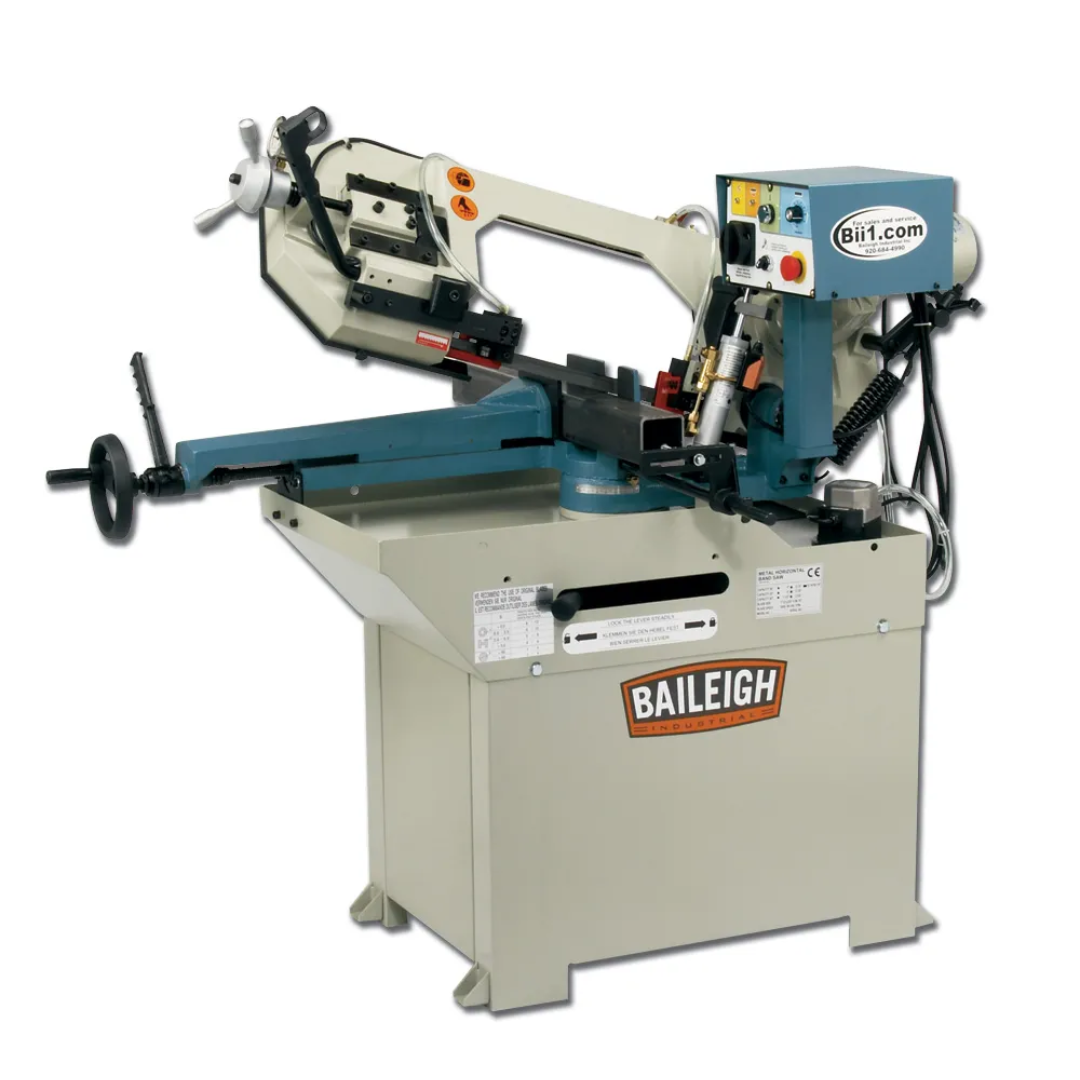
Best Industrial Horizontal Band Saw: Top Picks for Metal Fabrication Shops
Finding the best industrial horizontal band saw means matching the machine to the work you actually do. That means looking at round capacity, degree of automation, material type, and production volume. Whether you are cutting bar stock in a one-man machine shop or running production cuts on structural steel, the right horizontal band saw makes the difference between efficient throughput and a machine that bottlenecks your floor. This guide covers the top picks, the key specs to compare, and how to choose the right saw for your shop.

Quick Answer
The best industrial horizontal band saw depends on your cutting capacity and automation needs. For light-to-mid industrial use, the Baileigh BS-250M and BS-916M deliver precision at accessible price points. For production shops, the semi-automatic BS-330SA and BS-360SA cut unattended with hydraulic downfeed. All are built for steel, stainless, and aluminum — not hobby-grade cuts.
Our pick: Baileigh 8.66-Inch Mitering Horizontal Bandsaw BS-250M — $6,198.21. View more >
In This Guide
- What Is an Industrial Horizontal Band Saw?
- Manual vs. Semi-Automatic vs. Fully Automatic
- Key Specs to Evaluate
- Comparison Table
- Best Industrial Horizontal Band Saws — Top 5 Picks
- Industrial vs. Light-Duty: Knowing the Difference
- How to Choose the Right Machine
- Maintenance and Long-Term Ownership
- Frequently Asked Questions
- Conclusion
What Is an Industrial Horizontal Band Saw?
An industrial horizontal band saw is a floor-mounted, production-grade saw. It uses a continuous loop blade running in a horizontal plane to cut metal stock. The workpiece is held stationary in a hydraulic or mechanical vise while the saw head descends through it under controlled downfeed pressure. When the cut is complete, the head returns to the top position, automatically or manually depending on the machine's automation level.
Unlike vertical band saws, where the blade runs up-and-down and the operator feeds the work by hand, a horizontal saw does the feeding itself. The operator sets up the vise, starts the cut, and the machine does the rest. This design is what makes horizontal band saws the standard cut-off tool worldwide. They are used in metal fabrication shops, machine shops, structural steel operations, and production manufacturing facilities.
The key distinction between an industrial machine and a light-duty saw is construction quality and cutting capacity. Industrial horizontal band saws feature heavy cast steel or cast iron frames and precision hydraulic downfeed systems. They also have industrial-grade vises that hold stock without shifting. Their blade speeds are optimized for ferrous and non-ferrous metals. They are built to run continuously through production shifts, not for the occasional weekend cut.

Manual vs. Semi-Automatic vs. Fully Automatic
The most important decision in choosing an industrial horizontal band saw is the level of automation. It determines how much operator involvement each cut requires. It also determines your throughput capacity and the machine's price point.
Manual Horizontal Band Saws
On a manual machine, the operator lowers the saw head by hand using a handle or a manual downfeed control. After the cut, the operator raises the head, repositions or replaces the workpiece, and starts the next cut. Manual saws are well suited to job shops that cut a variety of stock in small quantities. The Baileigh BS-250M and BS-916M are strong manual options. They bring hydraulic downfeed control to what is otherwise a hand-operated machine. The hydraulic system limits downfeed pressure rather than automating the feed entirely.
Semi-Automatic Horizontal Band Saws
A semi-automatic saw adds a hydraulic raise-and-lower cycle to the blade head. The operator loads the workpiece and starts the cycle. The saw then descends, cuts, and returns to the top position on its own. The operator then repositions the material and starts the next cycle. This setup is ideal for production shops that cut large quantities of the same stock. The Baileigh BS-330SA and BS-360SA operate this way. That is a significant productivity increase over manual operation when you are cutting hundreds of pieces per shift.
Fully Automatic Horizontal Band Saws
Fully automatic machines combine semi-automatic blade cycles with an automatic feeding system. The system advances the bar stock after each cut by a programmable length. The operator loads a full bar and sets the cut length. Then the machine runs the entire bar unattended. These are the highest-output machines in production fabrication. They require a larger initial investment. They are most cost-effective in high-volume repetitive cutting operations.

Key Specs to Evaluate
When comparing industrial horizontal band saws, these are the specifications that determine real-world performance:
- Round capacity (90°): The maximum diameter of round stock the saw can cut at a straight 90-degree cut. This is the defining capacity spec. Match it to the largest bar or tube stock you regularly cut.
- Rectangular capacity: Maximum width and height of rectangular material at 90°. Important for flat bar, structural angle, and channel stock.
- Miter capacity: The angular range the saw head or vise can tilt. Industrial saws typically miter to 45° or 60° left and right. Some models offer up to 60° capability.
- Blade speed: Industrial metal-cutting band saws run at lower surface feet per minute (SFM) than woodworking saws. Variable speed models let you match blade speed to material: slower for hard steel, faster for aluminum and soft metals.
- Motor HP and voltage: Industrial saws typically run 1.5 HP to 5 HP or more. Confirm your shop's available voltage and phase before ordering. In this guide, the BS-250M runs on 110V single-phase. The BS-916M and BS-300M run on 240V single-phase. The BS-330SA and BS-360SA run on 220V three-phase.
- Downfeed type: Hydraulic downfeed with adjustable cutting pressure is the standard on industrial machines. It prevents blade deflection and blade burning on hard materials.
- Coolant system: Built-in flood coolant is standard on industrial horizontal saws. It extends blade life, prevents heat buildup in ferrous metals, and improves cut quality on stainless steel and tool steel.
- Frame material: Cast iron or welded steel frames are standard on industrial machines. Cast iron dampens vibration better. Welded steel can handle higher rigidity loads.

Comparison Table: Best Industrial Horizontal Band Saws
Here is a side-by-side comparison of the top industrial horizontal band saws by capacity, automation, and best-fit use case:
| Model | Round Cap. | Automation | Motor | Best For | Price |
|---|---|---|---|---|---|
| Baileigh BS-250M | 8.66″ | Manual / Hydraulic | 2 HP | Job shops, entry industrial | $6,198 |
| Baileigh BS-916M | 8.75″ | Manual / Hydraulic | 1.5 HP | Small shops, structural fab | $6,645 |
| Baileigh BS-300M | 9.75″ | Manual / Hydraulic | 2 HP | Mid-volume fab, diverse stock | $7,612 |
| Baileigh BS-330SA | 13″ | Semi-Automatic | 3 HP | Production shops, high volume | $25,409 |
| Baileigh BS-360SA | 14″ | Semi-Automatic | 5 HP | Heavy production, large structural | $34,435 |
Best Industrial Horizontal Band Saws — Top 5 Picks
These are the top-performing industrial horizontal band saws available from our horizontal band saw collection. Each has been selected for industrial build quality, real-world cutting capacity, and long-term reliability in production environments:
1. Baileigh 8.66-Inch Mitering Horizontal Bandsaw BS-250M — $6,198.21
The BS-250M is Baileigh's entry-level industrial horizontal band saw. It is built to full industrial standards. The 8.66-inch round capacity handles most common bar stock and tube diameters used in job shops and light fabrication. The mitering head swivels for angled cuts without repositioning the vise. Hydraulic downfeed delivers consistent cutting pressure through the full stroke. This prevents blade binding and extends blade life. It is the go-to for shops that want an industrial-grade horizontal band saw without the production-scale investment. View more >

2. Baileigh Horizontal Band Saw BS-916M — $6,645.27
The BS-916M is a heavy-duty manual horizontal band saw. It has an 8.75-inch round capacity and a vise mitering system for 0° to 45° angle cuts. The industrial-grade construction and hydraulic feed control deliver reliable, accurate cuts on structural steel, solid bar, and tubing in job shops and fabrication operations. This saw combines industrial build quality with manual simplicity. That makes it ideal for shops that value reliability and low-maintenance operation over automated production cycles. View more >
3. Baileigh 10-Inch Horizontal Bandsaw BS-300M — $7,611.85
The BS-300M steps up to a 9.75-inch round capacity. It handles larger bar stock and structural sections that push past the limits of smaller industrial saws. It runs on 240V single-phase power, so it is accessible for shops without three-phase electrical service. The standard flood coolant system and 2 HP motor make it capable of sustained production cutting on steel, aluminum, and stainless. This is the mid-range horizontal band saw for shops that need more capacity than the BS-250M without moving to a semi-automatic machine. View more >

4. Baileigh 13-Inch Semi-Automatic Horizontal Bandsaw BS-330SA — $25,409.09
The BS-330SA is Baileigh's production-grade semi-automatic horizontal band saw. It is the saw for shops that run serious volume. The 13-inch round capacity handles heavy structural steel, large-diameter bar, and pipe with ease. Semi-automatic operation means the head descends, cuts, and returns automatically. The operator simply loads, positions, and starts each cycle. The 45° swivel head allows miter cuts on large structural stock. The BS-330SA is the right investment for fabrication shops, contract cutting operations, and production facilities where throughput matters. View more >

5. Baileigh 14-Inch Semi-Auto Horizontal Bandsaw BS-360SA — $34,434.58
The BS-360SA is the largest saw in this guide. It is a 14-inch, 5 HP semi-automatic machine built for the heaviest production cutting demands. The 5 HP motor delivers sustained power through large-diameter solids, thick-walled structural steel, and difficult alloys. Semi-automatic hydraulic operation automates clamping, feed, and head return. This lets the saw run repeat cycles with minimal operator involvement. This is the machine for facilities where downtime is not an option. Their production volumes demand a heavy-duty platform that can run all day, every day. View more >

Industrial vs. Light-Duty: Knowing the Difference
Not every horizontal band saw sold is built for industrial use. Knowing what sets an industrial machine apart from a light-duty or hobbyist model keeps you from buying the wrong saw for the work you do.

Industrial band saws feature all-cast or heavy-welded steel frames. These frames absorb vibration and maintain dimensional accuracy through thousands of cuts. The hydraulic systems on industrial machines are engineered for continuous use, not occasional light cutting. Industrial vises clamp stock securely without creep or slippage. Industrial blades run at precise, consistent speeds designed for ferrous metal cutting. Industrial machines are also supported by manufacturer parts availability and service networks that keep production floors running.
Light-duty horizontal band saws are sometimes marketed as "metal-cutting" saws at consumer-grade price points. They use lighter frame construction, simpler blade tension systems, and vises with less clamping force. They work for occasional cuts on small stock. But they are not designed for the cycle frequency, material variety, or dimensional accuracy requirements of a commercial shop. Blade wear is faster. Frame deflection can compromise cut squareness. Maintenance cycles are more frequent.
If your shop bills for metalwork, the industrial machine pays for itself quickly. The gains come in blade life, cut accuracy, and reduced setup time. The initial price difference becomes a smaller fraction of total cost of ownership over time.

How to Choose the Right Industrial Horizontal Band Saw for Your Shop
Choosing the right industrial horizontal band saw requires answering a few key questions about your work before comparing specs and prices:
What is the largest stock you regularly cut?
Your round capacity requirement determines the minimum saw you need. If you consistently cut 9-inch round solid bar, the BS-250M's 8.66-inch capacity is insufficient. You need the BS-300M (9.75 inches) or larger. Buy one size up from your current maximum to give yourself room as your business grows and stock sizes change.

How many cuts do you make per day?
Volume is the key driver for automation level. If you make 10–30 cuts per shift on varied stock, a manual hydraulic saw like the BS-916M or BS-300M is likely sufficient. Suppose you make 100+ cuts per shift on the same stock size. Then the semi-automatic BS-330SA pays for itself in operator time saved within a year. Count your actual daily cut volume and use it to justify the step to semi-automatic.
What materials do you cut?
All industrial horizontal band saws on this list cut mild steel and aluminum. For stainless steel, hardened alloys, and tool steel, verify that the machine has a coolant system (or coolant-ready base). Also verify that it has a blade speed range appropriate for those materials. Variable-speed models are more flexible across diverse material types. The Baileigh BS-330SA runs variable blade speeds from 82 to 270 SFPM. It also includes an integrated flood coolant system, which suits a wide range of materials.

Do you need miter capability?
If you regularly cut tube and bar at angles for structural frameworks, pipe fittings, or weldment assemblies, choose a mitering model. The BS-250M has a swivel miter head (up to 60°). The BS-330SA has a 45° swivel head. The BS-916M and BS-300M miter to 45° through an adjustable vise. The BS-360SA page lists no miter range. Call us before you buy if you need angled cuts on a saw that size. Not all horizontal band saws miter. Confirm before purchasing if angled cuts are part of your regular workflow.
What power is available in your shop?
Industrial band saws come in single-phase 240V and three-phase configurations. Single-phase is more common in smaller shops. The BS-300M runs on it. Three-phase is standard in larger manufacturing facilities. It powers the larger BS-330SA and BS-360SA. Confirm your available power before ordering to avoid a costly electrical upgrade.

Maintenance and Long-Term Ownership
Industrial horizontal band saws are low-maintenance machines when operated correctly. But neglecting a few routine service points will shorten blade life and reduce cut accuracy.
Shopping for horizontal band saws? See the full selection or call 888-308-5580.
Shop Horizontal Band Saws
- Blade tension: Check and adjust blade tension at every blade change. Under-tensioned blades deflect under cutting load. Over-tensioned blades break prematurely. Follow the manufacturer's tension specification for the blade width you are running.
- Blade guides: Inspect the blade guides (carbide or roller guides depending on the model) regularly. Worn guides allow blade twist that produces skewed cuts. Replace them when wear is visible.
- Coolant system: Clean the coolant reservoir and replace coolant on the manufacturer's recommended schedule. Contaminated coolant reduces cutting performance and can accelerate blade wear on ferrous materials.
- Hydraulic fluid: On semi-automatic machines, check hydraulic fluid levels monthly. Low hydraulic fluid causes sluggish or inconsistent head movement and can damage hydraulic seals over time.
- Vise wear: Inspect vise jaw faces for wear that reduces clamping force or introduces slippage. On high-cycle production machines, jaw replacement may be needed after extended use.
- Blade selection: Always use the correct TPI (teeth per inch) for the material you are cutting. Thin-walled tube and small-diameter bar require more TPI than solid large-diameter stock. The wrong blade causes premature wear and rough cut surfaces.

Industrial horizontal band saws from Baileigh and Ellis are built to give many years of service with routine maintenance. Parts availability from both manufacturers is strong. The straightforward hydraulic and mechanical systems on these machines are repairable by any competent industrial maintenance technician.
Frequently Asked Questions
What is the best industrial horizontal band saw for a small metal fabrication shop?
For a small to mid-size metal fabrication shop, the Baileigh BS-250M or BS-916M are strong starting points. Both deliver full industrial build quality at accessible price points. They have enough capacity for the most common bar stock and structural sections used in fabrication work. If your volume justifies it, the BS-300M adds a larger 9.75-inch capacity on single-phase 240V power. It is the go-to for shops without three-phase service who still need industrial performance.
What round capacity do I need on a horizontal band saw?
Your round capacity requirement should be at least equal to the largest diameter of round stock you regularly cut. Ideally, it is one size above that. If your largest regular cut is 7-inch round, an 8.66-inch or 8.75-inch machine gives you coverage plus growth room. Avoid sizing exactly to your current maximum. Stock sizes tend to increase as a shop takes on larger work.
What is the difference between a manual and semi-automatic horizontal band saw?
On a manual horizontal band saw, the operator lowers the saw head by hand for each cut. The operator raises it at the end of the stroke. On a semi-automatic machine, the head descends, cuts, and returns to the top position automatically via a hydraulic system. The operator simply loads the material and starts each cycle. Semi-automatic operation is significantly faster for high-volume repetitive cutting. It also reduces operator fatigue on long production runs.
Do industrial horizontal band saws come with coolant systems?
Most industrial horizontal band saws either include a built-in flood coolant system or have a coolant-ready base designed to accept one. Coolant is essential for cutting ferrous metals, particularly stainless steel, hardened alloys, and tool steel. This is because coolant prevents blade heat buildup that shortens blade life and degrades cut quality. For shops that cut steel regularly, a coolant system is not optional. It is standard equipment.
How do I choose the right blade TPI for my horizontal band saw?
Blade TPI (teeth per inch) should be matched to the cross-section of the material being cut. The general rule is to have at least 3 teeth in contact with the material at all times. Thin-walled tubing, sheet, and small-diameter bar use higher TPI (10–14 TPI). Large solid bar, heavy structural stock, and thick plate use lower TPI (4–6 TPI). Running the wrong TPI causes premature blade wear, stripped teeth, and poor cut surfaces.
Can a horizontal band saw cut aluminum and stainless steel?
Yes. Industrial horizontal band saws cut aluminum, stainless steel, mild steel, alloy steel, brass, copper, and most non-ferrous metals. Aluminum requires higher blade speeds. It also requires a blade specifically designed for non-ferrous cutting to prevent chip loading. Stainless steel and hardened alloys require lower blade speeds, appropriate blade TPI, and flood coolant. These prevent work hardening and premature blade wear. Variable-speed models are most flexible across this range of materials.
Conclusion
Choosing the best industrial horizontal band saw means matching capacity, automation level, and materials capability to what your shop actually does. For most job shops and fabrication operations, the Baileigh BS-250M, BS-916M, or BS-300M deliver full industrial performance at the right scale. For production shops running high volumes, the semi-automatic BS-330SA or BS-360SA are the right investment. All are built to the industrial standard that commercial metalworking demands. Explore our full selection of horizontal band saws and find the right machine for your shop. Or call us, and our team will help you match the specs to your work.
Safety and standards references: OSHA 1910.212 general requirements for all machines and OSHA metalworking fluids: standards.
Explore the category: Metalworking. Related collections: Industrial Bandsaws, Metal Band Saws and Mitre Band Saw.
Related Reading
Talk to an Industrial Band Saw Specialist
Not sure which horizontal band saw fits your shop's production requirements? Our team can help you match the right machine to your cutting volume, material type, and automation needs.
Featured Horizontal Band Saws


Shop All Horizontal Band Saws
Browse our full selection of industrial horizontal band saws for metalworking, fabrication, and production cutting. Expert guidance available by phone.
Shop All Horizontal Band Saws