

Quick Answer
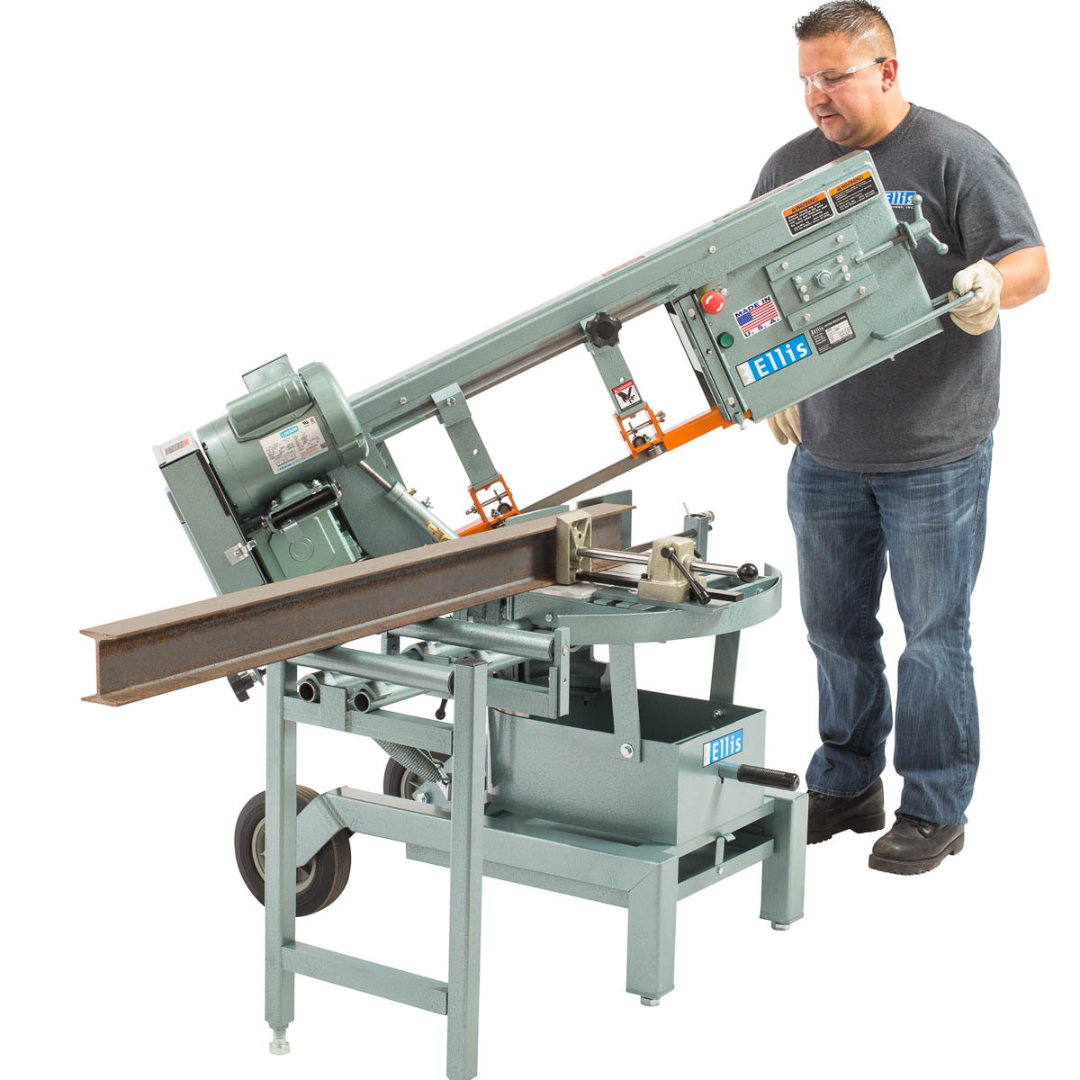
A cold saw is typically faster on mild and structural steel up to about 4 to 5 inches in diameter. But most models cap out at 4 to 6 inch round stock. A band saw handles solid bar of 10, 12, or 16 inches. It generally costs less at equivalent cutting capacity.
In This Guide
- How Each Saw Works
- Band Saw vs Cold Saw: Key Differences
- What a Cold Saw Does Best
- What a Band Saw Does Best
- Cutting Different Materials
- Cost of Ownership
- Metal Cutting Band Saws Compared Side by Side
- Metal Cutting Band Saws We Can Recommend
- How to Choose: Cold Saw or Band Saw?
- Frequently Asked Questions
- Conclusion
Featured Band Saws

Ellis Saw
Ellis 2000 Mitre Band Saw – Horizontal & Vertical Metal Cutting, 17″ Capacity
$6,545.00
With a 17 inch capacity, the Ellis 2000 is a mitre band saw for horizontal and vertical metal cutting. It suits fabricators who handle larger sections. Compare its capacity with your work before choosing.

Ellis Saw
Ellis 3000 Mitre Band Saw - 13-1/2" Round Capacity, 2 HP, Variable Speed Shorter (still strong)
$6,795.00
Variable speed and a 2 HP motor come with a 13-1/2 inch round capacity on the Ellis 3000. Variable speed is useful when you switch between metals. Check the capacity against your largest section.

RIKON
RIKON 10-342EVS 18" Bandsaw - 2.5HP Electronic Variable Speed
$3,499.99
RIKON builds this 18 inch band saw for both wood and metal, with a 2.5 HP motor and electronic variable speed. It suits a fabrication shop that also saws wood. Confirm your blade choice for each material.

Baileigh
Baileigh 8.66-Inch Mitering Horizontal Bandsaw, 2 HP (BS-250M)
$6,198.21
A mitering horizontal band saw with a 2 HP motor and an 8.66 inch round capacity. It has a swivel head that cuts angles up to 60 degrees. Variable blade speeds from 66 to 280 SFPM and hydraulic downfeed suit steel, stainless and aluminum. Check the blade you plan to run for each material.
How Each Saw Works
The Cold Saw
A cold saw (also called a circular cold saw or cold cut saw) uses a toothed circular blade spinning at low RPM to cut metal in a single downward chop motion. The blade typically spins at 15–100 RPM, depending on material and blade diameter. Unlike an abrasive cut off saw, the cold saw blade doesn't grind through metal. It shears the metal with individual teeth, much like a milling cutter. This low-speed, high-tooth-engagement approach removes chips efficiently. It transfers heat into the chip rather than the workpiece or blade, hence the name "cold" saw. The result is a cut that stays cool to the touch, produces no sparks, leaves minimal burr, and maintains tight dimensional tolerances. Cold saw blades are either high-speed steel (HSS) or carbide-tipped. They are resharpened rather than discarded, so the blade is a long-term capital item rather than a consumable.

The Metal-Cutting Band Saw
A metal-cutting band saw uses a long, continuous loop of toothed bi-metal or carbide-tipped blade. The blade runs on two or three wheels and cuts in a single continuous downward direction. Horizontal band saws clamp the workpiece stationary while the blade head descends through it. Vertical band saws keep the blade running vertically while the operator feeds material into it. Metal band saws run their blades at controlled surface speeds, typically 80–350 SFPM depending on material. This is far slower than a circular cold saw's blade tip speed. The thin, narrow blade removes a small kerf. The many small teeth in continuous contact mean each tooth takes a light chip load. This is why band saws handle difficult-to-machine alloys and large cross-sections that would strain a cold saw.
Band Saw vs Cold Saw: Key Differences
| Feature | Cold Saw | Metal Band Saw |
|---|---|---|
| Blade type | Toothed circular disc (HSS or carbide-tipped); resharpened | Continuous loop bi-metal or carbide; replaced when worn |
| Cutting speed | Fast — especially on common steels; carbide variants cut faster | Slower per cut; semi-automatic models run unattended |
| Cut quality / finish | Excellent — minimal burr, true square ends, no heat discoloration | Good to excellent with bi-metal blade; slight burr possible |
| Heat generated | Very low — heat goes into chip; workpiece stays cool | Low — controlled with coolant; no sparks |
| Max material diameter | Limited — typically 4–6" round maximum | Much larger — 10–16"+ on production models |
| Bundle/layer cutting | Not practical — single piece only | Yes — multiple pieces per cut boosts throughput |
| Exotic / tough alloys | Slow; blade wear increases on hard alloys | Better — controlled feed rate and many teeth handle tough materials |
| Blade economy | High upfront blade cost; resharpened many times (long life) | Lower blade cost; replaced when worn (not resharpened) |
| Machine cost | Higher, especially carbide-tipped automated models | Lower for equivalent capacity, especially on larger sections |
| Unattended operation | Requires operator for each cut (manual/semi-auto) | Fully automatic horizontal models cut and stop unattended |
| Best for | High-speed precision cutoff on common steel, small/medium diameter | Large sections, tough alloys, bundle cutting, unattended production |
What a Cold Saw Does Best
Speed on Common Steel Grades
A cold saw is typically faster than a band saw on a piece-by-piece basis. This holds for mild steel, structural steel, and other common grades up to 4–5" in diameter. The circular blade covers the cut area quickly. A 2" round bar in mild steel might take 10–20 seconds. A band saw cuts at a controlled feed rate, so it takes longer on the same piece. For shops doing high-volume cutoff on standard material, this speed advantage directly affects throughput.

Exceptional Cut Quality
A sharp cold saw blade produces one of the cleanest cuts in metal fabrication. The ends are square, with minimal or no burr and no heat-affected zone. The cut surface is often ready to weld, thread, or assemble without secondary cleanup. This clean edge quality is the cold saw's defining advantage over abrasive cutoff methods. It is also its primary advantage over band saws in precision applications. For parts that go straight from saw to weld or threading without deburring, the cold saw pays for itself in saved labor.

No Sparks, Low Noise
Cold saws cut by shearing rather than grinding, so they produce no sparks and run at relatively low noise levels, typically 75–85 dB. For an abrasive cut off saw, the figure is 95–105 dB. This makes cold saws practical in enclosed fab shops, near paint booths, or in facilities where spark control matters for safety or fire codes. For comparison, the National Institute for Occupational Safety and Health recommends an eight-hour exposure limit of 85 dBA.
Long Blade Life Through Resharpening
A cold saw blade, especially a carbide-tipped model, is resharpened rather than thrown away when it dulls. A single carbide blade can be resharpened 15–25 times before it's worn beyond use. Over its full life, this makes the per-cut blade cost of a cold saw competitive with or better than a band saw. This is true even though the initial blade cost is much higher. This economy improves further at high production volumes where the blade is used consistently rather than sitting idle.

What a Band Saw Does Best
Large Cross-Section Cutting
A cold saw's diameter is limited by its blade. Most models cap out at 4–6" round stock. A production horizontal band saw handles solid bar stock 10", 12", or 16" in diameter without difficulty. For machine shops, forge shops, or steel service centers cutting large billets, heavy-wall pipe, or oversized structural sections, only a band saw provides the necessary capacity. There is no practical cold saw solution for large-diameter work.

Bundle and Layer Cutting
A horizontal band saw can cut multiple pieces in a single stroke. Bundle together a dozen pieces of small round bar or tube, clamp them, and cut the whole bundle at once. The throughput of a well-set-up band saw cutting bundles can match or exceed a cold saw's piece-by-piece rate on small-diameter material. Cold saws are not designed for bundle cutting. The blade geometry and chop motion make it impractical and unsafe to run multiple unsecured pieces simultaneously.

Difficult-to-Machine Alloys
Nickel-based superalloys, titanium, hardened tool steels, and other tough materials push cold saws toward their limits. Blade speed must drop dramatically, feed forces increase, and blade wear accelerates. A band saw manages these materials significantly better. It runs its blade at low surface speed, with many fine teeth taking light chip loads. Each tooth touches the material briefly, dissipates heat into the chip, and exits the cut before overheating. For shops that regularly cut Inconel, stainless, or hardened alloy steel, a band saw is the more capable and economical tool.

Unattended and Automatic Operation
A fully automatic horizontal band saw is equipped with a vise, blade descent control, and automatic shutoff. It cuts a piece and stops when it's through, without an operator at the machine. The operator loads the material, sets the length stop and descent speed, and walks away. Production shops run these machines lights-out, through shifts, cutting hundreds of pieces overnight. A cold saw requires an operator to initiate and monitor every cut. For shops where labor cost per part matters, the band saw's automation capability is a significant operational advantage.

Lower Machine Cost at Large Capacity
For equivalent cutting capacity on large-section material, a band saw costs significantly less than a cold saw. The band saw is mechanically simple, with two wheels, a blade, a vise, and a head. This translates to a lower machine price at any given capacity point. A quality horizontal band saw capable of 10" round costs considerably less than a cold saw capable of the same capacity (if one even exists at that size). For shops that need large cutting capacity and aren't prioritizing maximum speed on small-diameter common steel, the band saw offers more value per dollar of capital investment.
Cutting Different Materials: Which Saw Wins?
| Material | Cold Saw | Metal Band Saw | Better Choice |
|---|---|---|---|
| Mild steel / structural steel (small diameter) | Excellent — fast, clean finish | Good — clean, slightly slower | Cold saw (speed and finish) |
| Mild steel (large diameter, 6"+) | Not capable | Excellent | Band saw |
| Stainless steel | Good, but blade wear increases | Excellent with bi-metal blade and coolant | Band saw |
| Alloy steel / tool steel | Possible; slow on hard grades | Very good — controlled feed rate, low blade temperature | Band saw |
| Nickel alloys / titanium / superalloys | Poor — high blade wear, slow | Good — many fine teeth, low speed, light chip load | Band saw |
| Aluminum / non-ferrous | Excellent with correct blade speed | Good with correct TPI and speed | Cold saw (finish and speed) |
| Bundle / multiple pieces per cut | Not suitable | Excellent | Band saw |
Cost of Ownership
The cost comparison between a band saw and a cold saw depends heavily on production volume, material type, and part size. Neither tool is universally cheaper. Each has cost advantages in its own domain.
Machine Cost
Band saws generally cost less than cold saws at equivalent cutting capacity, especially on larger material. A quality automatic horizontal band saw capable of cutting 10" round starts in the $3,000–$8,000 range for a solid production machine. Cold saws with carbide blades and automated feed systems are priced higher. Their practical capacity tops out well below what large band saws handle.
Blade Cost Per Cut
This is where the comparison gets nuanced. A band saw blade costs $20–$80 and is replaced when worn. A carbide cold saw blade costs $300–$1,000+ but is resharpened 15–25 times. On common mild steel at moderate volume, the per-cut cost of a cold saw can be comparable to or lower than a band saw. This is when the cold saw uses resharpened carbide blades. On difficult alloys or at lower volumes where blade life per sharpening drops, the economics favor the band saw. Industry estimates for cutting 2" mild steel bar typically show cold saw at roughly $0.04–$0.05 per cut and band saw at $0.02–$0.04 per cut. But these figures shift significantly with material hardness, blade condition, and cutting speed.
Labor Cost
An automatic band saw cuts unattended. A cold saw requires an operator. At high production volumes, the labor cost difference alone can more than offset the band saw's lower machine cost. Shops running two or three shifts find that the band saw's automation multiplies its effective output. It does this without adding headcount.
Metal Cutting Band Saws Compared Side by Side
On the Band Saw vs Cold Saw question, the table below lines up the metal cutting band saws from our store. These are the saws that the picks cover. Start with cutting capacity.
| Model | Price | Key feature | Best for |
|---|---|---|---|
| Ellis 1800 Mitre Band Saw – Horizontal & Vertical Metal Cutting, 14″ Capacity | $5,995.00 | Both cut orientations, rated for a 14 inch capacity | Mid-size metal fabrication needing mitre cuts |
| Ellis 4000 Industrial Mitre Band Saw – 13-1/2″ Round, 22″ Flat Capacity | $6,999.00 | Industrial build with 13-1/2 inch round, 22 inch flat capacity | Industrial floors cutting large round or flat metal |
| RIKON 15-400 4" x 6" Horizontal Metal Cutting Bandsaw | $699.99 | Three blade speeds at 80, 120 and 180 feet per minute | Stainless steel and brass alloy cutting on a bow saw |
| Ellis 1600 Mitre Band Saw – Horizontal & Vertical Metal Cutting, 10″ Capacity | $5,299.00 | Takes metal up to 10 inch in either orientation | Metal jobs that fit a 10 inch capacity |
Size the capacity to the metal you cut. Then read the key feature to see which saw handles your material, speed and cut direction.
Metal Cutting Band Saws We Can Recommend
Cold saw or band saw? The models below from our store cover the metal cutting side of that choice. Match capacity to your largest stock and think about cutting volume before deciding.
1. Ellis 1800 Mitre Band Saw – Horizontal & Vertical Metal Cutting, 14″ Capacity — $5,995.00
Fills the middle of the Ellis range. It has a 14 inch capacity and can cut horizontally or vertically as a mitre band saw. View more >
2. Ellis 4000 Industrial Mitre Band Saw – 13-1/2″ Round, 22″ Flat Capacity — $6,999.00
Takes on industrial-size sections with a 13-1/2 inch round capacity and a 22 inch flat capacity. View more >
3. RIKON 15-400 4" x 6" Horizontal Metal Cutting Bandsaw — $699.99
Suits smaller metal jobs. It cuts as a horizontal bow saw, or as a vertical bandsaw once the included table is fitted. It makes miter cuts up to 45 degrees. View more >
4. Ellis 1600 Mitre Band Saw – Horizontal & Vertical Metal Cutting, 10″ Capacity — $5,299.00
Works for shops that cut metal in smaller sections. It has a 10 inch capacity and both horizontal and vertical operation. View more >
How to Choose: Cold Saw or Band Saw?
| Your Situation | Choose | Why |
|---|---|---|
| High-speed precision cutoff, small/medium diameter common steel | Cold saw | Faster per cut, best finish, minimal burr |
| Cutting large-diameter material (6"+) | Band saw | Cold saws lack the capacity |
| Exotic or hard alloys (stainless, Inconel, titanium) | Band saw | Better blade life, controlled feed, no heat buildup |
| Bundle cutting / multiple pieces per stroke | Band saw | Cold saws can't cut bundles practically or safely |
| Unattended / lights-out production cutting | Band saw | Automatic horizontal models cut and stop without an operator |
| Burr-free finish with no secondary cleanup | Cold saw | Cold saw's shearing action produces the cleanest edge |
| General fabrication shop, mixed materials and sizes | Both (band saw first) | Band saw handles more situations; cold saw adds speed/finish for small common steel |
Many serious metal fabrication shops run both. The band saw handles large sections, tough alloys, bundle cuts, and after-hours automated cutting. The cold saw handles high-speed precision cutoff on the small-to-medium common steel that makes up the bulk of daily work.
If the table points you to a band saw, match the capacity to your largest stock. The Ellis 1800 has a 14 inch capacity and cuts horizontally or vertically. The Ellis 4000 takes industrial-size sections with a 13-1/2 inch round capacity and a 22 inch flat capacity. The RIKON 15-400 is a 4 inch by 6 inch horizontal saw priced at $699.99.
Frequently Asked Questions
What is the difference between a band saw and a cold saw?
A cold saw uses a toothed circular blade spinning at low RPM to chop through metal in a single downward stroke. It produces a clean, burr-free cut by shearing chips rather than grinding. A band saw uses a continuous loop of toothed blade running on two wheels. It cuts in a steady continuous motion at controlled surface speeds. Cold saws are faster on small-diameter common steel and produce a cleaner finish. Band saws handle larger material, difficult alloys, bundle cuts, and automated production that cold saws can't.
Is a cold saw better than a band saw?
Neither is universally better. They excel in different situations. A cold saw is better for high-speed precision cutoff on common steel up to about 4–5" in diameter where burr-free finish matters. A band saw is better for large-section material, difficult-to-machine alloys, bundle cutting, and unattended production. Most professional metal fab shops use both and route each job to the appropriate tool.
Why is it called a cold saw?
The "cold" in cold saw refers to the fact that the workpiece stays cool during cutting. Unlike abrasive saws, a cold saw's low-RPM toothed blade transfers heat into the chip rather than the metal being cut. Abrasive saws generate intense heat through friction and can discolor or harden the cut surface. The workpiece remains cool enough to handle immediately after the cut and shows no heat-affected zone. This matters for precision parts that will be welded or machined after cutting.
Can a cold saw cut stainless steel?
Yes, a cold saw can cut stainless steel, but it needs the right blade speed and feed rate. Blade wear is also higher than on mild steel. A bi-metal band saw is generally a better choice for stainless. Its many fine teeth at controlled surface speed maintain a cooler cut, preserve blade life better, and handle the work-hardening tendency of stainless more effectively than a cold saw's circular blade. For high-volume stainless cutting at small diameters, a cold saw with a carbide blade and correct parameters can work well.
How long does a cold saw blade last?
A high-speed steel (HSS) cold saw blade typically lasts several hundred to a few thousand cuts on mild steel before it needs resharpening. This depends on blade diameter, cutting speed, material, and coolant use. A carbide-tipped cold saw blade lasts significantly longer between sharpenings. It potentially lasts tens of thousands of cuts on mild steel. It can also be resharpened 15–25 times over its service life. This makes the total cost of a cold saw blade, amortized over its full life, competitive with band saw blades despite the higher upfront price.
What is a metal band saw used for?
A metal band saw is used for cutting metal stock to length across a wide range of sizes and materials. Horizontal band saws are the most common type in production environments. They clamp the material and cut automatically, handling solid bar, tube, pipe, structural sections, and large billets. Vertical band saws allow contour and curve cutting in metal. Band saws are preferred for large-diameter material, exotic alloys, and bundle cutting. They are also preferred for any application where unattended automatic operation, lower machine cost, or long-term blade economy matters more than maximum cut speed on small common-steel pieces.
Conclusion
A band saw and a cold saw both cut metal. They differ in how they cut, what they cost and where they win. So choose by your material, volume and budget. Looking for the right fit? Start with our band saws and narrow it down by size and price.
Explore the category: Saws for Metal Cutting. Related collections: Cold Saws, Metal Band Saws and Horizontal Band Saws.
Related Reading
Shop Band Saws at Iron Line Tools

Ellis 1600 Mitre Band Saw
Price: $5,299 | Type: Mitre Band Saw
The Ellis 1600 is a USA-made professional horizontal/vertical mitre band saw. It has a 10" round cutting capacity and precision miter cuts from 0–60°. It is built for metal fab shops that need serious cutting capacity and accuracy. These are the jobs where a cold saw falls short on size or material.

Baileigh BS-300M 10-Inch Horizontal Bandsaw
Price: $7,611.85 | Type: Horizontal Band Saw
The Baileigh BS-300M is a 10-inch horizontal metal cutting band saw. It has a 2 HP motor on 240V single-phase power, a 9.75″ round capacity and hydraulic descent control. Flood coolant and an automatic shut-off come standard. It is built for fab shops that need serious cutting capacity and accuracy. These are the jobs where a cold saw falls short on size or material.
Metal fabrication: which saw fits your volume?
Reach out to our team with your material and budget. We will compare both machines for you.