

Quick Answer
Choose a cut off saw for speed on thin stock such as rebar, angle iron, thin-wall tube, and conduit. Choose a band saw for clean cuts with no heat-affected zone. Also choose a band saw for large solid round bar of 4 inches and up. A cut off saw handles that poorly or not at all.
In This Guide
- How Each Saw Works
- Cut Off Saw vs Band Saw: Key Differences
- What a Cut Off Saw Does Best
- What a Band Saw Does Best
- Cutting Different Materials
- Cost of Ownership and Blade Life
- Cut Off Saw and Band Saw Models Compared
- Band Saws That Handle Metal and Tough Stock
- How to Choose: Cut Off Saw or Band Saw?
- Frequently Asked Questions
- Conclusion
Featured Band Saws

Ellis Saw
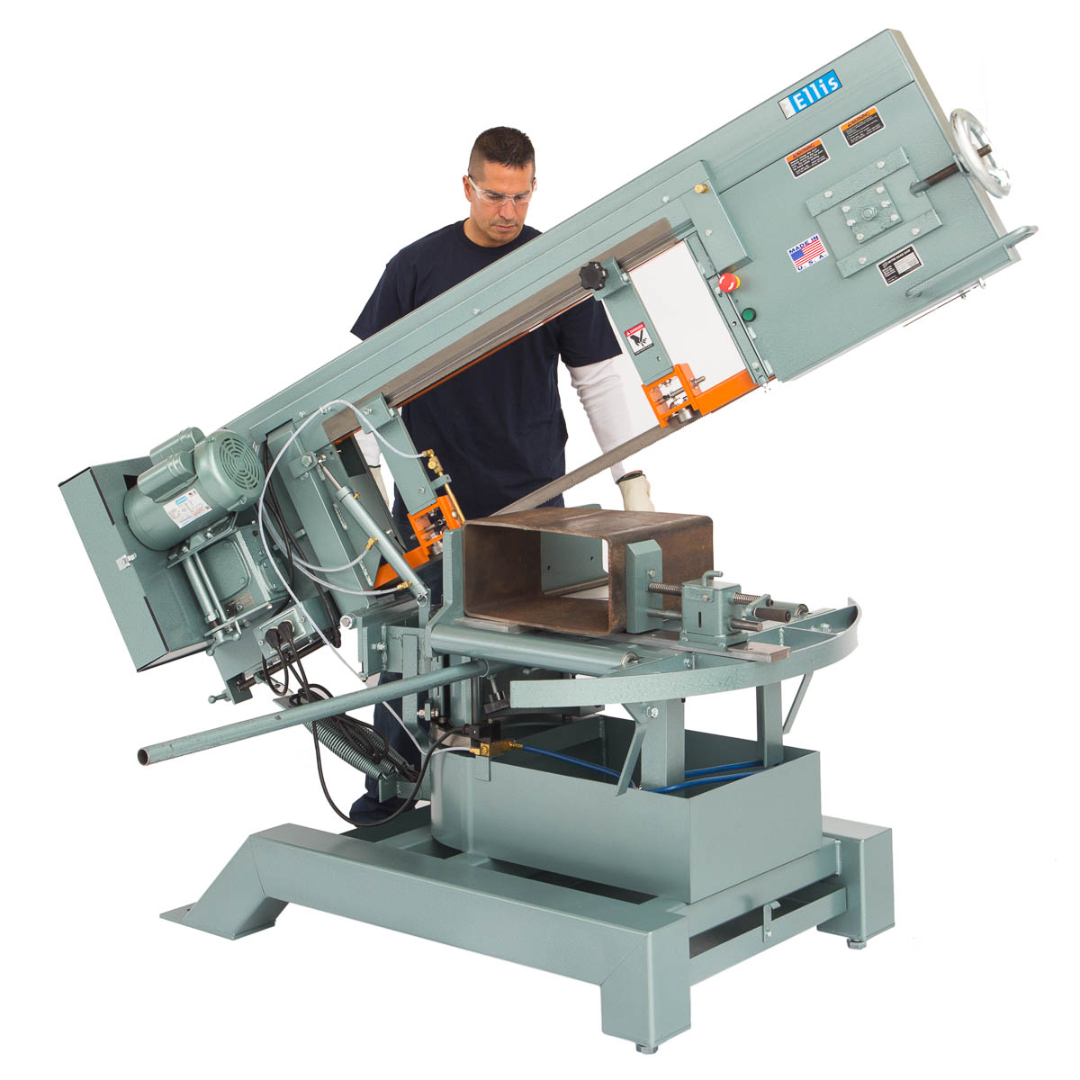
Ellis 4000 Industrial Mitre Band Saw – 13-1/2″ Round, 22″ Flat Capacity
$6,999.00
The Ellis 4000 mitre band saw is industrial in build. It offers a 13-1/2 inch round capacity and a 22 inch flat capacity. It suits heavy production cutting in a metal shop. Ask our team about blade and floor space needs.

Ellis Saw
Ellis 1800 Mitre Band Saw – Horizontal & Vertical Metal Cutting, 14″ Capacity
$5,995.00
Ellis sells the 1800 as a mitre band saw for horizontal and vertical metal cutting. It has a 14 inch capacity. It sits between the smaller and larger Ellis models. That is a sensible choice when your stock sizes vary. Check your sections first.

RIKON
RIKON 10-342EVS 18" Bandsaw - 2.5HP Electronic Variable Speed
$3,499.99
The RIKON 10-342EVS is a wood and metal machine. It is an 18 inch band saw with a 2.5 HP motor and electronic variable speed. It suits a shop that cuts both metal and wood with one saw. Check the blade you plan to run for each material.

Baileigh
Baileigh 8.26 x 6.69" Manual Horizontal Bandsaw: Geared Head (BS-210M)
$4,542.93
A compact metal cutting band saw with a geared head and a 1 HP motor on 110V power. Its blade speeds are from 66 to 280 SFPM. It has hydraulic descent control and a swivel head that miters to 60 degrees. Compare its 6.69 inch round capacity with your largest section.
How Each Saw Works
The Cut Off Saw
"Cut off saw" refers to two distinct types of tool that share the same name. Understanding the difference matters. The first type is the abrasive cut off saw (also called a chop saw or dry cut saw). It uses a spinning abrasive disc to cut through metal, masonry, or pipe by friction and abrasion. The disc is a large reinforced grinding wheel. These saws run at 3,500–4,000 RPM and cut quickly. The second type is the cold saw (also called a cold cut saw). It uses a toothed circular blade at low RPM and no abrasive action, producing cool, burr-free cuts. Both types cut in a straight line only, in a single downward chop motion.

The Band Saw (for Metal Cutting)
A metal-cutting band saw uses a long, continuous toothed blade. The blade is a loop of high-speed steel or bi-metal steel. It runs on two wheels and cuts continuously in one direction. Metal band saws come in two main configurations. In horizontal band saws, the workpiece is clamped stationary and the blade head swings down through it. In vertical band saws, the blade runs vertically and the operator guides material into the blade. Metal-cutting band saws run their blades at far lower speeds than wood band saws, typically 80–300 SFPM. They run slower to preserve blade life and cut cleanly without generating excess heat.

Cut Off Saw vs Band Saw: Key Differences
| Feature | Cut Off Saw (Abrasive) | Band Saw (Metal Cutting) |
|---|---|---|
| Cutting action | Abrasive disc spinning at high RPM | Continuous toothed blade loop, low speed |
| Cut types | Straight only; 90° and miter cuts | Straight, miter, and curves (vertical bandsaw) |
| Heat generated | High — sparks, hot debris, heat-affected zone | Low — can cut with coolant; no heat-affected zone |
| Cut quality / finish | Rough; burrs and scale; secondary cleanup needed | Smooth; minimal burr; often ready to use |
| Kerf width | Wide — abrasive disc removes 3–5mm of material | Narrow — blade removes 1–2mm of material |
| Material versatility | Metal, masonry, tile (disc-dependent) | Metals primarily; bi-metal blades handle hardened alloys |
| Capacity (material size) | Limited by disc diameter — typically up to 4–5" round | Much larger — up to 12"+ round or structural sections |
| Cut speed | Very fast for thin stock | Slower, but unattended/semi-automatic on horizontal models |
| Safety | Sparks, flying debris, disc fracture risk | Lower debris risk; blade failure is rare if maintained |
| Portability | Compact and portable — job site ready | Stationary shop tool; portable band saws exist for pipe |
| Best for | Fast cuts on thin metal; construction, demo, fabrication | Precision cuts on thick or expensive stock; production shops |
What a Cut Off Saw Does Best
Speed on Thin Stock
For quickly cutting rebar, angle iron, thin-wall tube, conduit, or flat bar to length, an abrasive cut off saw is extremely fast. There's no blade-speed setup, no coolant system, and no complex fixture. Clamp the material, bring the disc down, and the cut is done in seconds. On a construction site, getting things cut to rough length quickly is what matters. There, this speed advantage is real and significant.

Portability
Abrasive cut off saws are compact enough to move around a job site or fit in a truck. Many models weigh under 40 lbs. A floor-standing horizontal band saw is a fixed shop tool that goes nowhere. The cut off saw's portability makes it the tool of choice for on-site work, regardless of cut quality. Examples are structural steel, plumbing, HVAC rough-in, and demolition.

Low Initial Cost
A quality abrasive cut off saw costs far less than a comparable metal-cutting band saw. Entry-level models start under $200. Professional grade models run $400–$800. A quality horizontal band saw suitable for a professional shop starts at $1,500–$3,000 and goes up sharply from there. The cut off saw's lower entry cost is a legitimate factor for shops or tradespeople who don't need the precision or capacity of a band saw.
Versatility Across Materials (with the Right Disc)
By swapping abrasive discs, a cut off saw can cut ferrous metal, non-ferrous metal, masonry, tile, and concrete. No other single cutting tool matches this material flexibility. A metal band saw is essentially a metal-only tool; changing blade TPI and speed helps with different metal types, but it's still not going to cut masonry.
What a Band Saw Does Best
Precision Cuts with Superior Finish Quality
A metal-cutting band saw produces a cut with minimal burr and no heat-affected zone. The blade removes a narrow kerf of material cleanly. This leaves a surface that often requires no secondary cleaning before welding, grinding, or assembly. An abrasive cut off saw leaves scale, burrs, and a heat-discolored surface. That surface typically needs deburring, grinding, or wire-brushing before use. The band saw's cleaner cut has real value for work where that cleanup time adds up. Examples are production shops, precision fabrication, and machine shops.

Cutting Large-Section Material
A standard abrasive cut off saw with a 14" disc can cut material up to roughly 4–5" in diameter or width. A horizontal band saw, especially a larger industrial model, can cut solid bar stock 6", 10", or 12" in diameter. It can also cut large structural sections and heavy-wall tube that an abrasive disc could never reach. Only a band saw provides the capacity for machine shops, structural steel fabricators, or anyone cutting large billets.

Unattended and Semi-Automatic Cutting
Horizontal band saws can be set up to cut and stop automatically when the cut is complete. The operator clamps the material, sets the vise, and walks away. Production shops rely on this to run cuts overnight or batch many identical pieces without constant operator attention.

Reduced Noise and No Flying Sparks
Abrasive cut off saws are loud, typically 95–105 dB. They also produce a shower of hot sparks that can travel 15–20 feet. Metal band saws operate much more quietly and produce no sparks. This makes them safer and more practical in enclosed shop environments. In these environments, sparks near fluids, gas lines, or finished surfaces would be a hazard. For comparison, the National Institute for Occupational Safety and Health recommends an eight-hour exposure limit of 85 dBA.

Cutting Different Materials: Which Saw Wins?
| Material | Cut Off Saw | Band Saw | Better Choice |
|---|---|---|---|
| Thin-wall tube / conduit | Fast, rough cut | Clean, precise cut | Cut off (speed) or Band saw (finish) |
| Rebar / angle iron | Excellent — quick, portable | Good — cleaner cut | Cut off saw |
| Large solid round bar (4"+) | Poor or impossible | Excellent — designed for this | Band saw |
| Stainless steel / alloy steel | Possible but wastes disc; high heat | Excellent with bi-metal blade + coolant | Band saw |
| Structural steel (I-beam, channel) | Possible on smaller sections | Excellent on large sections | Band saw (larger sections) |
| Masonry / tile / concrete | Excellent with diamond/masonry disc | Not suitable | Cut off saw |
| Non-ferrous metals (aluminum, copper) | Poor — disc loads up quickly | Very good with correct blade and speed | Band saw |
Cost of Ownership and Blade Life
The recurring consumable cost of an abrasive cut off saw is often underestimated. A quality abrasive cutting disc costs $3–$8. It may last through 50–150 cuts on mild steel, depending on disc quality, material thickness, and operator technique. A bi-metal band saw blade costs $20–$60. But it can last several thousand cuts on steel when used correctly, with appropriate blade speed, feed rate, and coolant. For shops that cut metal at volume, the band saw's far lower consumable cost over time often justifies the higher initial machine cost. The math only favors the cut off saw when total cut volume is low.
Cut Off Saw and Band Saw Models Compared
Deciding between a Cut Off Saw vs Band Saw? Here are the band saws from our store that the picks cover. Compare capacity first, since it limits what each one can cut.
| Model | Price | Key feature | Best for |
|---|---|---|---|
| RIKON 15-400 4" x 6" Horizontal Metal Cutting Bandsaw | $699.99 | Horizontal bow saw that also runs vertical with the included table | Miter cuts up to 45 degrees in metal |
| Ellis 1600 Mitre Band Saw – Horizontal & Vertical Metal Cutting, 10″ Capacity | $5,299.00 | Metal cutting in two orientations, 10 inch capacity | Mitre cuts in metal where 10 inch capacity is enough |
| Ellis 2000 Mitre Band Saw – Horizontal & Vertical Metal Cutting, 17″ Capacity | $6,545.00 | 17 inch flat capacity (11 inch round), horizontal and vertical | Wide flat sections up to 17 inch at 90 degrees |
| Ellis 3000 Mitre Band Saw - 13-1/2" Round Capacity, 2 HP, Variable Speed Shorter (still strong) | $6,795.00 | 2 HP motor, variable speed, 13-1/2 inch round capacity | Cutting different metals at a speed you can adjust |
Check each saw's capacity against the largest piece of metal you cut. Then use the speed details to match it to your materials.
Band Saws That Handle Metal and Tough Stock
Both band saws and cut off saws cut tough materials. These metal cutting band saws from our store show the band saw side. Check your largest stock and how many cuts you make before choosing.
1. RIKON 15-400 4" x 6" Horizontal Metal Cutting Bandsaw — $699.99
Cuts brass alloys up to stainless steel on a 4 inch by 6 inch horizontal saw. It has three blade speeds of 80, 120 and 180 feet per minute. View more >
2. Ellis 1600 Mitre Band Saw – Horizontal & Vertical Metal Cutting, 10″ Capacity — $5,299.00
Offers horizontal and vertical metal cutting with a 10 inch capacity in a mitre band saw. It suits shops sawing mid-sized stock. View more >
3. Ellis 2000 Mitre Band Saw – Horizontal & Vertical Metal Cutting, 17″ Capacity — $6,545.00
Steps up to a 17 inch capacity for larger metal sections. It still cuts horizontally and vertically as a mitre band saw. View more >
4. Ellis 3000 Mitre Band Saw - 13-1/2" Round Capacity, 2 HP, Variable Speed Shorter (still strong) — $6,795.00
Brings a 2 HP motor and variable speed to a 13-1/2 inch round capacity. That lets you change the speed to suit different materials. View more >
How to Choose: Cut Off Saw or Band Saw?
| Your Situation | Choose | Why |
|---|---|---|
| Job site / construction / demolition | Cut off saw | Portable, fast, handles varied materials |
| Machine shop / production fabrication | Band saw | Clean finish, large capacity, unattended operation, lower consumable cost |
| Cutting large rounds or thick solid bar | Band saw | Abrasive cut off saw lacks the capacity |
| Occasional metal cuts, small shop | Cut off saw | Lower entry cost; adequate for occasional use |
| Cutting stainless, alloy, or specialty metals | Band saw | Controlled feed rate, coolant capability, no heat-affected zone |
| Masonry or concrete cutting | Cut off saw | Band saw blades are not suitable for masonry |
| High-volume steel production with finish requirements | Band saw | Blade economy, semi-automatic operation, consistent quality |
Many shops that work with metal have both tools. The cut off saw handles portable, on-the-fly cuts and masonry applications. The band saw handles anything where material size, cut quality, or production volume puts the abrasive disc out of its depth.

If the table points you to a band saw, match the capacity to your largest stock. The RIKON 15-400 is a 4 inch by 6 inch horizontal saw. It has three blade speeds of 80, 120 and 180 feet per minute. The Ellis 1600 offers a 10 inch capacity. The Ellis 2000 steps up to a 17 inch capacity for larger metal sections.
Frequently Asked Questions
What is the difference between a cut off saw and a band saw?
A cut off saw uses a spinning abrasive disc or toothed circular blade to make a single downward chop cut, like a chop saw or cold saw. A band saw uses a continuous loop of toothed blade running on two wheels. It cuts in a controlled, continuous motion. Cut off saws are faster and more portable for straight cuts on thin metal. Band saws offer greater capacity, cleaner cuts, and much lower consumable costs at volume. Neither tool can replace the other entirely.
Is a band saw or cut off saw better for cutting metal?
It depends on the application. An abrasive cut off saw is better for cutting thin-wall tube, rebar, or flat bar quickly on a job site. A metal band saw is better for cutting large solid bar stock, structural sections, or stainless steel. It is also better for precision work where surface finish matters. Production shops and machine shops almost universally choose band saws. They do so for their better finish quality, lower blade consumption cost, and larger cutting capacity.
Can a band saw replace a cut off saw?
A band saw replaces most of what an abrasive cut off saw does for metal cutting. It also does it better in terms of finish quality and material economy. The exceptions are portability and masonry cutting. Cut off saws go to the job site, but band saws usually don't. Band saw blades can't cut brick or concrete. If your work is shop-based metal fabrication, a band saw is the better long-term investment. If you need to cut on site or need to cut masonry, a cut off saw is still necessary.
How long do cut off saw blades (discs) last compared to band saw blades?
Abrasive cut off saw discs typically last 50–150 cuts on mild steel before wearing out. They cost $3–$8 each. A quality bi-metal band saw blade costs $20–$60. But it can last several thousand cuts on steel when used at the correct speed and feed with appropriate coolant. At any significant cutting volume, band saw blades are dramatically cheaper per cut. The break-even point depends on your volume. But most production shops find band saw operating costs lower within the first month of regular use.
What is a cut off saw used for in metalworking?
In metalworking, a cut off saw is primarily used for cutting metal stock to rough length quickly. This includes rebar, angle iron, flat bar, conduit, thin-wall tube, and small round stock. On job sites, it's often used to cut structural steel components, pipe, and HVAC components during installation. Cold saws (a type of cut off saw) are used for precision cutoffs in machine shops. They are used where a good finish is needed. Abrasive cut off saws are also widely used for cutting masonry, tile, and concrete. For this, they use the appropriate diamond or abrasive disc.
What size material can each saw cut?
An abrasive cut off saw with a 14" disc can typically cut material up to 4–5" in diameter or width. A metal-cutting band saw's capacity depends on its size. A bench-top model cuts up to 4–5" round. A floor-standing production model can cut 10–16" round bar stock or large structural sections. For anything over 4–5" in diameter or width, a band saw is usually the only practical option.
Conclusion
Cut-off saws and band saws both cut metal but work differently. Choose by your material, the cuts you make and what each costs to own and run. To see current models and pricing, explore our band saws collection.
Explore the category: Saws for Metal Cutting. Related collections: Cut Off Saw, Metal Band Saws and Horizontal Band Saws.
Related Reading
Shop Band Saws at Iron Line Tools

Ellis 1600 Mitre Band Saw
Price: $5,299 | Type: Mitre Band Saw
The Ellis 1600 is a USA-made professional horizontal/vertical mitre band saw. It has a 10" round cutting capacity and precision miter cuts from 0–60°. It is ideal for structural steel, heavy bar stock, and precision metal cuts that abrasive cut off saws can't match in quality or capacity.

Baileigh BS-300M 10-Inch Horizontal Bandsaw
Price: $7,611.85 | Type: Horizontal Band Saw
The Baileigh BS-300M is a 10-inch horizontal metal cutting band saw. It has a 2 HP motor on 240V single-phase power, a 9.75″ round capacity and hydraulic descent control. Flood coolant and an automatic shut-off come standard. It is ideal for tube, pipe, angle and bar stock, and for the cuts that abrasive cut off saws can't match in quality or capacity.
Cut-off saw or band saw for tough materials?
Speak with our team about your jobs, the metals involved and blade life to compare the two.