

Metal Band Saw vs Chop Saw: Which Is Right for Your Fabrication Shop?
Every metal fabrication shop eventually has to answer the band saw vs chop saw question. Both tools cut metal. Both have a place in professional shops. But they work in completely different ways. They excel in different applications and serve different production demands. Buying the wrong one can cost you time, money, and cut quality.
This guide breaks down everything you need to know about metal band saws vs chop saws. It explains how each machine works, where each one shines, which materials they handle best, and how to choose the right tool for your workflow. We also clarify the important difference between abrasive chop saws, cold saws, and carbide double-mitre saws. The industry often muddles this distinction.
Quick Takeaways
- Band saws excel at structural steel, pipe, and odd-angle cuts
- Chop saws deliver fast, repeatable crosscuts on profiles and bar stock
- Cold saws and carbide chop saws run cool — no sparks, no burr
- Aluminum fabrication shops often prefer a double-mitre chop saw
- High-volume professional shops often run both tools
Quick Answer
A metal band saw is the better choice for structural steel, pipe, tube, and I-beams. It leaves a clean, near-square cut, but a cut takes 30 seconds to 5 minutes. An abrasive chop saw is faster at 5 to 30 seconds per cut. But the cut is rougher, and it should never be used on aluminum.
In This Guide
- What Is a Metal-Cutting Band Saw?
- What Is a Chop Saw? (And What Type Do You Actually Need?)
- Metal Band Saw vs Chop Saw: Full Comparison
- When to Choose a Metal Band Saw
- When to Choose a Chop Saw
- Cutting Aluminum: Band Saw or Chop Saw?
- Metal Band Saw vs Chop Saw: Models Compared
- Metal Band Saw Picks for a Fabrication Shop
- Band Saw Blade Selection Guide
- Do Professional Shops Use Both?
- How to Choose Between a Metal Band Saw and a Chop Saw
- Frequently Asked Questions
- Find Your Metal Band Saw or Chop Saw at Iron Line Tools
- Conclusion
Featured Metal Band Saws

Ellis Saw
Ellis 4000 Industrial Mitre Band Saw – 13-1/2″ Round, 22″ Flat Capacity
$6,999.00
This mitre band saw is industrial in size, with a 13-1/2 inch round and 22 inch flat capacity. It is the heavy end of the band saw side of this comparison. It is for shops cutting large material all day.

Ellis Saw
Ellis 2000 Mitre Band Saw – Horizontal & Vertical Metal Cutting, 17″ Capacity
$6,545.00
This mitre band saw suits larger sections. It cuts metal horizontally and vertically with a 17 inch capacity. It fits shops that want a band saw's controlled cut instead of an abrasive chop saw.

LeBlond
LeBlond Vertical Band Saws LVS-50
Call for pricing
This contour band saw handles complex shapes, curves and angles. It has a stationary blade design, a movable workpiece and an integrated blade welder. A chop saw cannot follow curves, so this covers contour work.

Baileigh
Baileigh Variable Speed Vertical Band Saw BSV-18VS-220-V2 1230401
$9,037.55
This variable speed vertical bandsaw is for fabricators, machine shops and maintenance departments. Variable speed control lets you tune the blade to the metal. This is useful for cuts a chop saw cannot make.
What Is a Metal-Cutting Band Saw?
A metal-cutting band saw uses a continuous loop blade. This is a thin strip of toothed metal welded into a closed band. It runs between two or more drive wheels at controlled speeds. Unlike wood band saws that run at high RPMs, metal band saws operate at low surface feet per minute (SFPM). They typically run between 50 and 350 SFPM, depending on the material being cut. This slow, steady blade movement generates minimal heat, produces a clean kerf, and dramatically extends blade life.
Metal band saws come in two primary configurations:
- Horizontal band saws pivot the blade head down into the workpiece as gravity feeds the cut. Ideal for cut-to-length production work on bar stock, structural steel, pipe, and tube. The workpiece stays clamped and stationary while the blade works through it.
- Vertical band saws hold the blade vertically while the operator feeds the workpiece into it. This is similar to a woodworking band saw. They are best for contour cuts, notching, and shapes that can't be clamped flat.
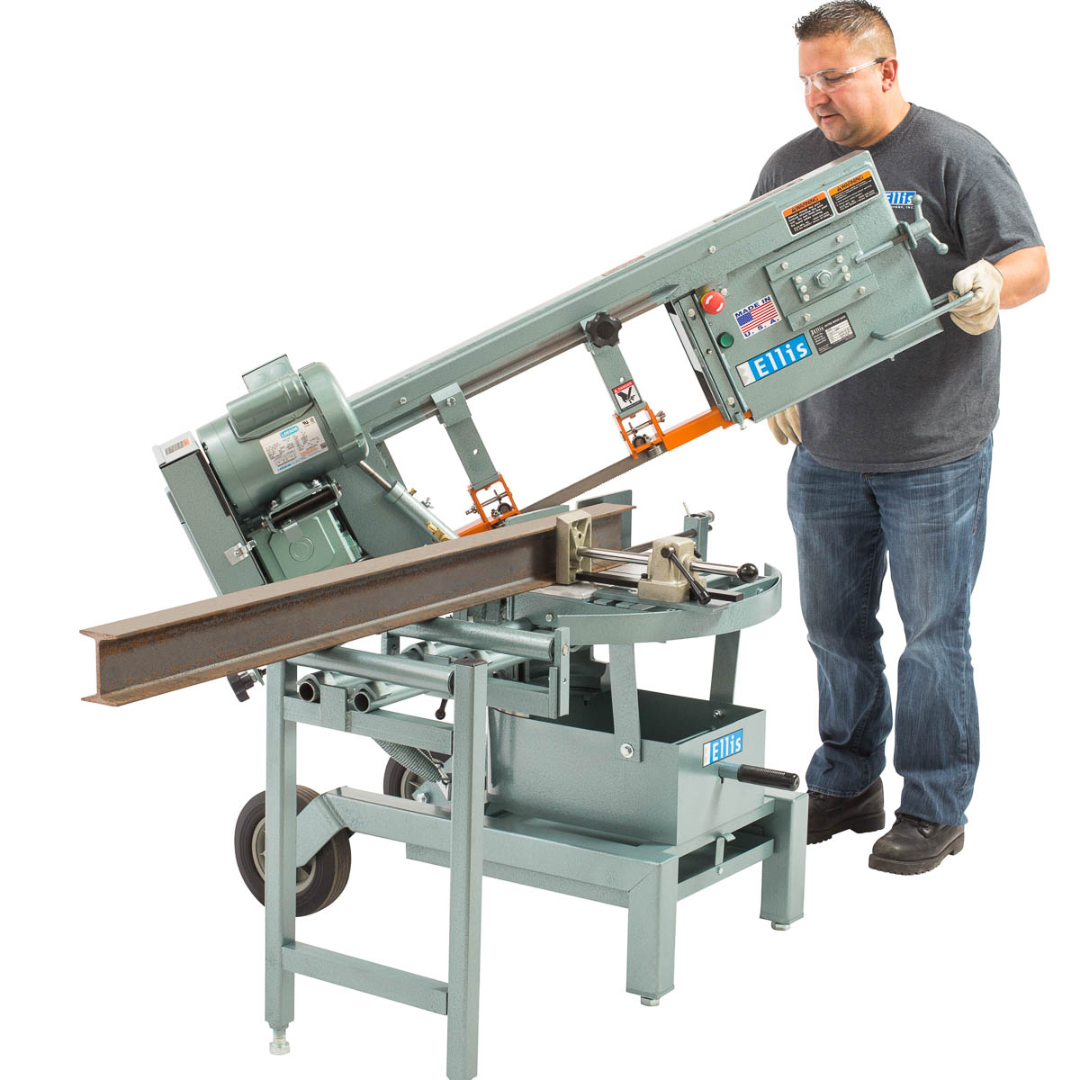
- Dual-position mitre band saws (like the Ellis series) convert between horizontal and vertical orientations. They also rotate their heads for angle cuts. These are the most versatile option for shops that need precision mitre capability alongside standard horizontal sawing.
Blades for metal-cutting band saws are made from bi-metal (high-speed steel teeth welded to a flexible alloy back), carbide-tipped, or carbon steel. Bi-metal is the industry workhorse. Carbide tips are preferred for hardened steels and very hard materials.
What Is a Chop Saw? (And What Type Do You Actually Need?)
The term "chop saw" is used loosely in the industry. It covers at least three meaningfully different machines. Before choosing between a bandsaw vs chop saw, it's worth knowing which type of chop saw the comparison actually applies to:
Abrasive Chop Saw (Cutoff Saw)
This is the most common and least expensive type. It uses a bonded abrasive disc (similar to a large grinding wheel). The disc spins at very high RPMs, typically 3,450 to 5,000 RPM, to grind through steel bar stock, angle iron, and tube. It is fast, loud, and inexpensive. But it throws a significant shower of sparks and produces heat that can work-harden cut edges. It also leaves a rough, slightly tapered kerf that usually needs cleanup before welding. It is not suitable for aluminum or non-ferrous metals, because the abrasive disc can load up and shatter. OSHA's machine guarding standard requires guarding against hazards such as flying chips and sparks.

Cold Saw
A cold saw uses a toothed circular blade, typically made of high-speed steel (HSS) or tungsten carbide. The blade rotates at very low RPMs (15–120 RPM). The slow speed and large blade diameter generate almost no heat at the cut. Chips carry away the heat rather than transferring it to the workpiece, hence the name. Cold saws deliver a burr-free, square cut with a tight kerf. They're the professional standard for steel bar stock and structural profiles when cut quality matters. The cycle time per cut is slower than abrasive types, but zero cleanup is required.
Carbide Double-Mitre Chop Saw
The most precise and most productive category. These machines use large-diameter carbide-tipped circular blades and programmable heads that cut compound angles simultaneously. They're the industry standard for aluminum extrusion, curtain wall profiles, door and window frames, and structural aluminum — any application where precision length and angle repeatability at high volume is required. Machines like the OMGA TR series can hold tolerances within fractions of a millimeter across thousands of cuts per shift.
Metal Band Saw vs Chop Saw: Full Comparison
| Factor | Metal Band Saw | Abrasive Chop Saw | Cold Saw / Carbide Chop Saw |
|---|---|---|---|
| Cut Speed | Moderate (30 sec–5 min per cut, material dependent) | Fast (5–30 seconds per cut) | Moderate–Fast (30 sec–2 min; no cleanup needed) |
| Cut Quality | Clean, near-square; minimal burr on bi-metal blades | Rough, slightly tapered; grinding cleanup typically required | Excellent — burr-free, square, weld-ready |
| Heat Generated | Low — slow blade speed keeps the cut cool | High — sparks and heat-affected zone on cut edge | Very low — chips carry heat away from workpiece |
| Sparks / Debris | Fine chips; minimal spark | Heavy spark shower; abrasive dust | Chips only; no sparks |
| Material Range | Steel, stainless, aluminum, cast iron, pipe, structural profiles | Ferrous metals only (steel, iron) — not aluminum | Steel, stainless, aluminum, brass, copper, non-ferrous profiles |
| Section Capacity | Up to 17"+ (Ellis 2000), handles round, square, structural | Typically 3"–4" bar stock; limited structural capacity | Up to 22" flat / 13.5" round (professional double-mitre) |
| Mitre / Angle Cuts | Yes — head rotates on dual-position models | Limited — fixed or manual swing head, single bevel only | Yes — compound double-mitre capability on professional saws |
| Coolant / Lubrication | Flood coolant recommended for ferrous metals | None — incompatible with abrasive disc | Built-in coolant system on cold saws and professional chop saws |
| Noise Level | Moderate — steady blade hum | Very loud — high-pitch disc grinding | Moderate — lower RPM means quieter operation |
| Blade / Consumable Cost | $20–$120 per bi-metal blade; long life with coolant | $5–$15 per abrasive disc; frequent replacement | $150–$600+ per carbide blade; very long life |
| Typical Price Range | $1,000–$8,000+ (professional models) | $150–$800 | $3,000–$65,000+ (double-mitre, professional CNC models) |
| Best For | Structural steel, pipe, high-capacity ferrous and non-ferrous cutting | Quick rough cuts on steel bar stock; budget-conscious shops | Aluminum extrusion, precision profiles, high-volume repeatable cuts |

When to Choose a Metal Band Saw
A metal band saw — whether horizontal, vertical, or dual-position — is the right choice when:
- You're cutting structural steel, pipe, tube, or I-beams. Band saws handle large cross-sections and irregular profiles that chop saws simply can't reach. A dual-position mitre band saw like the Ellis 1600 can cut round stock up to 10" in diameter. It also easily handles structural angles and channels.
- Cut quality matters for downstream work. Band saw cuts require little to no cleanup for welding or further machining. The low-speed blade leaves a smooth, consistent kerf that an abrasive chop saw cannot match.
- You need odd angles on large material. Dual-position mitre band saws rotate their heads through compound angles. This is invaluable for structural fabrication, handrail work, and custom metalwork.
- You're cutting a range of materials. With the right blade, a metal band saw will cut mild steel, stainless steel, aluminum, cast iron, brass, and copper without machine swaps. Abrasive chop saws are ferrous-only.
- Long-run blade economics matter. A single bi-metal blade on a flood-cooled band saw can make thousands of cuts. Abrasive discs wear out rapidly and must be replaced frequently.
- You cut in vertical position for contours and shapes. Dual-position saws convert to vertical mode for notching, freehand shapes, and cuts that require guiding the workpiece. A chop saw can't do that at all.

When to Choose a Chop Saw
A chop saw — whether abrasive, cold saw, or carbide double-mitre — is the right choice when:
- Cycle time is the priority on standard bar stock. Abrasive chop saws and cold saws make crosscuts in seconds on common steel profiles. For a shop doing dozens of identical cuts per day on 1"–3" round bar or flat stock, a chop saw's throughput is hard to beat.
- You need compound mitre accuracy at high volume. CNC double-mitre chop saws like the OMGA TR series can produce hundreds of precision angle cuts per hour to within a fraction of a millimeter. This is impossible to match with a band saw at the same throughput.
- You're cutting aluminum extrusions, profiles, or window/door framing. A carbide-tipped double-mitre chop saw is the industry standard for aluminum fabrication shops. The cut is clean, cool, and burr-free. Band saws also cut aluminum well, but can't match the repeatability of a CNC mitre saw at production speed.
- Portability matters. Abrasive chop saws and some cold saws are compact and movable. This is useful on a job site or in a shop with limited floor space. Professional band saws are fixed-installation machines.
- You're on a tight budget for occasional steel cutting. An abrasive chop saw at $200–$500 is pragmatic for a small welding shop that makes rough steel cuts a few times a day. It's not precise, but it works for tack-welded structural work.

Cutting Aluminum: Band Saw or Chop Saw?
Aluminum deserves its own discussion because it behaves very differently from steel. The choice of tool matters more than most fabricators initially realize.
Never cut aluminum with an abrasive chop saw. Aluminum loads up in the abrasive matrix of the disc. This causes the disc to become unbalanced and potentially shatter catastrophically. This is a serious safety hazard, not just a quality issue.
For aluminum cutting, you have two good options:
Metal Band Saw for Aluminum
A metal band saw cuts aluminum cleanly and efficiently with a carbide or bi-metal blade set to the correct speed (typically 200–350 SFPM for aluminum). Flood coolant or mist lubrication prevents aluminum from welding onto the blade teeth. Band saws are especially good for solid aluminum bar, plate, and irregular shapes. Band saws with a speed range let you dial in the cutting speed. One example is the variable-speed Ellis 3000 (60–190 FPM). The three-speed Ellis 1600, 1800 and 2000 top out at 230 FPM, so check the speed range against your alloy.
Carbide Chop Saw for Aluminum Profiles
A carbide double-mitre chop saw is the industry-preferred solution for aluminum extrusions, curtain wall components, anodized profiles, and window or door frames. The carbide blade produces a shear-cut at low RPMs. This leaves a mirror-finish surface requiring no deburring. CNC double-mitre saws like the OMGA TR 2A and TR 2B series add programmable angle control, pneumatic clamping, and chip evacuation. This gives full production-line capability.

Metal Band Saw vs Chop Saw: Models Compared
This table lines up the metal band saws from our store that the picks below cover. For the Metal Band Saw vs Chop Saw decision, check the Key feature column first. Look there for capacity and cut style.
| Model | Price | Key feature | Best for |
|---|---|---|---|
| Ellis 1800 Mitre Band Saw – Horizontal & Vertical Metal Cutting, 14″ Capacity | $5,995.00 | Horizontal and vertical metal cutting with 14 inch capacity | Metal jobs that need mitre cuts |
| Ellis 3000 Mitre Band Saw - 13-1/2" Round Capacity, 2 HP, Variable Speed Shorter (still strong) | $6,795.00 | 13-1/2 inch round capacity, 2 HP, variable speed | Round metal cutting in a shorter but still strong saw |
| RIKON 15-400 4" x 6" Horizontal Metal Cutting Bandsaw | $699.99 | 4 x 6 inch capacity, 80, 120 and 180 feet per minute | Cutting anything from brass alloys up to stainless |
| Baileigh BSV-18VS-V2 - Vertical Band Saw 1230389 | $8,663.00 | Variable speed with an 18 inch throat capacity | Fabrication facilities and machine shops needing precision |
Use the capacity and speed details to match a saw to your material and cut style. Then weigh that against what a chop saw would handle for the same job.
Metal Band Saw Picks for a Fabrication Shop
Choose from the metal band saws below. They are all from our store and cover the band saw side of this comparison. Check your material, capacity and how often you cut mitres before you pick a size.
1. Ellis 1800 Mitre Band Saw – Horizontal & Vertical Metal Cutting, 14″ Capacity — $5,995.00
This mitre band saw does both horizontal and vertical metal cutting. It has a 14 inch capacity. It gives a fab shop square and mitred cutoffs plus some freehand work on one machine. View more >
2. Ellis 3000 Mitre Band Saw - 13-1/2" Round Capacity, 2 HP, Variable Speed Shorter (still strong) — $6,795.00
Variable speed and a 2 HP motor set this mitre band saw apart. It has a 13-1/2 inch round capacity. It is a sensible step up for shops that cut different metals and need to adjust the speed. View more >
3. RIKON 15-400 4" x 6" Horizontal Metal Cutting Bandsaw — $699.99
This 4 inch by 6 inch horizontal bandsaw has blade speeds of 80, 120 and 180 feet per minute. They cover brass alloys up to stainless steel. Miter cuts reach 45 degrees, so it can stand in for a small chop saw. View more >
4. Baileigh BSV-18VS-V2 - Vertical Band Saw 1230389 — $8,663.00
This vertical band saw is made for curves and contours. It has an 18 inch throat capacity and variable speed for fabrication shops and machine shops. A chop saw cannot do this work. View more >
Band Saw Blade Selection Guide
Getting blade selection right makes a bigger difference to cut quality and tool longevity than any other variable on a metal band saw. Here's a quick-reference guide:
| Material | Recommended Blade Type | TPI (Teeth Per Inch) | Speed (SFPM) |
|---|---|---|---|
| Mild Steel (solid) | Bi-metal | 4–6 TPI | 130–200 |
| Mild Steel (tube / thin wall) | Bi-metal | 10–14 TPI | 150–250 |
| Stainless Steel | Bi-metal or Carbide-tip | 6–10 TPI | 75–130 |
| Tool Steel / Hardened Steel | Carbide-tipped | 3–6 TPI | 50–100 |
| Aluminum (solid) | Bi-metal with hook tooth | 2–4 TPI | 200–350 |
| Aluminum (extrusion / thin wall) | Carbide-tip | 10–14 TPI | 250–400 |
| Cast Iron | Carbide-tipped | 4–6 TPI | 75–130 |
| Copper / Brass | Bi-metal | 6–10 TPI | 150–300 |
The general rule: the thinner the wall or section, the more teeth need to be engaged at the same time. A 4 TPI blade on thin-wall tube will strip teeth. A 14 TPI blade on solid 6" bar will clog and overheat. When in doubt, lean toward more teeth on thinner sections and fewer teeth on solid material.

Do Professional Shops Use Both?
In most production metal fabrication environments, the answer is yes. There is good reason for this. A metal band saw and a chop saw are basically complementary tools, not competitors for the same job. For production cutting, see our guide to the best industrial horizontal band saw.
A typical layout in a structural steel fab shop might include a horizontal band saw for cut-to-length work on beams, columns, pipe, and bar stock. It produces clean, square cuts that go straight into the welding fixture with no grinding. Alongside it, a cold saw or carbide chop saw handles the high-volume crosscuts on lighter profiles and bar ends. These are cuts where cycle time matters more than kerf quality.
In an aluminum fabrication shop (windows, doors, curtain wall), the balance shifts. A double-mitre CNC chop saw handles 80–90% of the cutting volume at production speed. A band saw handles special shapes, thick solid stock, and cuts the chop saw can't reach geometrically.
Understanding which tool owns each cutting operation in your workflow is the key to making the right investment decision. It often shows that the right answer isn't "band saw or chop saw" but "which band saw and which chop saw."
How to Choose Between a Metal Band Saw and a Chop Saw
Decide by the stock you cut and how many cuts you make. Then match the saw to it.
- Structural steel, pipe, tube and I-beams: choose a metal band saw. The Ellis 1800 cuts horizontally and vertically with a 14 inch capacity. So it gives square and mitred cutoffs plus some freehand work on one machine.
- Different metals that need different speeds: the Ellis 3000 adds variable speed and a 2 HP motor with a 13-1/2 inch round capacity.
- A small chop saw replacement on a budget: the RIKON 15-400 costs $699.99. It has blade speeds of 80, 120 and 180 feet per minute and miter cuts that reach 45 degrees.
- Curves and contours: a chop saw cannot do this work. The Baileigh BSV-18VS-V2 has an 18 inch throat capacity and variable speed.
- Cycle time on standard bar stock: if you make dozens of identical cuts a day on 1 inch to 3 inch round bar, a chop saw fits better.
Frequently Asked Questions
What is the main difference between a metal band saw and a chop saw?
A metal band saw uses a continuous looped blade moving at low speed (50–350 SFPM). It slices through metal with minimal heat and a clean, consistent kerf. A chop saw uses a rotating disc or blade that plunges downward through the workpiece in a single stroke. Band saws excel at large cross-sections, pipe, and varied materials. Chop saws excel at fast, repeatable crosscuts on bar stock and profiles. The two tools are often complementary rather than interchangeable.
Can a chop saw replace a band saw for metal cutting?
Not entirely. An abrasive chop saw is limited to roughly 3"–4" capacity on ferrous metals. It can't handle aluminum safely, and it leaves a rough cut. A cold saw or carbide chop saw is more precise. But it is still limited by the blade's plunge depth and the workpiece's geometry. They can't handle pipe, odd shapes, or contour cuts the way a band saw can. For shops cutting structural steel, large round bar, or a variety of material types, a band saw covers applications that no chop saw can match.
Which is better for cutting steel — a band saw or a chop saw?
It depends on the section size and the cut quality required. A cold saw is fast and efficient for mild steel bar and tube under 3" in diameter when a quick rough cut is acceptable. A metal band saw is the superior tool for larger sections, structural profiles, or applications requiring a clean weld-ready cut with minimal cleanup. For precision compound mitre cuts at high volume, a cold saw or carbide double-mitre saw wins on throughput. Most production shops use both.
Can both a band saw and a chop saw cut aluminum?
A metal band saw and a carbide chop saw can both cut aluminum safely and effectively with the right blade and speed settings. However, an abrasive chop saw should never be used on aluminum. The aluminum loads into the abrasive matrix and can cause the disc to shatter. For aluminum extrusions and profiles, a carbide double-mitre chop saw is typically preferred because of its precision and cycle speed. For solid aluminum bar and plate, a band saw with a carbide or hook-tooth bi-metal blade set to 200–350 SFPM is excellent.
What is a cold saw, and how does it differ from a standard chop saw?
A cold saw uses a toothed circular blade made of high-speed steel (HSS) or carbide. It rotates at very low RPMs (15–120 RPM). The slow speed means chips carry heat away from the cut. This leaves both the workpiece and the blade cool. It produces a burr-free, square, weld-ready cut. A standard abrasive chop saw spins much faster, generates significant heat and sparks, and leaves a rougher cut surface. Cold saws cost considerably more than abrasive chop saws. But they eliminate cleanup time and produce higher quality results.
What TPI blade should I use in a metal-cutting band saw?
The rule of thumb is to keep at least 3 teeth engaged in the material at all times. For solid bar and structural steel, 4–6 TPI is typical. For thin-wall tube and hollow profiles, 10–14 TPI prevents blade snagging and tooth stripping. Aluminum uses coarser blades (2–4 TPI) with hook geometry to clear chips. For stainless or hardened tool steel, carbide-tipped blades in the 6–10 TPI range provide the best results at reduced speeds (75–130 SFPM).
Related Reading
- Types of Band Saws: Horizontal, Vertical, and Mitre Explained
- Band Saw vs Circular Saw: When to Reach for Each Tool
- Ellis Band Saw Comparison: 1100, 1200, 1500, 1600, 1800, 2000, 3000, 4000
- Best Vertical Band Saws for Metalworking: Top Picks for Fabrication Shops
- Best Industrial Horizontal Band Saw: Top Picks for Metal Fabrication Shops
Find Your Metal Band Saw or Chop Saw at Iron Line Tools
Iron Line Tools lists professional metal-cutting band saws and double-mitre chop saws from Ellis, Baileigh, OMGA, and more. They are backed by expert support and factory-direct pricing.
Shop Metal-Cutting ToolsConclusion
A metal band saw and a chop saw both cut metal but work differently. So choose by your material, the cuts you make and the shop you run. Looking for the right fit? Start with our metal band saws and narrow it down by size and price.
Chop saw or band saw for your fabrication shop?
Consult our team on cutting aluminum, blade selection and production demands to find your fit.