

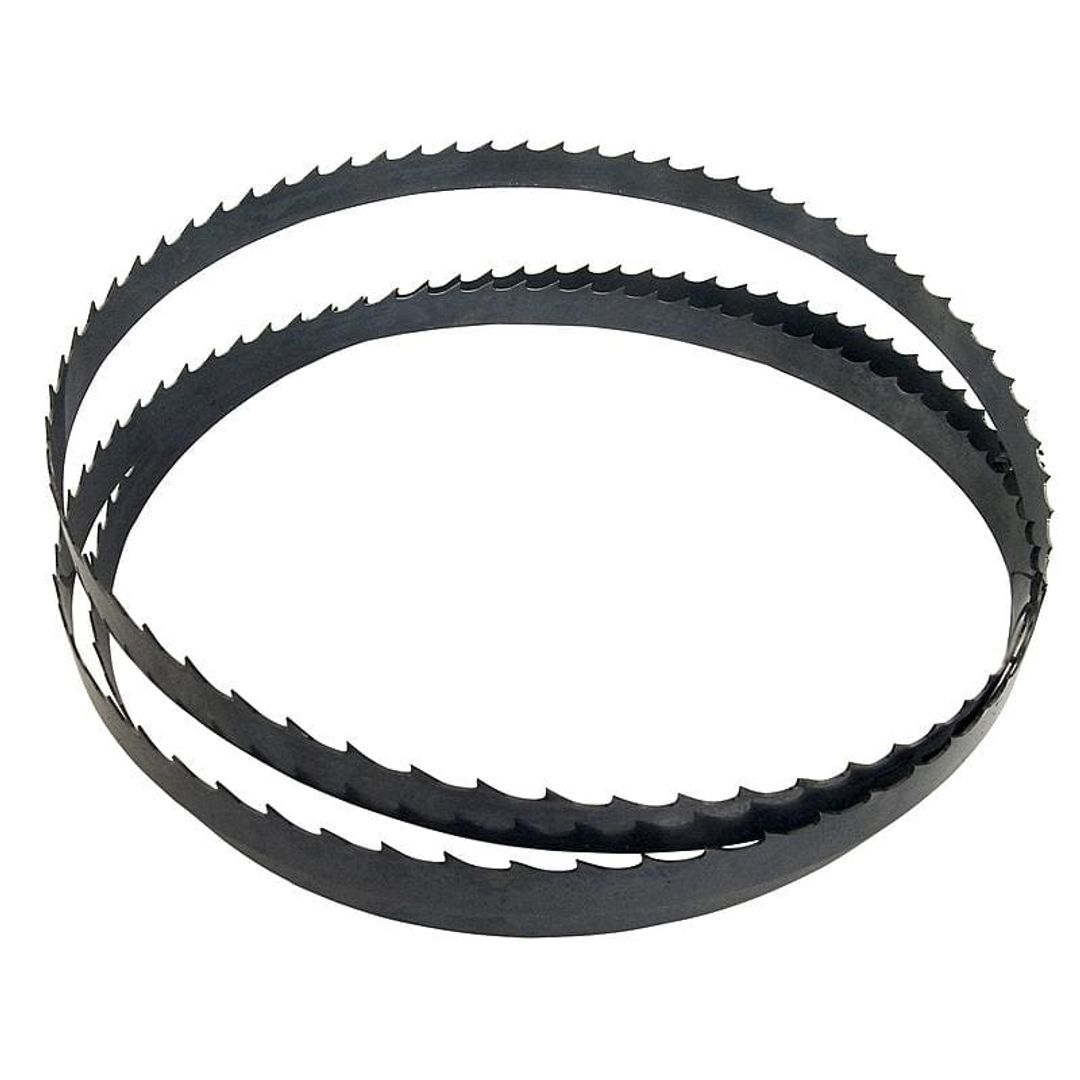
Bandsaw Blade Selection Guide: Width, TPI, and Pitch for Woodworking
This bandsaw blade selection guide shows you how to pick the right blade for your saw and your cuts. You will learn the woodworking band saw blade width guide, how to read TPI, and how pitch changes the cut. Ready to shop? Browse our full range of bandsaw blades for every 14-inch and 18-inch woodworking saw.

Quick Answer
The right bandsaw blade is the widest one your cut allows, with at least 3 teeth in the thickness of the wood. Use 1/4" at 6 TPI for general curves, 1/2" at 3 TPI for general ripping, and 3/4" or wider at 2-3 TPI for resawing.
In This Guide
- The Five Specs in Any Bandsaw Blade Selection Guide
- Step 1: Match the Blade Length to Your Saw
- Woodworking Band Saw Blade Width Guide
- Band Saw Blade TPI Guide for Woodworking
- Band Saw Blade Pitch Guide for Woodworking Cuts
- Blade Material and Thickness
- Best Bandsaw Blade by Woodworking Job
- Bandsaw Blade Width and TPI Compared
- Our Bandsaw Blade Picks
- Common Blade Selection Mistakes
- How to Choose: A 4-Question Checklist
- Frequently Asked Questions
- Conclusion
Featured Bandsaw Blades

RIKON
RIKON 19-1210 124" x 1/4" 025 x 6TPI Reg Blade All-Pro
$54.99
Regular tooth, 124 inch long and 1/4 inch wide with 6 TPI, the 19-1210 All-Pro matches the width and TPI this guide suggests for general curves. Check that your saw takes a 124 inch length first.

RIKON
RIKON 19-1212 124" x 1/2" x 025 3 TPI Hook Blade All-Pro
$44.99
Ripping is the job for a 1/2 inch blade at 3 TPI, and this 19-1212 All-Pro hook blade follows that rule in a 124 inch length. Confirm the length against your saw before you order.

RIKON
RIKON 19-1214 124" x 3/4" 032 3 TPI Hook Blade All-Pro
$44.99
At 3/4 inch wide with 3 TPI, this All-Pro hook blade falls in the range the guide gives for resawing. It is cut to 124 inch for 14 inch and similar saws. Check your saw's blade length first.

RIKON
RIKON 19-1905 176" x 1" x .035" x 2TPI Hook Blade
$69.99
Widest of the group, the 19-1905 is a 176 inch hook blade, 1 inch wide, with 2 TPI. It fits the guide's advice to run a wide blade at low TPI for deep resaw cuts. Only order it if your saw takes a 176 inch blade.
The Five Specs in Any Bandsaw Blade Selection Guide
Every bandsaw blade is defined by five specs: length, width, thickness, teeth per inch (TPI), and tooth shape. Get the first two wrong and the blade will not fit or track. Get the last three wrong and the cut will burn, wander, or tear out.
Start with the job, not the blade. Curves, straight rips, and resawing each call for a different setup. This guide walks through each spec in order, then pulls it together in a quick-pick table.
Step 1: Match the Blade Length to Your Saw
Blade length is fixed by your saw. Check the manual, the label on the frame, or the manufacturer website. A 14-inch saw often takes a 93-1/2" or 111" blade, but models differ, so always confirm your exact length.
Use the same loop length your saw was built for. A wrong length will not tension correctly. Browse our bandsaw blades once you know your number.

Woodworking Band Saw Blade Width Guide
Blade width is measured across the blade from the tooth tip to the back edge. This woodworking band saw blade width guide comes down to one rule: use the widest blade that still turns the tightest curve in your project.
Wide blades for straight cuts and resawing
Wide blades resist twisting and track straight. Use 1/2" to 1" for ripping and resawing. Wide blades also hold tension better, which gives cleaner faces on thick boards.
Narrow blades for curves
Narrow blades turn tighter. A 1/8" blade can cut a very small circle, but it flexes and drifts in straight cuts. Choose the narrowest blade only when the curve demands it. Lee Valley notes that narrower blades cut tighter curves, while wider blades deflect less.

Choosing band saw blade width for woodworking projects
When choosing band saw blade width for woodworking projects, measure the smallest radius in your design. Then pick the widest blade that fits it from the table below.
| Blade Width | Smallest Radius It Can Cut | Best Use |
|---|---|---|
| 1/8" | 3/16" | Tight scrollwork and small parts |
| 3/16" | 5/16" | Fine curves in thin stock |
| 1/4" | 5/8" | General curves and light joinery |
| 3/8" | 1-7/16" | Gentle curves and mixed work |
| 1/2" | 2-5/8" | General ripping and large curves |
| 5/8" | 4" | Straighter cuts and light resaw |
| 3/4" | 5-1/2" | Resawing and straight rips |


Band Saw Blade TPI Guide for Woodworking
TPI means teeth per inch. This band saw blade TPI guide for woodworking is built on one rule: keep at least 3 teeth in the wood at all times. Fewer teeth than that and the blade will snag and chatter.
What TPI band saw blade for woodworking?
So what TPI band saw blade for woodworking should you buy? Here is the short answer by stock thickness and job.
| Job | Recommended TPI | Why |
|---|---|---|
| Resawing thick hardwood | 2-3 TPI | Big gullets clear sawdust and keep the blade cool |
| General ripping and crosscutting | 3-4 TPI | Fast cuts with a decent surface |
| General curves | 6 TPI | Smooth enough for most furniture parts |
| Fine curves and thin stock | 10-14 TPI | Cleaner edges, slower feed |
| Plywood and panels | 10 TPI or higher | Reduces chipping on veneer |
More teeth give a smoother cut but clog faster in thick wood. Fewer teeth cut faster but leave a rougher edge. Match the TPI to the thickest board you will cut with that blade.


Band Saw Blade Pitch Guide for Woodworking Cuts
Pitch is the distance from one tooth tip to the next. It is the flip side of TPI: a 3 TPI blade has a pitch of about 1/3". This band saw blade pitch guide for woodworking cuts also covers tooth shape, because shape changes how the pitch behaves.
Regular tooth
Regular teeth are evenly spaced with a 0° rake. They cut smoothly and handle curves well, so they suit finer work and veneered or thin stock.
Skip tooth
Skip blades leave out every other tooth, which gives wide gullets. They clear dust well in softwood and general cuts, and the 0° rake keeps the cut controlled.
Hook tooth
Hook teeth have an aggressive rake of about 10°. They bite fast in thick hardwood and resawing, but can leave a rougher surface.
Variable pitch
Variable pitch blades mix tooth sizes. This cuts vibration and noise, so it is a good pick when finish quality matters.


Blade Material and Thickness
Carbon steel blades are affordable and work well for most home shops. Bi-metal blades last longer, which pays off in frequent ripping. Carbide-tipped blades cost more but hold an edge through hard, dense, or abrasive wood.
Thickness matters too. A thinner blade bends around a small wheel more easily. A thicker blade stays straighter in resawing but needs a larger wheel. Always match thickness to your wheel size.


Best Bandsaw Blade by Woodworking Job
| Woodworking Job | Width | TPI | Tooth Style |
|---|---|---|---|
| Tight scrollwork | 1/8"-3/16" | 10-14 | Regular |
| General curves | 1/4" | 6 | Skip or regular |
| General ripping | 1/2" | 3 | Hook |
| Resawing | 3/4" or wider | 2-3 | Hook or carbide |
| Plywood | 1/4"-3/8" | 10+ | Regular |
Use this table as a starting point. If a cut burns, add teeth or slow the feed. If it bogs down, drop the TPI.
Bandsaw Blade Width and TPI Compared
Here are the bandsaw blades from our store that the picks below cover, lined up in one table. Start with blade width in the Key feature column, since the guide says to use the widest blade your cut allows.
| Model | Price | Key feature | Best for |
|---|---|---|---|
| RIKON 19-1101 111" x 3/16" 025 10 TPI Reg Blade | $55.99 | Fine 10 TPI regular teeth on a 3/16 inch wide, 111 inch blade | Tight curves and fine detail cuts in thinner wood |
| RIKON 19-1100 111" x 1/4" 025 6 TPI Skip Blade | $55.99 | 6 TPI skip tooth blade, 1/4 inch wide | Regular curved cuts in general woodworking projects |
| RIKON 19-1103 111" x 1/2" 025 3 TPI Hook Blade | $34.99 | Wider 1/2 inch blade with hook teeth at 3 TPI | General ripping through thicker woodworking lumber |
| RIKON 19-1106 RESAW PRO 111" x 3/4" x .035" x 3 TPI Carbide Tipped PRO-CT Bandsaw Blade | $149.99 | Carbide tips on a wide 3/4 inch blade made for resawing | Resawing wide boards into thinner pieces |
| Laguna ProForce Bandsaw Blade, 1/4'' x 115'', 6 TPI BBPF-14-14-115 | $49.99 | Hand-finished 115 inch blade with a precision welded joint | Intricate shaping and contour work in hardwood or softwood |
Match the width and TPI in the Key feature column to the curve or thickness of your cut, then confirm the blade length fits your saw.
Our Bandsaw Blade Picks
These are blades that match the jobs above. Check the loop length against your saw before ordering. Prices are current as of this post.
1. RIKON 19-1101 111" x 3/16" 025 10 TPI Reg Blade — $55.99
A fine blade for tight curves and thin stock. Pick it when smooth edges matter more than speed. View more >
2. RIKON 19-1100 111" x 1/4" 025 6 TPI Skip Blade — $55.99
Our go-to general curve blade. The skip tooth clears dust well in everyday woodworking. View more >
3. RIKON 19-1103 111" x 1/2" 025 3 TPI Hook Blade — $34.99
A budget-friendly ripping blade with a hook tooth for fast, straight cuts. View more >
4. RIKON 19-1106 RESAW PRO 111" x 3/4" x .035" x 3 TPI Carbide Tipped PRO-CT Bandsaw Blade — $149.99
A carbide-tipped resaw blade for thick hardwood. It costs more but stays sharp far longer. View more >
5. Laguna ProForce Bandsaw Blade, 1/4'' x 115'', 6 TPI BBPF-14-14-115 — $49.99
A 115" blade for saws that take that length, with a 6 TPI tooth for general curves. View more >
Common Blade Selection Mistakes
Most blade problems come from a few repeat mistakes.
- Using one blade for every task. A single general blade is a compromise on all of them.
- Thinking more teeth always means a cleaner cut. Too many teeth clog and burn in thick wood.
- Blaming the blade when the real problem is a dull edge or bad tension.
- Ignoring wheel size when picking blade thickness.
How to Choose: A 4-Question Checklist
Run through these four questions before you buy:
- What is my saw's blade length?
- What is the smallest curve I will cut?
- How thick is the stock?
- Do I need speed or a smooth finish?
Answer those and the right blade is easy to find. Shop all bandsaw blades to filter by size.
Frequently Asked Questions
What is the best bandsaw blade for woodworking?
There is no single best blade. A 1/4" 6 TPI blade is a good general choice, while 1/2" at 3 TPI handles most ripping. Pick by job.
What TPI should I use for resawing?
Use 2-3 TPI with a wide blade of 3/4" or more. The big gullets clear sawdust from tall cuts.
What blade width should I use for curves?
Use the widest blade that can turn your smallest radius. A 1/4" blade handles a radius of about 5/8".
What is the difference between hook and skip tooth blades?
Hook blades have an aggressive 10° rake for fast cuts in thick wood. Skip blades have a 0° rake and wide gullets for smoother, controlled cuts.
How do I know what size blade fits my band saw?
Check your manual or the label on the frame for the blade length. Width depends on what your saw can tension.
How often should I change my bandsaw blade?
Replace it when it burns the wood, drifts, or needs extra pressure to cut. Keep a spare for your most-used size.
Conclusion
Good bandsaw blade selection comes down to length, width, TPI, and tooth shape matched to the job. Use the widest blade that fits your curve, keep three teeth in the cut, and choose the tooth style for the wood. When you are ready, shop our bandsaw blades and pick the right one for your saw.
Safety and standards references: OSHA woodworking eTool: band saws and OSHA 1910.213 woodworking machinery requirements.
Explore the category: Band Saws. Related collections: Metal Cutting Bandsaw Blades.
Related Reading
- Types of Bandsaw Blades: Hook Tooth vs Skip Tooth vs Regular
- How to Use a Band Saw: Complete Guide to Setup, Cuts, and Technique
- Best Band Saw for Woodworking in 2026
- Best Stationary Wood Band Saws for Resawing Thick Lumber: Top Picks
- How to Set Up a Stationary Band Saw for Accurate Woodworking Cuts
- Signs That It Is Time to Replace Your Band Saw Blade
Is your blade width right for your curves?
Our team can check length, pitch and thickness against your 14 inch or 18 inch machine.