

Best Resaw Band Saws for Woodworking Shops
If you want smooth, consistent boards from wide slabs of hardwood, you need the right machine for the job. The best resaw band saws for woodworking shops combine high resaw capacity, rigid frames, and powerful motors to slice through 10" or more of figured maple, walnut, or cherry without deflection or blade drift. Whether you're resawing bookmatched panels, slicing your own veneers, or breaking down rough lumber, our resaw band saws range from capable 14" floor models to dedicated 18" professional machines built specifically for high-volume resaw work.

Quick Answer
The best resaw band saws for woodworking shops are floor-standing 14" to 18" machines with at least 13" of resaw capacity, a rigid frame, precision blade guides, and a motor of 1.5 HP or more. For wide-slab production work, the Laguna LT18 Resaw Master (18" resaw capacity, 5 HP) and the Laguna 18|BX (16" resaw capacity, 3 HP) are the top choices. For smaller shops doing occasional resawing, the RIKON 10-342EVS and Laguna 14|CX (both 13" resaw capacity) deliver outstanding results.
In This Guide
- › What Makes a Band Saw Good for Resawing?
- › Best Resaw Band Saws at a Glance
- › Our Top Picks for Resaw Band Saws
- › How to Choose the Right Resaw Band Saw for Your Woodworking Shop
- › Choosing the Right Blade for Resawing
- › 14" vs 18" Band Saws for Resawing
- › Setting Up Your Band Saw for a Perfect Resaw
- › Best Resaw Band Saws by Budget
- › Watch: How to Resaw Big Wood on a Band Saw
- › Frequently Asked Questions
- › Conclusion
What Makes a Band Saw Good for Resawing?
Resawing means ripping lumber on its edge to reduce its thickness or slice it into two or more thinner boards. It's one of the most demanding cuts a band saw makes because the blade must maintain a straight kerf through the full height of a board, often 6", 10", or even 14" of dense hardwood, in a single continuous pass. Not every band saw is up to that task.
The machines that handle resaw work best share four key traits: enough throat depth and resaw height to handle the stock you're cutting, a motor with enough HP to push through dense hardwood without bogging down, precision blade guides that hold the blade firmly on its path, and a heavy frame that doesn't flex under lateral load. Miss any one of these and your boards come out with washboard surfaces, variable thickness, or severe drift that makes every cut a correction exercise.
Resaw Height and Throat Depth
Resaw height is the maximum board thickness the saw can handle in a single pass. Throat depth is the distance from the blade to the vertical column, which limits how wide a board you can run through. These two specs together define the maximum workpiece the machine can process. The 14" saws in this guide list 13" of resaw capacity (the RIKON 10-1414 lists 14"), while the Laguna 18" saws list 16" (18|BX and 18|CX) and 18" (LT18).
Motor Horsepower
Resawing tall, dense stock demands sustained power. A saw that handles 2" oak easily might bog down or stall cutting 8" maple at the same feed rate. The rule of thumb: at least 1.5 HP for 14" resaw work in hardwood, and 2 HP or more for production resawing of wide stock. Electronic variable speed adds flexibility, letting you dial back speed for harder species and push faster through softer wood.
Blade Guide System
Guides that hold the blade laterally and prevent twist are what separate a resaw machine from a general-purpose band saw. Ceramic guides, Euro-style guides, and cool-block systems all keep the blade tracking straight. The guide adjustment range matters too — guides that can't be set close enough to the blade allow wobble that shows up as ridges in the cut face.
Frame Mass and Vibration
Cast iron wheels and a heavy, rigid frame damp the vibration that sends a blade off course during long resaw cuts. Lightweight benchtop band saws vibrate under load. Floor-standing models with enclosed bases stay planted and transmit far less chatter to the blade.

Best Resaw Band Saws at a Glance
Use this table to compare the top resaw band saws in our lineup by price, motor, resaw capacity, and best application. All machines are floor-standing saws suitable for resaw work.
| Model | Price | Motor | Resaw Capacity | Best For |
|---|---|---|---|---|
| Laguna LT18 Resaw Master | $6,699 | 5 HP | 18" | Production shop, wide slabs |
| Laguna 18|CX Bandsaw | $4,899 | 1.75 HP (110V) | 16" | Serious woodworker, premium build, 110V power |
| RIKON 10-342EVS 18" EVS | $3,499.99 | 2.5 HP (220V) | 13" | Variable-speed resawing, mixed species |
| Laguna 18|BX Bandsaw | $3,299 | 3 HP (220V) | 16" | Value 18" for mid-size shops |
| Laguna 14|CX Bandsaw | $2,999 | 1-3/4 HP (110V) | 13" | Premium 14" with electronic variable speed |
| Maksiwa SF.35.MI 14" Bandsaw | $2,399 | 1-3/4 HP | Not listed | Cast iron wheels and table, mid-size shop |
| Laguna 14|BX Bandsaw | $2,149 | 1.75 HP (110V) / 2.5 HP (220V) | 13" | Solid 14" for occasional resaw |
| RIKON 10-1414 14" 2-Speed | $1,699.99 | 1-3/4 HP | 14" | Two-speed 14" with micro-adjust drift fence |
| Laguna 14|12 Bandsaw | $1,699 | 1.75 HP | 13" | 13" resaw capacity on a 14" frame |
| RIKON 10-324TG 14" Tool-Less | $1,199.99 | 1.5 HP | 13" | Entry-level, tool-less blade guides |
Prices, motor ratings, and Laguna specs come from our product pages. Resaw capacity for the RIKON saws is from RIKON's published specifications for the 10-342EVS, 10-1414, and 10-324TG. Maksiwa SF.35.MI motor and construction details are from a retailer listing.

Our Top Picks for Resaw Band Saws
These five machines represent the best resaw band saws for woodworking shops across a range of budgets and production demands. Each has been selected for its resaw capacity, motor power, guide system quality, and overall build that makes sustained, accurate resaw cuts possible.
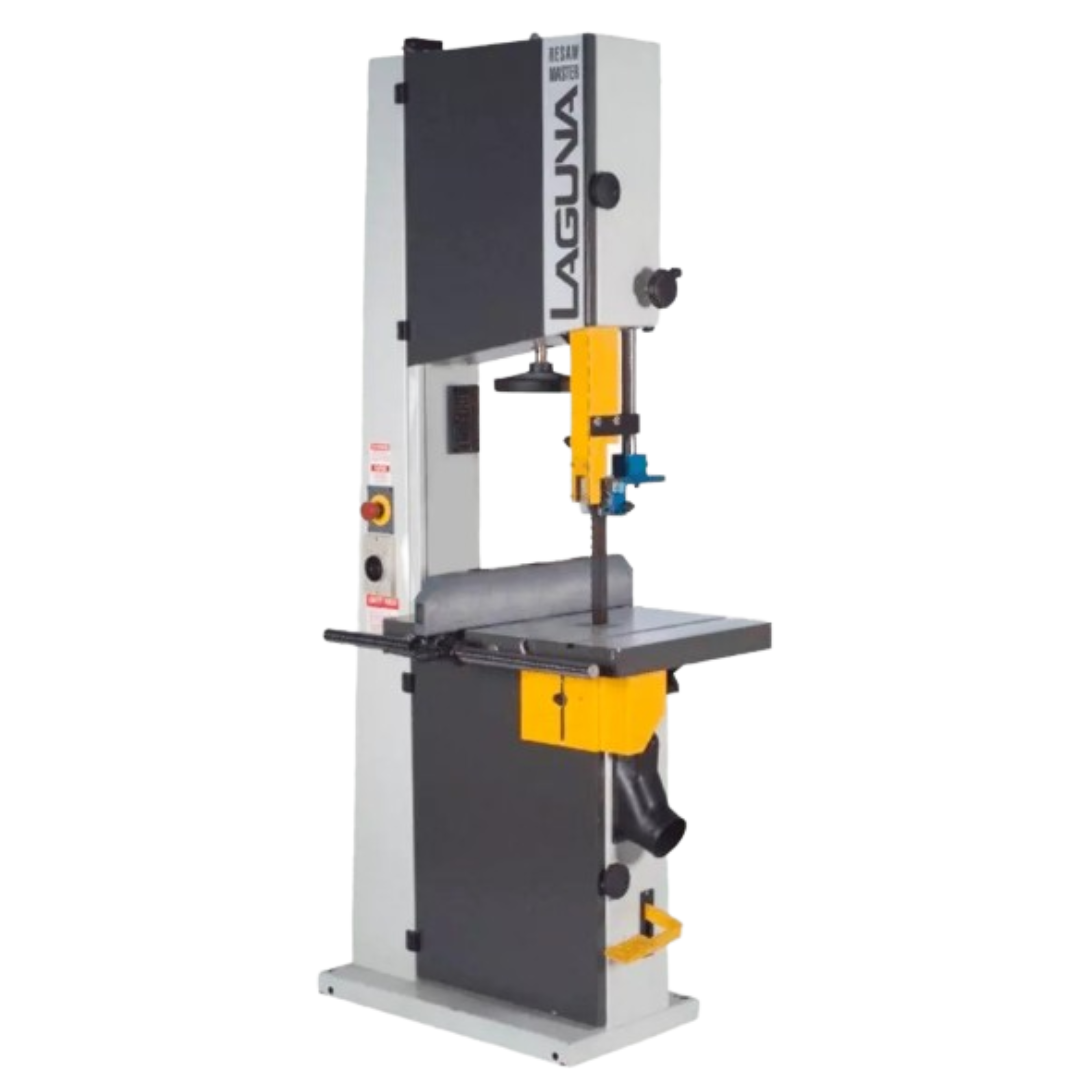
1. Laguna LT18 Resaw Master Industrial Bandsaw — $6,699
The LT18 Resaw Master is not a general-purpose woodworking band saw. It is a dedicated resaw machine for production shops. Its product page lists 18" of resaw capacity, a 17" throat, a 5 HP LEESON motor (220V, available in 1-phase or 3-phase), a 19" x 25" table, and blade widths from 3/4" to 2". Laguna guides with thumbscrew adjustment, a rack-and-pinion upper guide, geared trunnions, an EZ tension indicator, and a standard high/low aluminum fence round out the package. If your shop resaws wide slabs every day and needs consistent thickness board after board, this is the machine that earns its floor space. View more >

2. Laguna 18|CX Bandsaw MBAND18CX110175 — $4,899
The Laguna 18|CX lists 16" of resaw capacity and an 18-7/32" throat over a 20" x 26" cast iron table. Its 1.75 HP TEFC motor runs on standard 110V power, and a mechanical variable speed drive covers 100–290 FPM (low) and 1200–3500 FPM (high). A 10-point ceramic guide system, cast iron wheels, a disc brake with micro-switch, and a magnetic starter come standard, and the saw weighs 480 lbs. The tradeoff is motor power: at $4,899 it has less horsepower than the 3 HP 18|BX, so choose it for 110V power and speed control rather than raw cutting power. View more >
3. RIKON 10-342EVS 18" Bandsaw — 2.5HP Electronic Variable Speed — $3,499.99
The RIKON 10-342EVS brings electronic variable speed to an 18" band saw. RIKON lists a 2.5 HP TEFC motor on 220V single phase, blade speed that varies electronically from 82 to 3,280 ft/min with a digital readout, a 17-1/2" cutting width, 13" of resaw capacity, and spring-loaded tool-less guides with upper and lower ball bearings. Variable speed lets you dial in lower blade speeds for dense hardwoods like padauk or wenge and ramp up for softer domestic species, which makes it unusually flexible for shops that resaw many species. Its 13" resaw capacity matches the 14" Laguna saws, so the extra size shows up in cutting width and table space, not resaw height. View more >

4. Laguna 18|BX Bandsaw MBAND18BX2203 — $3,299
The Laguna 18|BX lists 16" of resaw capacity, an 18" throat, a 3 HP 220V single-phase motor, a 20" x 26" cast iron table, and a 10-point ceramic guide system, with a disc brake, a magnetic starter, and blade widths up to 1-1/4". At $3,299 it costs $1,600 less than the 18|CX and has 3 HP against the 18|CX's 1.75 HP, which makes it the better value for shops that resaw dense hardwood on 220V power. The 18|CX adds mechanical variable speed and runs on 110V. View more >
5. Laguna 14|CX Bandsaw MB14CX — $2,999
Not every shop needs an 18" machine. If your resaw work typically involves boards up to 13" wide and you want a premium 14" saw, the Laguna 14|CX adds electronic variable speed to the 14" Laguna saws in this guide. Its product page lists 13" of resaw capacity, a 13-5/8" throat, a 1-3/4 HP TEFC motor on 110V, a cast iron table, and a ceramic guide system. Electronic variable speed with a digital readout (60–1600 ft/min low range, 160–4400 ft/min high range) and a dual speed pulley system let it handle both woodworking and metal cutting. It also works as a general-purpose saw for curves, joinery, and ripping. View more >

How to Choose the Right Resaw Band Saw for Your Woodworking Shop
Matching the machine to your actual resaw needs prevents both overspending on capacity you won't use and under-buying a saw that frustrates you every time you try to push it. Walk through these four factors before you buy.

Throat Depth and Resaw Height
Start with the widest board you realistically expect to resaw on a regular basis. The 14" saws in our lineup have about 13-5/8" of cutting width and list 13" of resaw capacity (the RIKON 10-1414 lists 14"). If you're processing wide slab lumber, bookmatching figured hardwood, or slicing boards from your own logs, step up to a Laguna 18" machine: 16" of resaw capacity on the 18|BX and 18|CX, and 18" on the LT18. WoodworkingAdvisor calls 12" a practical floor for resaw height and suggests 13.5" or more for stock 8" and wider. Buy to the capacity you need today and may need in the next five years, because upgrading a band saw is an expensive proposition.
Motor Horsepower and Speed
Domestic hardwoods like cherry and walnut push a smaller motor harder than pine or poplar, and dense exotics like purpleheart, hard maple, or wenge will stall an underpowered saw mid-cut, leaving a blade mark in the face of your board. WoodworkingAdvisor's sizing guide suggests about 1.5–1.75 HP for 3–6" mixed stock on 115V, 2 HP or more for 6–8" hardwood on 230V, and 2.5 HP or more for dense hardwood 8" and wider. By that guide, the Laguna 18|BX (3 HP) and LT18 (5 HP) have headroom for wide, dense stock, while the Laguna 14|CX, Laguna 14|12, Laguna 18|CX, and RIKON 10-1414 (all 1.75 HP) and the RIKON 10-324TG (1.5 HP) suit narrower or softer stock. The Laguna 14|BX offers 2.5 HP on 220V. Electronic variable speed (EVS), as found on the RIKON 10-342EVS and the Laguna 14|CX, adds another layer of control when you're cutting unfamiliar species or abrasive wood.
Blade Guide System
Blade guides are what keep the blade from wandering, twisting, or deflecting under load. Upper and lower guide assemblies both matter; many production problems trace directly to guides that are worn, improperly adjusted, or simply not close enough to the work. Look for a saw with guides that adjust close to both faces of the blade and that can accommodate a range of blade widths from 1/4" to at least 3/4".


Fence System and Table Size
A flat, large table and a reliable fence are non-negotiable for resaw work. The fence keeps every cut a consistent distance from the blade, and a true, flat table ensures the board lies flat throughout the cut. Miter slots add versatility for angled rip cuts. Check that any fence offered or available for the machine is robust enough to hold its setting under the lateral pressure a wide resaw cut generates — a fence that slips mid-cut means wasted material and a potential safety issue.
Choosing the Right Blade for Resawing
Even the best resaw band saw performs poorly with the wrong blade installed. The two critical blade specs for resaw work are width and TPI (teeth per inch).

Blade Width for Resawing
A wider blade has more beam strength to resist deflection when pushed laterally through tall stock. Laguna advises using the widest blade your saw will allow for resawing, and WoodworkingAdvisor suggests a 3/4" blade for 3–6" stock, 3/4" to 1" for 6–8" stock, and 1" for stock 8" and wider. Blade width capacity depends on the saw: the 14" saws in this guide top out at 3/4", the Laguna 18|BX and 18|CX take up to 1-1/4", the RIKON 10-342EVS takes up to 1-3/8", and the LT18 runs 3/4" to 2". A 1/2" blade can handle occasional resaw work on thinner boards, but it flexes more and takes more skill to track straight through tall stock. Avoid blades narrower than 1/2" for resaw cuts.
TPI Recommendations for Resawing
TPI determines how smooth the cut face is and how fast the blade moves material. Laguna recommends coarse blades of 2 to 3 TPI for resawing wood and cutting stock up to 8" thick, because the large gullets clear chips efficiently and prevent clogging. Too many teeth means the gullets fill with sawdust faster than they can clear, causing the blade to overheat and wander. The RIKON 19-1106 RESAW PRO carbide-tipped blade is a 111" x 3/4" x .035" carbide-tipped 3 TPI blade for woodworkers who want longer blade life in abrasive hardwood and figured wood. At 111" long, it fits saws that take a 111" blade, such as the RIKON 10-324TG and 10-1414. The Laguna 14" saws take a 115" blade, and the 18" saws take 145" or longer.
| Blade Width | TPI Range | Best Use Case | Notes |
|---|---|---|---|
| 1/4" | 6–10 | Tight curves, scrollwork | Not suitable for resaw |
| 1/2" | 3–6 | Thin stock resaw, curves | Acceptable for occasional, shallow resaw |
| 3/4" | 2–3 | Standard resaw cuts | Recommended width for all resaw work |
| 1" | 2–3 | Production resaw, wide slabs | Requires saw support; maximum beam strength |
14" vs 18" Band Saws for Resawing
The choice between a 14" and an 18" band saw for resaw work comes down to the width and volume of stock you process. Here is an honest breakdown of what each size delivers.


14" Band Saws for Resawing
A 14" floor-standing band saw is the right choice for a solo woodworker or small shop that resaws boards up to about 13" wide. The Laguna 14|CX, Laguna 14|12, and Laguna 14|BX and the RIKON 10-324TG each list 13" of resaw capacity, and the RIKON 10-1414 lists 14". The footprint is smaller, the price is lower, and the saw does double duty as a general-purpose woodworking machine. The limitation is resaw height: boards taller than the saw's capacity need multiple passes or simply won't fit the work.
18" Band Saws for Resawing
An 18" machine opens up work that most 14" saws cannot do, but size alone does not buy resaw height. The Laguna 18|BX and 18|CX list 16" of resaw capacity and the LT18 lists 18". The RIKON 10-342EVS lists 13" of resaw capacity, the same as the 14" saws, with a 17-1/2" cutting width and electronic variable speed. Wide bookmatched panels and slab resawing beyond 13" call for the Laguna 18" machines. The trade-off is floor space, weight, and cost: the Laguna 18|BX weighs 410 lbs and the 18|CX 480 lbs, and both need permanent installation and room to work around.
Setting Up Your Band Saw for a Perfect Resaw
Even the best resaw band saw for woodworking shops underperforms if it is not set up correctly. These three setup steps make the biggest difference in resaw cut quality. Safety comes first: OSHA's woodworking machinery standard, 29 CFR 1910.213(i), requires that all portions of a band saw blade be enclosed or guarded except the working portion between the bottom of the guide rolls and the table, that band saw wheels be fully encased, and that each band saw have a tension control device.

Tensioning the Blade for Resaw Work
Blade tension is the most commonly under-set parameter on a band saw used for resaw cuts. Most woodworkers tension by feel — a light tap on the blade to check for flutter — but for resaw work, the blade needs to be tensioned higher than for general cutting. A properly tensioned resaw blade should produce a clean, single tone when plucked and show minimal side deflection when you push on it gently with a finger. Under-tensioned blades wander and produce bowed cut faces; over-tensioned blades stress the frame and can crack wheels on lighter machines. Follow the manufacturer's tension guide for the specific blade width you're using.
Drift and Fence Alignment
Blade drift is the natural tendency of a band saw blade to cut at a slight angle to the fence. This varies by blade, tension, and saw alignment. Before resaw work, determine the drift angle of your blade by making a freehand cut along a marked line in scrap and noting the angle the board naturally tracked. Set your fence parallel to that actual cut angle, not parallel to the saw table's miter slot. Resaw cuts made without correcting for drift result in tapered boards and wasted material.
Speed and Feed Rate
Feed rate is how fast you push the board through the blade. Too fast and the blade deflects and heats up; too slow and the blade burnishes the wood, dulls quickly, and can wander. The right feed rate sounds like a steady, smooth cutting noise — not a labored groan or a high-pitched whine. For saws with electronic variable speed, you can reduce blade speed (surface feet per minute) when cutting dense hardwoods to reduce heat buildup. Let the saw do the work and use consistent, steady pressure from start to finish of each cut.
Best Resaw Band Saws by Budget
Budget shapes the choice more than any single spec. Here is an honest look at what different spending levels buy you in resaw band saw quality and capability.
Under $1,500 — Entry Level
At this price, the RIKON 10-324TG at $1,199.99 is the entry point to a capable 14" shop floor saw with tool-less blade guides. It has a 1.5 HP motor and, per RIKON's specifications, 13" of resaw capacity, so it handles light resawing and general woodworking without breaking the budget. The tool-less guide adjustment makes setup and blade changes faster. At this tier you are getting a solid machine, but you will notice the limits of the 1.5 HP motor when you push into taller or denser resaw cuts.

Starting Small: 10" Band Saws for Learning to Resaw
If you are just beginning to explore resawing and want to learn technique on narrower boards before committing to a floor-standing 14" saw, a 10" band saw like the RIKON 10-3062S at $649.99 or the RIKON 10-310 at $449.99 can resaw narrow boards. RIKON lists a 5" cutting height and a 1/2 HP motor on the 10-3062S. These are not dedicated resaw machines. Resaw capacity is limited, and they are not designed for sustained deep cuts in hardwood, but they let you practice blade selection, drift correction, and feed rate control on a lower-stakes machine before stepping up. Think of a 10" band saw as a learning tool, not a production resaw machine.
$1,500–$3,000 — Mid-Range
This is where most serious hobbyist woodworkers and small professional shops land. The Laguna 14|12 at $1,699 lists 13" of resaw capacity and a 13-5/8" throat with a 1.75 HP motor, which makes it one of the best values for a resaw-focused 14" machine. The Laguna 14|CX at $2,999 lists the same 13" of capacity and adds electronic variable speed with a digital readout and a dual speed pulley system. At this tier you have enough machine for regular resaw work on boards up to 13" wide.

$3,000–$7,000 — Professional Grade
At the top end, the Laguna 18|BX at $3,299 (16" resaw capacity, 3 HP) is the entry point to resaw heights beyond 13". The RIKON 10-342EVS at $3,499.99 adds electronic variable speed and a 17-1/2" cutting width, but its resaw capacity is 13". The Laguna 18|CX at $4,899 and the Laguna LT18 Resaw Master at $6,699 are for shops where the band saw is a production tool, not an occasional-use machine. If you are resawing lumber weekly or processing wide slabs regularly, the step up to this tier pays for itself in time saved and material yield.
Watch: How to Resaw Big Wood on a Band Saw
This video walks through the full process of setting up and running a resaw cut on a band saw — from blade tensioning and fence alignment to feed rate and what to listen for during the cut.
Frequently Asked Questions
What is resaw height on a band saw?
Resaw height is the maximum board thickness — measured as the board stands on its edge — that the saw can cut in a single pass. It is determined by the distance between the table surface and the upper blade guide assembly at its highest position. A 14" band saw with a 13" resaw capacity, such as the Laguna 14|CX, can slice through a board up to 13" wide when the board is fed on its edge.
What is the minimum resaw height I need for bookmatching?
For bookmatched panels from common lumber widths, 8" of resaw height handles most hardwood boards sold in kiln-dried 4/4 and 8/4 stock. For wide slabs, figured lumber, or boards from your own logs, WoodworkingAdvisor calls 12" a practical floor and suggests 13.5" or more for stock 8" and wider. A 13" saw covers most boards, and the Laguna 18" machines (16" and 18" capacity) cover true slab work.
Can I use a 14" band saw for resawing?
Yes, a good 14" band saw with at least 1.5 HP, a 3/4" resaw blade, and a reliable fence can handle most resaw work for a small shop. Premium 14" models like the Laguna 14|CX and the Laguna 14|12 (13" resaw capacity each) are capable machines for boards up to 13" wide. The limitation is resaw height: boards wider than the saw's capacity won't fit in a single pass.
What blade TPI should I use for resawing hardwood?
Use a 2 to 3 TPI blade for resaw cuts in hardwood. Low TPI means larger gullets between teeth, which clear chips quickly during deep cuts and prevent clogging and heat buildup. The RIKON RESAW PRO carbide-tipped 3 TPI blade, a 111" blade for saws like the RIKON 10-324TG and 10-1414, is a good choice for woodworkers who want extended blade life on demanding hardwood resaw cuts.
How do I prevent blade drift when resawing?
First, correct your blade tension — an under-tensioned blade wanders more. Second, determine the actual drift angle of your blade by making a freehand cut along a straight pencil line and noting the angle the board naturally tracks. Set your fence parallel to that cut angle rather than parallel to the miter slot. Consistently drifting cuts despite correct fence angle usually point to guides that need adjustment or a blade that is dull and needs replacement.
Do I need a resaw fence for a band saw?
Yes, for consistent results. A fence set parallel to the blade's actual cutting direction keeps every pass the same thickness from start to finish. Without a fence, maintaining consistent width across the full length of a board requires skill and concentration that makes wide resaw work unreliable. Most floor-standing band saws accept an aftermarket fence, and many come with one included.
What is the difference between a resaw band saw and a regular band saw?
A dedicated resaw band saw like the Laguna LT18 Resaw Master is optimized specifically for tall, straight rip cuts — it has a larger resaw height, a heavier frame, more motor power, and guide geometry tuned for wide blades. A regular general-purpose band saw is built for curves, joinery, and lighter ripping. Many premium general-purpose band saws like the Laguna 18|CX perform both roles well; dedicated resaw machines sacrifice some curve-cutting agility for maximum straight-line performance.
How much HP do I need for resawing hardwood?
At least 1.5 HP for occasional resaw work in softer domestic hardwoods like cherry and poplar. For regular hardwood resawing on 230V, WoodworkingAdvisor suggests 2 HP or more, and 2.5 HP or more for dense hardwood 8" and wider. The RIKON 10-342EVS (2.5 HP), Laguna 18|BX (3 HP), and Laguna LT18 (5 HP) meet that bar, while the 1.75 HP Laguna 14|CX, 14|12, and 18|CX suit narrower or softer stock. More horsepower prevents stalling and maintains consistent cut quality over long sessions.
How do I tension a band saw blade for resaw cuts?
Raise the upper blade guide to its maximum height and tension the blade using the manufacturer's scale as a starting point for the blade width in use. For a 3/4" resaw blade, tension should be noticeably firm — the blade should not deflect more than a few millimeters under light lateral hand pressure. Run a test cut in scrap and check for a smooth, straight cut face. Wavy cut faces indicate insufficient tension or a worn blade.
Can a 10" band saw resaw lumber?
A 10" band saw can make light resaw cuts on narrow boards, but it is not a dedicated resaw machine. RIKON lists a 5" cutting height and a 1/2 HP motor on its 10-3062S. The motor is not built for sustained deep cutting, the resaw height is limited, and the frame is not designed to absorb the lateral forces generated by wide resaw cuts in hardwood. Use a 10" band saw for practice or light work; step up to a 14" or 18" floor model for real resaw production.
What wood species are hardest to resaw on a band saw?
Dense, interlocked-grain hardwoods like hard maple, hickory, and tropical exotics (purpleheart, padauk, wenge) are the most demanding species for resaw cuts. They require slower feed rates, sharper or carbide-tipped blades, and more HP than domestic softwoods or ring-porous hardwoods like oak and ash. Electronic variable speed, as on the RIKON 10-342EVS, lets you dial in the right cutting speed for each species to prevent blade overheating and drift.
Conclusion
The best resaw band saws for woodworking shops match the machine to the actual width, volume, and species you need to cut, not just the biggest saw on the floor. For most small to mid-size shops, a premium 14" machine like the Laguna 14|CX or the Laguna 14|12 (13" resaw capacity each) handles day-to-day resaw work without the footprint or cost of an 18" floor machine. For wide slabs beyond 13", the Laguna 18|BX, Laguna 18|CX, and Laguna LT18 Resaw Master (16" to 18" of resaw capacity) are purpose-built for the job, and the RIKON 10-342EVS adds electronic variable speed for mixed species. Browse our full selection of resaw band saws for woodworking shops to find the machine that fits your production demands and budget.
Related collections: Wood Band Saws, Bandsaw Blades and Table Saws.
Related Reading
Talk to a Resaw Band Saw Specialist
Not sure which machine fits your resaw capacity needs? Our team can help you match the right saw to your shop, species, and budget.
Featured Resaw Band Saws


Shop All Resaw Band Saws
Browse our full selection of resaw band saws for woodworking shops — from entry-level 14" floor models to dedicated 18" professional resaw machines.
Shop Resaw Band Saws →Questions? Call us at 888-308-5580