

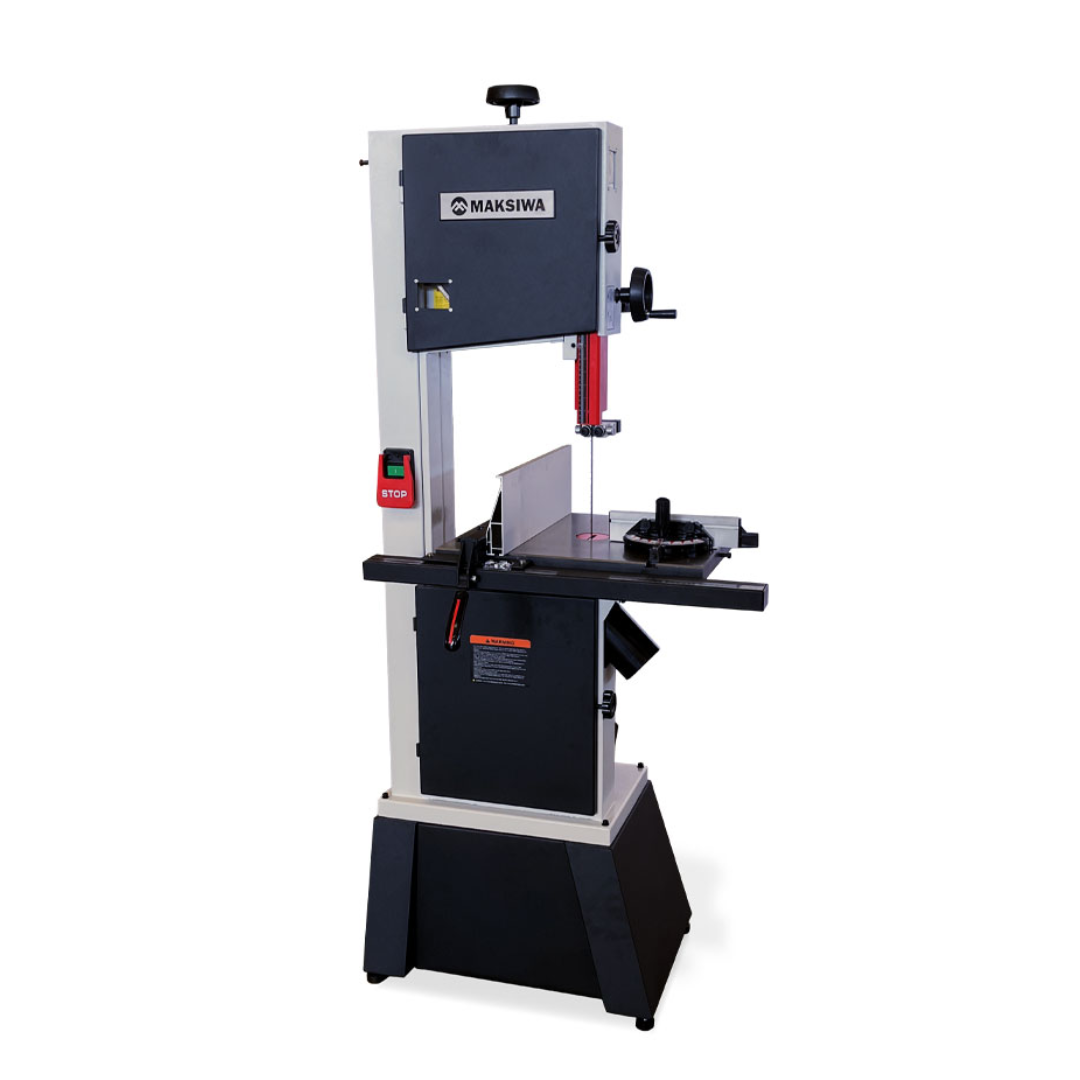

Band Saw vs Table Saw: Key Differences and Which One Your Shop Really Needs
Both band saws and table saws cut wood, but that's where the similarities end. Knowing the real differences between a band saw and a table saw will save you money, shop space, and a lot of frustration. This guide breaks it down cut type by cut type. It gives honest advice on which tool belongs in your shop and when you might actually need both.
Quick Answer
A band saw handles curves, resawing, and irregular shapes. A table saw handles rip cuts, crosscuts, and dadoes. A band saw can partly replace a table saw for ripping solid lumber. It does not replace one for sheet goods or dado and groove cuts.
In This Guide
- What Is a Band Saw?
- What Is a Table Saw?
- Band Saw vs Table Saw: Band Saw Models Compared
- Pairing a Band Saw With Your Table Saw
- Band Saw vs Table Saw: Head-to-Head Comparison
- When to Use a Band Saw
- When to Use a Table Saw
- Can a Band Saw Replace a Table Saw?
- Safety: Band Saw vs Table Saw
- Space and Cost: Band Saw vs Table Saw
- What Professional Woodworking Shops Actually Use
- How to Choose Between a Band Saw and a Table Saw
- Frequently Asked Questions
- Conclusion
Featured Band Saws

RIKON
RIKON 10-342EVS 18" Bandsaw - 2.5HP Electronic Variable Speed
$3,499.99
This RIKON 18 inch model has a 2.5 HP motor and electronic variable speed. It is aimed at shops that might lean on a band saw more than a table saw. A quick-adjust fence helps with rip cuts. Check that you have the floor space and power for it.

RIKON
RIKON 10-310 10" Bandsaw with stand and miter gauge
$449.99
The RIKON 10-310 is a 10 inch band saw with a stand and a miter gauge. It is entry level and made for limited space. It makes a sensible second saw beside a table saw. Check that its capacity covers the stock you cut.

Castaly
$98,890.00
Production volume rather than space decides when the Castaly Auto Copy Band Saw comes into play. That is because it is an automated machine. Ask our team about capacity and setup before you compare it with a table saw.

Ellis Saw
Ellis 3000 Mitre Band Saw - 13-1/2" Round Capacity, 2 HP, Variable Speed Shorter (still strong)
$6,795.00
This Ellis mitre band saw works where a table saw would struggle. It offers a 13-1/2 inch round capacity with a 2 HP motor and variable speed. It is a heavy-duty choice for pro shops. Check the capacity against your biggest cut.
What Is a Band Saw?
A band saw is a power saw that uses a long, continuous looped blade stretched between two (or three) wheels. The blade runs in one direction only. It always runs downward through the cut. This gives the band saw its unique safety and cutting characteristics compared to every other type of saw in a woodworking shop.
Band saws are best known for their ability to cut curves and irregular shapes. They are also known for resawing thick lumber into thinner boards and handling cuts that a table saw simply can't make. The blade width sets the tightest radius it can cut. A narrow ¼" blade is for tight ornamental curves. A wider ½"–¾" blade is for straight resawing and production work.
In professional and industrial settings, band saws are far more capable machines than the hobbyist 14" benchtop models found in most home shops. Industrial band saws are built for production throughput. Examples are the Maksiwa SF.35.MI 14” Bandsaw and the Ellis mitre band saw series (heavy welded steel construction). They have precision blade tracking and the rigidity needed for repeatable, accurate cuts all day.

What Is a Table Saw?
A table saw uses a circular blade that spins through a slot in a flat work surface. The workpiece is fed into the blade. It goes either along the fence for rip cuts (parallel to the grain) or against the miter gauge for crosscuts (across the grain). The blade height and tilt angle are adjustable. A dado stack can be fitted for grooves and rabbets.
Table saws are the workhorse of most woodworking shops because of their accuracy and speed on straight cuts. A good table saw with a sharp carbide blade leaves a surface clean enough for furniture joinery with little additional processing. That efficiency is why table saws have dominated production woodworking for decades.
In professional cabinetry and millwork shops, the “table saw” of the industrial world is the sliding panel saw. One such machine is the Maksiwa BMS.1600.IR Sliding Panel Saw. It handles full sheets of plywood, MDF, and large solid panels with a precision and repeatability that a standard cabinet table saw can't match.

Band Saw vs Table Saw: Band Saw Models Compared
If the Band Saw vs Table Saw choice has you leaning toward a band saw, this table lines up the models from our store that the picks cover. Look at the size and motor details first.
| Model | Price | Key feature | Best for |
|---|---|---|---|
| Maksiwa SF.35.MI 14” Bandsaw | $2,399.00 | Curve-cutting bandsaw in the 14 inch class | Shops adding a band saw to a table saw |
| RIKON 10-1414 14" 2 Speed Deluxe Bandsaw | $1,699.99 | SP coated table with enhanced quick release blade tension | Smooth workpiece travel over a low-friction table |
| RIKON 10-324TG 14" Bandsaw 1.50 HP Motor with Tool-Less Guides | $1,199.99 | Quick release blade tension lever and large adjustment handles | Shop cutting that needs a stronger motor and a stand |
| RIKON 10-3062S 10" 2 Speed Deluxe Bandsaw with Stand, and SP coated table | $649.99 | 1/2 HP motor, two blade speeds, stand and SP coated table | Smaller projects where a 10 inch saw is enough |
Each row lists size, speed and motor details. Use them to match a band saw to the curved cuts that your table saw cannot make.
Pairing a Band Saw With Your Table Saw
Both saws earn space in a woodworking shop. These band saws from our store suit the cuts a table saw cannot make. Weigh your floor space and the thickness of stock you resaw before buying.
1. Maksiwa SF.35.MI 14” Bandsaw — $2,399.00
A 14 inch Maksiwa bandsaw can handle the curved and resawn cuts a table saw cannot. So it pairs well with a saw you already own. View more >
2. RIKON 10-1414 14" 2 Speed Deluxe Bandsaw — $1,699.99
Rips straight with its 6 inch tall fence and micro-adjustment. Its 14 inch capacity covers resawing, which a table saw cannot do. View more >
3. RIKON 10-324TG 14" Bandsaw 1.50 HP Motor with Tool-Less Guides — $1,199.99
Partners well with a table saw. It is a 1-1/2 HP, 14 inch saw for curves and resawing. It has a base stand that includes a storage shelf. View more >
4. RIKON 10-3062S 10" 2 Speed Deluxe Bandsaw with Stand, and SP coated table — $649.99
Adds curve cutting to a table saw shop without much floor space. That is because this 10 inch saw comes with a stand and runs a 1/2 HP motor. View more >
Band Saw vs Table Saw: Head-to-Head Comparison
Here's how the two saws compare across every factor that matters in a working shop:
| Factor | Band Saw | Table Saw |
|---|---|---|
| Primary cut type | Curves, resawing, irregular shapes | Rip cuts, crosscuts, dadoes |
| Blade type | Continuous loop, cuts downward | Circular spinning blade |
| Kickback risk | Very low — downward cut only | Higher — workpiece can bind and kick |
| Cut surface finish | Slightly fuzzy; 1–3 planing passes | Cleaner; fewer passes to finish |
| Dust direction | Pulled downward — away from operator | Thrown toward operator |
| Resawing thick lumber | Excellent — best tool for the job | Limited by max blade height |
| Sheet goods / panels | Poor — not designed for it | Excellent (panel saw even better) |
| Joinery cuts | Good once tuned — tenons, half-laps | Excellent — dadoes, rabbets, tenons |
| Shop footprint | Smaller — vertical stance | Larger — needs infeed/outfeed room |
| Kerf width | Narrow — less material waste | Wider — more material removed |
| Best for | Curves, resawing, veneer, green wood | Panels, straight production ripping |

When to Use a Band Saw
A band saw earns its place in your shop any time the cut involves one of the following:
- Resawing thick lumber: Splitting a 4" thick board into thinner slabs, or cutting your own veneer from a figured blank. The narrow kerf wastes less wood. The downward blade pull handles the thickness without the kickback risk a table saw carries at that depth.
- Curved and irregular cuts: Chair legs, cabriole legs, curved aprons, ornamental shapes. None of these are possible on a table saw. A band saw is the only production-capable power saw for the job.
- Green or live-edge wood: Live-edge slabs, freshly felled lumber, and wood with irregular grain or embedded voids. These are hazardous to run through a spinning table saw blade. A band saw handles them safely.
- Joinery on wide stock: Once properly tuned with a quality fence, a band saw is accurate enough for tenon cheeks, half-lap joints, and bridle joints. This is especially true on stock too wide or thick for a table saw's height capacity.
- Smaller shop footprint: Band saws stand vertically and require minimal side clearance. If your shop space is tight, a band saw can take over a table saw's ripping duties. It does so while occupying a fraction of the floor space.
One non-negotiable: a band saw must be properly set up. A poorly tuned band saw will drift and wander on every cut. Dial in the blade tension, tracking, guides, and fence alignment. Do this before judging whether the saw is capable of accurate straight work.

When to Use a Table Saw
A table saw — or a panel saw in a production environment — is the right tool when:
- Ripping boards to width at speed: For a single-pass rip on dimensioned lumber where you want a clean, finished surface straight off the saw, a table saw wins. It's faster, and the surface needs less cleanup. Most shops also have a fence dialed in for repeatable widths.
- Cutting sheet goods and full panels: Plywood, MDF, melamine, and large sheet materials belong on a table saw. Ideally, they go on a sliding table saw or panel saw for full-sheet accuracy. A band saw is not designed for this work.
- Dado and rabbet cuts: Stacked dado blades mount on a table saw to cut grooves and rabbets in a single pass. Band saws cannot do this at all.
- High-volume production ripping: If you're ripping hundreds of boards to consistent widths every day, the table saw or industrial panel saw is the speed and consistency choice. The cleaner exit surface also means less secondary processing before glue-up.
- Precise crosscuts with a sled: A table saw crosscut sled produces dead-square cuts with repeatable precision. That precision is difficult to match with other tools at production pace.
- Full-sheet panel breakdown: A sliding panel saw is the industrial evolution of the table saw. It is the only practical machine for handling full 4×8 sheets with a precision no band saw can approach.

Can a Band Saw Replace a Table Saw?
This drives the “bandsaw or table saw” debate in every small-shop forum. The honest answer is: partially, yes.
A well-tuned band saw with a quality fence can rip boards to width with impressive accuracy. The industry case made by serious woodworkers is that a band saw produces results essentially equal to a table saw for ripping dimensional solid lumber. This holds once you factor in a quick pass or two with a hand plane or jointer. The narrower kerf also wastes less material. This is a meaningful advantage when working expensive figured hardwoods.
But a band saw cannot replace a table saw for:
- Sheet goods and full-panel breakdown
- Dado and groove cuts with stacked blades
- High-volume ripping where a smooth exit surface matters straight off the saw
- Precise crosscuts using a table saw sled
Many experienced woodworkers land on this solution. Use a band saw as the primary ripping and resawing machine. Use a mitre band saw for crosscutting and angle work on metal or structural material. Use a track saw for sheet goods. In a production shop, the combination of a panel saw for sheets and an industrial band saw for solid stock covers virtually everything.

Safety: Band Saw vs Table Saw
On safety, band saws hold a clear structural advantage. The blade cuts downward only, so the workpiece is never in danger of being grabbed and thrown back at the operator. Kickback is the most common cause of serious table saw injuries. The band saw's blade geometry essentially eliminates it. Band saws still have a hazard of their own. OSHA's woodworking guidance says the most common injury is contact with the blade at the point of operation. So guard all of the blade except the cutting section.
Table saws have a spinning circular blade that can trap a workpiece between the blade and the fence, causing violent kickback. Modern saws address this with riving knives and anti-kickback pawls. In premium machines, flesh-sensing technology stops the blade in milliseconds. The risk is manageable, but it requires active attention and proper technique on every cut.
Band saw safety advantages:
- Downward-only blade cut — workpiece is held down, not launched
- Lower blade speed feels more forgiving on contact
- Less physically tiring over long sessions — fatigue is a major factor in woodworking injuries
- Dust pulled downward and away from the operator's face and lungs

Table saw with modern safety features:
- Riving knife prevents blade pinch on through-rip cuts
- Overhead blade guards in production machines improve containment
- Flesh-sensing technology stops the blade on contact
- Proper fence alignment eliminates most kickback scenarios

Space and Cost: Band Saw vs Table Saw
Footprint: Band saws stand vertically and can be positioned against a wall with minimal side clearance. A 14" band saw occupies a surprisingly small footprint. Table saws need clear space on all four sides. That means space in front for the operator, behind for outfeed, and on both sides for the fence range and crosscut capacity.
Cost at the professional level: At the hobbyist end, entry-level band saws and contractor table saws occupy similar price ranges. At the industrial level, quality machines represent significant investments in either category. But the sliding table saw and panel saw command higher price points because of their size, sliding carriage engineering, and precision requirements.
Blade cost and longevity: Band saw blades are consumables that wear with use. A quality bimetal or carbide-tipped band saw blade lasts longer but costs more upfront. Table saw carbide-tipped blades can be resharpened multiple times. They last years with proper use and occasional professional sharpening.

What Professional Woodworking Shops Actually Use
In a production woodworking environment, the band saw vs table saw debate looks different than it does in a hobbyist shop. This covers cabinet shops, furniture manufacturers, and millwork facilities. Most professional shops run a combination:
- Panel saw or sliding table saw for breaking down sheet goods and large panels — far more accurate and faster than a standard table saw for this class of work
- Radial arm saw or beam saw for crosscutting dimension lumber to length in high volume
- Industrial band saw for resawing, curved solid wood work, and any cutting that doesn't belong on a panel saw
The combination of a sliding panel saw and a quality industrial band saw covers virtually everything a production woodworking shop needs to cut. Call 888-308-5580 to speak with Iron Line Tools. Ask about the right combination for your shop's workflow and volume.

Shop Professional Band Saws & Panel Saws at Iron Line Tools

Maksiwa SF.35.MI 14” Bandsaw
Type: Industrial Band Saw | Build: Cast iron table, enclosed base, precision blade tracking
If the band saw vs table saw debate has you leaning toward a band saw for your primary ripping and resawing duties, the Maksiwa SF.35.MI is the production-grade machine that will justify that decision. Cast iron construction, precision blade guides, and a rigid enclosed base deliver the accuracy and repeatability that consumer band saws can't come close to. They do this at the price point where professional shops actually operate.

Maksiwa BMS.1600.IR Sliding Panel Saw
Price: $6,399 | Type: Sliding Panel Saw — the professional table saw
When the question is really “what replaces a table saw in a professional shop,” the answer is a sliding panel saw. The Maksiwa BMS.1600.IR handles full sheets of plywood, MDF, and solid panels. It does so with a precision and throughput that a standard cabinet table saw can't match. Its sliding carriage delivers repeatable accuracy on every cut. That is the kind of reliability production cabinetry and millwork shops depend on.
Browse Iron Line Tools' Full Saw Lineup
Band Saws | Panel Saws | Sliding Table Saws | Call 888-308-5580
How to Choose Between a Band Saw and a Table Saw
Start with the cuts you make most, then size the saw to your stock and floor space. Many shops end up needing both.
- Curves, resawing and irregular shapes: choose a band saw. The RIKON 10-324TG is a 1-1/2 HP, 14 inch saw for curves and resawing. It has a base stand that includes a storage shelf.
- Straight rips and resawing on one saw: the RIKON 10-1414 rips with a 6 inch tall fence and micro-adjustment. Its 14 inch capacity covers resawing.
- Adding curves to a table saw shop with little floor space: the RIKON 10-3062S is a 10 inch saw. It comes with a stand and runs a 1/2 HP motor.
- Rip cuts, crosscuts, dadoes and sheet goods: keep a table saw. That is because a band saw cannot replace it for sheet goods or dado and groove cuts.
Frequently Asked Questions
Is a band saw safer than a table saw?
Yes, a band saw is generally considered safer than a table saw for most woodworking operations. The blade cuts in one direction (downward only). This makes kickback essentially impossible. A table saw's spinning circular blade can trap and throw a workpiece back at the operator if the wood pinches behind the blade. This is a risk that must be actively managed through proper technique, riving knives, and blade guards. Both tools are safe when used correctly, but the band saw's blade geometry gives it an inherent safety advantage.
Can a band saw rip lumber as accurately as a table saw?
Yes, with proper setup. A well-tuned band saw with a quality fence and a sharp blade can rip lumber to accurate, repeatable widths. The cut surface will be slightly fuzzier than a table saw's. It may need one or two passes with a hand plane or jointer to clean up. But the accuracy of the cut itself is comparable. The narrower kerf also means less material waste on expensive hardwoods. This is a genuine advantage in furniture and millwork applications.
What can a band saw do that a table saw can't?
Band saws can cut curves, contoured shapes, and irregular profiles. This work is simply impossible on a table saw. They can resaw thick lumber (splitting a board along its thickness into thinner boards) far more effectively. They are limited only by the throat depth rather than blade height. Band saws also handle green wood, live-edge slabs, and irregular natural material that would create a kickback hazard on a spinning circular blade.
What can a table saw do that a band saw can't?
Table saws excel at cutting sheet goods and full panels to size. A band saw is not designed for this work. Table saws make dado and rabbet cuts using stacked blade sets. This is impossible on a band saw. Table saws also produce a cleaner rip surface in a single pass. This makes them faster for high-volume production ripping where post-processing time matters. A sliding panel saw takes this advantage further. It handles full 4×8 sheets with a precision no band saw can approach.
Should I buy a band saw or a table saw first?
It depends on what you build. If you work primarily with solid lumber (furniture, casework, turned or shaped components), a band saw handles the widest variety of solid-wood cuts. It also makes a strong first investment. If you work primarily with plywood, MDF, and sheet goods (cabinets, built-ins, shop furniture), a table saw or panel saw is the right first machine. Most serious production shops eventually run both. They pair a panel saw for flat stock with a band saw for everything else.
What saw do professional woodworking shops use instead of a standard table saw?
In production shops, the standard cabinet table saw is typically replaced by a sliding table saw or panel saw. It handles full sheet goods with far greater accuracy, safety, and throughput. These machines are paired with an industrial band saw for all solid wood cutting, curved work, and resawing. Call Iron Line Tools at 888-308-5580 to discuss the right combination for your production environment and budget.
Conclusion
A band saw and a table saw both cut wood. They differ in what they do best, how much space they take and what they cost. So choose the one your shop really needs. To see current models and pricing, browse our band saws collection.
Browse Table Saws by Type
- All table saws — benchtop through sliding
- Benchtop table saws — Proxxon FET and SawStop Compact
- Contractor table saws — SawStop Contractor Saw
- Hybrid table saws — Laguna Fusion F1, F2 and F3
- Cabinet table saws — SawStop Professional and Industrial
- Industrial table saws — SawStop Industrial Cabinet Saw
- Sliding table saws — Maksiwa sliding panel saws
Explore the category: Power Tools and Power Saws.
Related Reading
- Scroll Saw vs. Band Saw: Key Differences and Which One Is Right for You
- Best Band Saw for Woodworking in 2026: Top-Rated Bandsaws for Home Shops and Pros
- Do You Need a Band Saw? What Band Saws Are Used For and When One Is Worth It
- Best Stationary Wood Band Saws for Resawing Thick Lumber: Top Picks
- Bandsaws Under $500: Best Budget and Benchtop Band Saws for Woodworking
Karim Hassan
Founder, Iron Line Tools
Karim Hassan is the founder of Iron Line Tools. It is a North American supplier of industrial woodworking and metalworking machinery. With years of hands-on experience matching professional shops with the right equipment, Karim writes about machinery selection and shop setup. He also covers the real-world performance differences between industrial tools. Have a question about your shop's setup? Call 888-308-5580 or contact the team.
Table saw, band saw, or room for both?
Call us to talk through your cuts, floor space and safety needs. Do this before you commit to one.