

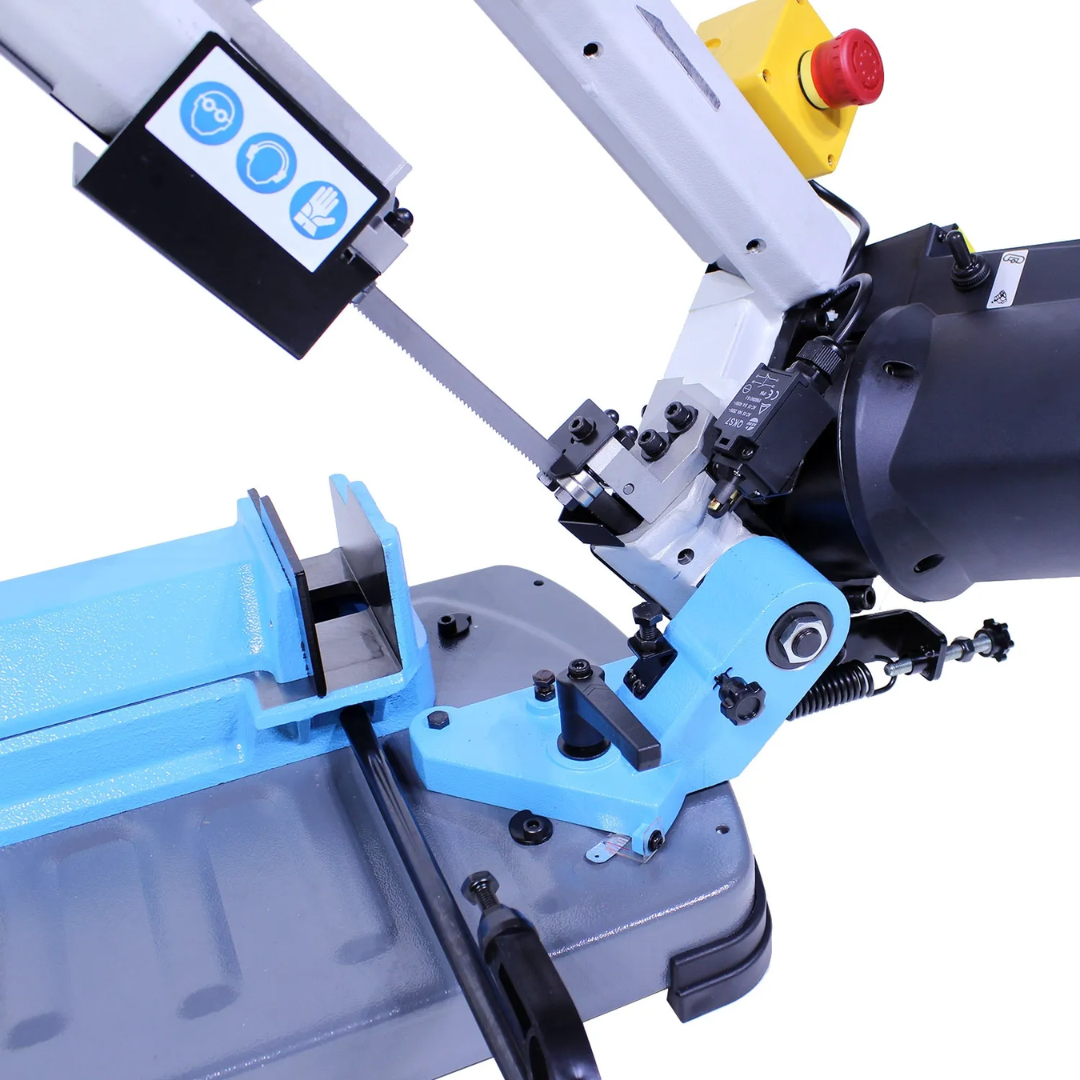
Can You Use a Band Saw to Cut Metal?
Yes — band saws can absolutely cut metal, but success depends on having the right blade, the right cutting speed, and — ideally — a machine designed for metalwork. Whether you're asking about a wood bandsaw in your shop, a portable corded model on a job site, or a dedicated horizontal or vertical metal-cutting saw, this guide walks through everything you need to know about cutting metal with a bandsaw safely and effectively.

Quick Answer
Can you use a band saw to cut metal? Yes. Band saws cut metal cleanly, quietly, and without sparks when you use a metal-specific blade with the correct TPI and slow the blade speed down for ferrous materials. Dedicated metal-cutting band saws (horizontal or vertical) are purpose-built for this work, but a variable-speed woodworking bandsaw with a bi-metal blade can handle soft metals like aluminum and brass in a pinch.
In This Guide
- What Makes a Band Saw Capable of Cutting Metal?
- Wood Band Saw vs. Metal Band Saw: Key Differences
- What Metals Can a Band Saw Cut?
- Choosing the Right Blade for Metal Cutting
- How to Cut Metal with a Band Saw (Step by Step)
- Cutting Speed Guide by Metal Type
- Tips for Better Cuts and Longer Blade Life
- Top Metal-Cutting Band Saws
- How to Choose the Right Band Saw for Metal Work
- Frequently Asked Questions
- Conclusion
What Makes a Band Saw Capable of Cutting Metal?
A band saw cuts by running a continuous loop of toothed blade over two or more wheels at a controlled speed. What separates a metal-capable setup from a wood-only one comes down to three things: blade material, tooth geometry, and blade speed.
Wood blades are designed for high speeds — typically 3,000 feet per minute (FPM) or more — and use coarse, widely spaced teeth to clear sawdust. Metal is fundamentally different. It's denser, generates more heat through friction, and produces sharp metallic chips (swarf) that can clog fine teeth or damage machine components if the speed is too high.
A proper setup for cutting metal with a bandsaw uses a bi-metal or carbide-tipped blade with fine teeth (higher TPI), and drops the blade speed dramatically — down to 100–300 FPM for most steels, and around 1,500 FPM for softer non-ferrous metals like aluminum. Without those adjustments, you'll burn through blades fast, get ragged cuts, or risk blade breakage.

Wood Band Saw vs. Metal Band Saw: Key Differences
Not all band saws are built the same. A woodworking bandsaw and a dedicated metal-cutting band saw differ in ways that matter enormously when cutting metal with a bandsaw.
| Feature | Woodworking Band Saw | Dedicated Metal Band Saw |
|---|---|---|
| Blade speed | 800–1,500 m/min (2,600–4,900 FPM) | 20–90 m/min (65–300 FPM) |
| Blade type | Carbon or hardened steel, 2–6 TPI | Bi-metal or carbide, 10–24 TPI |
| Coolant system | None | Built-in coolant (many models) |
| Motor torque | Lower — optimized for wood fiber | High torque for dense materials |
| Swarf management | Not designed for metal chips | Chip clearance and guards built in |
| Best for | Soft non-ferrous metals (occasional use) | Steel, stainless, aluminum, brass (production use) |
The bottom line: a wood bandsaw can cut soft non-ferrous metals (aluminum, brass, copper) occasionally and with the right blade, but it's not designed for the heat, swarf, or torque demands of regular metalwork. For anything involving steel or high-volume cuts, a dedicated metal band saw to cut metal is the correct tool.

What Metals Can a Band Saw Cut?
A properly equipped bandsaw to cut metal handles a wider range of materials than most people expect. Here's a practical breakdown by material:
- Mild steel: The most common application. Use a bi-metal blade at 10–18 TPI and slow the blade speed to 150–300 FPM. Coolant helps.
- Stainless steel: Harder to cut than mild steel. Requires a bi-metal or carbide-tipped blade, slow feed rate, and cutting fluid to prevent work hardening.
- Aluminum: Very bandsaw-friendly. Aluminum tolerates faster blade speeds (up to 1,500 FPM), and even a variable-speed woodworking bandsaw can handle it with a metal-cutting blade. Wax lubrication prevents galling.
- Brass and copper: Cut similarly to aluminum. Non-ferrous, so heat buildup is less of a concern. Use a fine-tooth blade at moderate speed.
- Cast iron: Brittle and abrasive. Use a carbide-tipped blade at very slow speed. Cutting produces fine dust rather than chips — wear a mask.
- Hardened steel: Generally not recommended for band saws. Hardened steel dulls carbide quickly. A cold saw or abrasive cutoff tool is better suited.
- Thin sheet metal and corrugated/perforated stock: Difficult to manage — sheets can flex, jam the blade, or produce burrs. Use a guillotine shear for thin flat stock, or clamp sheets tightly between sacrificial wood if a band saw is your only option.
Choosing the Right Blade for Metal Cutting
The blade is the single most important factor when cutting metal with a bandsaw. The wrong blade will break, produce rough cuts, or overheat the workpiece. The right one gives clean, precise results cut after cut.
Blade Material
There are three main types of bandsaw blades for metal cutting:
- Carbon steel blades: Least expensive. Must run at slow RPM, so cuts take longer. Best for occasional cuts in thin non-ferrous material or softer steels. Wear quickly on material thicker than 10 mm.
- Bi-metal blades: A carbon steel body with high-speed steel (HSS) teeth. The industry standard for most metalworking shops. Run faster than carbon blades, last longer, and handle mild steel and stainless well.
- Carbide-tipped blades: Most expensive and most capable. Handle the highest speeds and a wide range of hard materials including hardened steel. Best for high-production environments.
TPI (Teeth Per Inch) Guide
The rule for selecting TPI when bandsaw cutting metal: the thinner the material, the higher the TPI. You want at least 3 teeth in contact with the workpiece at any time — fewer teeth means the blade will catch and rip rather than slice.
| Material Thickness | Recommended TPI | Notes |
|---|---|---|
| Under 1/8" (3 mm) | 18–24 TPI | Sheet metal, thin-wall tubing |
| 1/8" – 1/2" (3–12 mm) | 14–18 TPI | Angle iron, flat bar, small round bar |
| 1/2" – 2" (12–50 mm) | 10–14 TPI | Square tubing, medium round bar, plate |
| Over 2" (50 mm) | 4–10 TPI (variable pitch) | Heavy bar stock, structural steel, billets |
Blade Width
Wider blades track straighter and are ideal for long, straight cuts in bar stock. Narrower blades allow tighter curves and contour cuts. For general metal cutting, a blade in the ½"–1" width range is a versatile starting point for most benchtop and floor-standing saws.

How to Cut Metal with a Band Saw (Step by Step)
Whether you're using a dedicated metal bandsaw or a variable-speed woodworking saw, the process for cutting metal with a bandsaw follows the same fundamentals:
- Install the correct blade. Select bi-metal or carbide-tipped, and match TPI to material thickness using the guide above. Never run a wood blade on metal.
- Set the blade speed. Reduce blade speed dramatically compared to wood cutting. For mild steel, start around 150–200 FPM. For aluminum, 600–1,500 FPM is acceptable. Variable-speed saws make this straightforward.
- Secure the workpiece. Clamp or vise the metal firmly. Movement during cutting causes blade deflection, poor cut quality, and can break the blade. On horizontal saws, the built-in vise does this for you.
- Apply lubrication. For steel and stainless, use cutting fluid or oil. For aluminum, cutting wax or WD-40 prevents aluminum from galling (welding to the blade teeth). No lubrication is needed for cast iron.
- Feed slowly and steadily. Let the blade do the work. Forcing the feed creates heat, dulls teeth, and can bow or break the blade. A steady, light feed produces the cleanest cut.
- Let the saw cool down on long cuts. Particularly on machines not equipped with coolant, pause on extended cuts to let the blade and workpiece cool. This extends blade life considerably.
- Clean up swarf. Metal chips accumulate fast. Clear the work area after each cut to prevent chip buildup from damaging wheel tires and guide bearings.

Cutting Speed Guide by Metal Type
Blade speed (in surface feet per minute, or SFPM) is the most commonly misconfigured setting when cutting metal with a bandsaw. Too fast and you generate heat that destroys blade life and work-hardens stainless. Too slow and you lose productivity. This chart gives you starting points — your specific alloy, blade condition, and coolant availability may require adjustment.
| Material | Recommended Speed (SFPM) | Recommended Blade |
|---|---|---|
| Mild Steel | 150–300 SFPM | Bi-metal, 10–14 TPI |
| Stainless Steel | 100–200 SFPM | Bi-metal, 14–18 TPI + cutting fluid |
| Aluminum | 600–1,500 SFPM | Bi-metal, 10–14 TPI + wax |
| Brass / Copper | 400–1,000 SFPM | Bi-metal, 14–18 TPI |
| Cast Iron | 50–150 SFPM | Carbide-tipped, 6–10 TPI (dry) |
| Tool Steel | 80–150 SFPM | Carbide-tipped, 10–14 TPI + coolant |
Tips for Better Cuts and Longer Blade Life
Cutting metal with a bandsaw is more forgiving than most people expect once you've dialed in the basics. A few habits separate hobbyists who burn through blades from fabricators who get hundreds of feet of clean cuts from a single set of teeth. The Fabricator advises running new blades at a slower feed rate while they break in.
- Break in new blades. A brand new bi-metal blade has sharp, fragile tooth tips. Run the first few cuts at roughly half the normal feed pressure to hone the teeth. This prevents premature chipping and extends blade life dramatically.
- Keep the blade guide bearings close. Set the upper guide bearing to within ¼" of your workpiece. This reduces blade flex and prevents deflection during the cut, especially on taller cuts.
- Don't force the feed on thick material. Heavy feed pressure generates heat. Let the blade's weight and a light hand pressure do the feeding — particularly on horizontal saws where gravity feed is the norm.
- Use wax or cutting oil on aluminum. Aluminum has a tendency to weld itself to blade teeth (a condition called galling). A swipe of cutting wax or a drop of WD-40 on the cut line before starting prevents this completely.
- Inspect blade tension regularly. An under-tensioned blade wanders and produces barrel-curved cuts. An over-tensioned blade risks snapping. Most saws have a tension guide; follow it and check before each use.
- Replace blades before they're completely dull. A dull blade works harder, generates more heat, and can damage wheel tires and guides. If you're pushing harder than usual to maintain feed rate, it's time for a new blade.

Top Metal-Cutting Band Saws
If you're serious about bandsaw cutting metal — whether in a fabrication shop, a maintenance environment, or on a job site — these are four machines that cover those jobs. Each is built for cutting metal, with continuously variable blade speed on the BS-127P and BSV-12VS-V2, and stepped speeds suited to steel on the Ellis 1600 (three speeds) and BS-916M (four speeds).
Here is how the four saws compare at a glance. Click any model name to go to its product page.
| Model | Price | Type | Blade speed | Cutting capacity |
|---|---|---|---|---|
| Baileigh BS-127P Portable Variable-Speed Metal-Cutting Bandsaw | $1,087.40 | Portable | 75 to 246 FPM, variable | 5 in. round |
| Ellis 1600 Mitre Band Saw — Horizontal & Vertical Metal Cutting, 10″ Capacity | $5,299.00 | Horizontal and vertical (converts in one step) | 55, 115 and 230 FPM | 10 in. round at 90° |
| Baileigh BSV-12VS-V2 Vertical Band Saw | $6,101.56 | Vertical | 100 to 1,000 FPM, variable | 12.2 in. throat, 6.875 in. cutting height |
| Baileigh BS-916M Horizontal Band Saw | $6,645.27 | Horizontal | 82, 132, 170 and 235 FPM | 8.75 in. round at 90° |
1. Baileigh BS-127P Portable Variable-Speed Metal-Cutting Bandsaw — $1,087.40
The BS-127P is Baileigh's portable metal-cutting solution — compact enough to take to the job site, capable enough for shop use. Its variable-speed motor lets you dial in blade speed from 75 to 246 FPM for mild steel and stainless steel. The electronic trigger handle and integrated material stop rod give you comfortable, repeatable cuts even in the field. Ideal for contractors, maintenance crews, and fabricators who need a band saw to cut metal anywhere. View more >
2. Ellis 1600 Mitre Band Saw — Horizontal & Vertical Metal Cutting, 10″ Capacity — $5,299
Ellis built the 1600 as a mitre bandsaw for production work that converts between horizontal and vertical operation in one step, giving you added versatility across round, pipe, flat, and rectangular stock. It cuts up to 10" round at 90° (6-7/8" at 45°), and the quick-adjusting camlock vise keeps the stock in position for every cut. If you're looking for a metal bandsaw built for daily fabrication-shop use that can also roll to the job site on its 10" wheels, the Ellis 1600 is a solid starting point. View more >
3. Baileigh BSV-12VS-V2 Vertical Band Saw — $6,101.56
Baileigh's BSV-12VS-V2 is a vertical metal-cutting band saw built for contour work, curved cuts, and irregular profiles that a horizontal saw can't handle. The inverter-controlled variable speed runs from 100 to 1,000 FPM, so you can match blade speed to aluminum or steel. Its heavy-duty steel frame and cast iron work table keep cuts accurate even on complex profiles. The right machine when you need a bandsaw that can follow a layout line through contours and intricate shapes. View more >
4. Baileigh BS-916M Horizontal Band Saw — $6,645.27
The BS-916M is a heavy-duty horizontal metal-cutting band saw with 0° to 45° miter capability and hydraulic feed control for repetitive production cutting. Load bar stock into the vise, set your angle, and the hydraulic descent control manages the cut — consistently, cut after cut (the bow return is manual). Hydraulic feed keeps cutting pressure smooth and steady instead of relying on manual downfeed. Built for fabrication and production shops that need repeatable cuts and a rigid cast iron and welded steel build. View more >
How to Choose the Right Band Saw for Metal Work
Not sure which direction to go? Here's a quick decision framework to match the machine to your work:
- Job site or mobile use? A portable bandsaw like the Baileigh BS-127P travels to the work. Well suited to contractors and maintenance crews.
- Cutting bar stock and structural shapes to length? A horizontal band saw is the standard choice. It holds the workpiece in a vise and feeds the blade by gravity or hydraulics, freeing your hands. The Baileigh BS-916M and the Ellis 1600 are built for exactly this.
- Contour cuts, curves, or irregular profiles? A vertical band saw gives you the table surface and blade visibility to follow a layout line. The Baileigh BSV-12VS-V2 is the right tool for this.
- Need both horizontal and vertical in one machine? The Ellis 1600 converts between orientations in one step, making it a versatile single investment for fabrication shops.
- Heavy production cutting? Look at semi-automatic or automatic horizontal saws with programmable lengths, hydraulic feeds, and coolant systems. These machines pay for themselves quickly in high-volume environments.

Frequently Asked Questions
Can a wood band saw cut metal?
A woodworking band saw can cut soft non-ferrous metals like aluminum and brass occasionally if you install a metal-cutting bi-metal blade and reduce blade speed. However, wood band saws run too fast for ferrous metals (steel, iron) and lack the torque and swarf management of a dedicated metal band saw. For regular metal cutting, use a machine designed for it.
What blade do I need to cut metal with a band saw?
For most metalwork, a bi-metal blade is the best choice — it's more durable than carbon steel and handles steel, stainless, and aluminum well. For TPI, match the tooth count to your material thickness: 18–24 TPI for thin sheet, 10–14 TPI for round or square bar stock, and 4–10 TPI for heavy structural sections.
What metals should you not cut with a band saw?
Avoid cutting hardened steel, corrugated sheet metal, and perforated plate on a band saw. Hardened steel dulls carbide blades quickly and is better handled by a cold saw or abrasive cutoff tool. Thin corrugated and perforated sheet tends to flex and jam the blade — a guillotine shear is safer and faster for those materials.
Is a horizontal or vertical band saw better for cutting metal?
It depends on the cut. Horizontal band saws are the standard for cutting bar stock and structural shapes to length — the workpiece is clamped in a vise and the blade feeds down through it, often automatically. Vertical band saws are better for contour cuts, curves, and irregular profiles because you can steer the workpiece across the table and follow a layout line. Many fabrication shops have both, or use a convertible mitre band saw that operates in either orientation.
Do I need cutting fluid when cutting metal with a band saw?
Yes, for most ferrous metals (steel, stainless) and some non-ferrous metals. Cutting fluid reduces heat, flushes chips out of the cut, and extends blade life significantly. For aluminum, cutting wax or light oil prevents galling (the aluminum welding to the blade teeth). Cast iron is the exception — it's cut dry because adding fluid causes the fine cast iron dust to form an abrasive slurry. OSHA's metalworking fluids guidance covers the health effects of skin contact and breathing in fluid, so manage it carefully.
Can you cut steel pipe and tubing with a band saw?
Yes — band saws are actually one of the best tools for cutting pipe and tubing because they produce a clean, burr-free cut without the distortion that comes from abrasive cutoff wheels. Use a bi-metal blade at 14–18 TPI for thin-wall tubing, and slow down for thick-wall structural square or round tubing. A mitre-capable band saw lets you cut pipe and tubing at any angle for welded frames and structures.
Conclusion
Band saws can cut metal — and cut it well — when you match the blade, speed, and machine to the material in front of you. Whether you're using a portable variable-speed model on a job site or a full-size horizontal or vertical saw in a production shop, the principles are the same: right blade, right speed, proper lubrication, and steady feed. Explore our full range of professional band saws to find the right machine for your metalworking needs.
Explore the category: Metalworking. Related collections: Metal Band Saws, Vertical Band Saws and Horizontal Band Saws.
Related Reading
- Bandsaw Blade Selection Guide: Width, TPI, and Pitch for Woodworking
- Types of Band Saws: A Complete Guide to Every Design
- Vertical vs Horizontal Band Saw: Which Is Best for Metal Cutting?
- Band Saw vs Cold Saw: Which Is Right for Metal Cutting?
- Ellis Band Saw Comparison: 1100, 1200, 1500, 1600, 1800, 2000, 3000, 4000
- Portable Band Saw Uses: What Can a Portaband Cut and Do?
- Corded vs. Cordless Portable Band Saw: Which Is Right for Your Job Site?
Need Help Choosing the Right Metal-Cutting Band Saw?
Our specialists can help you match the right machine to your material, capacity, and production requirements.
Featured Metal-Cutting Band Saws


Shop All Band Saws
Professional horizontal, vertical, and mitre band saws for metalworking — from portable job-site models to full-size production machines.
Shop All Band SawsQuestions? Call us: 888-308-5580