

In This Guide
Featured Belt Sander

RIKON
RIKON 50-120 6" x 48" Belt / 10" Disc Sander
$649.99
A large, robust RIKON sander built around a 6 inch by 48 inch belt and a 10 inch disc. The belt frame moves from horizontal to vertical, and the support fence comes off for access to the whole belt. It suits woodworkers who do most of their sanding on the belt.

RIKON
RIKON 50-1428 1" x 42" Belt/ 8" Disc Sander
$399.99
Larger surfacing projects are what the RIKON 50-1428 is made for, with a 1 inch by 42 inch belt, an 8 inch disc and a cast iron base frame. Larger tables and big handles make table angles easy to set. The redesigned belt adjustment simplifies tracking and belt changes, handy when you swap grits.

RIKON
RIKON 50-161VS 1" x 30" Belt 6" Disc VS Sander
$229.99
Small craft work is the target of the RIKON 50-161VS, which pairs a 1 inch by 30 inch belt with a 6 inch disc and variable speed. You can dial in the belt or disc speed for the material. Choose it for toys, jewelry or repair work rather than big panels.
What Is a Belt Sander?
A belt sander uses a continuous loop of sandpaper stretched between two spinning drums. As the motor drives the drums, the sandpaper belt rotates rapidly across the work surface, removing material faster than any other handheld sanding tool. Unlike random orbital sanders, belt sanders move in a single direction — they are designed for material removal, not fine finish work.

Belt sanders excel at tasks like stripping old paint or stain from decking, flattening rough-sawn lumber, removing dried glue lines, leveling a wood surface, and shaping stock. For final finish passes, you'll switch to an orbital sander after the belt sander does the heavy lifting. Used correctly, a belt sander is one of the most productive tools in a woodworking shop or on a job site.

Dust collection is important with belt sanders — they generate significant sawdust quickly. Most handheld belt sanders include an integrated dust bag; connecting to a shop vacuum through the dust port improves collection significantly and keeps your sanding surface cleaner, which helps the belt last longer and cut more efficiently.

Types of Belt Sanders
Handheld Belt Sanders
The most common type. A handheld belt sander features a belt typically 3–4 inches wide and 18–21 inches long, driven between two drums. You hold the tool and guide it across the workpiece. Handheld belt sanders are the right choice for large flat surfaces like decks, hardwood floors, dining tables, and long boards. Both corded and cordless models are available in this form factor.
Stationary (Benchtop) Belt Sanders
Stationary belt sanders mount to a workbench or stand. Instead of moving the tool over the workpiece, you hold the workpiece against the moving belt. This gives much finer control over the cut — ideal for smaller parts, edge work, shaping, and knife sharpening. Many benchtop belt sanders combine a belt with a disc sander on the same machine, making them especially versatile for small shop use.

Detail (Bandfile) Belt Sanders
Detail belt sanders, also called bandfiles, use a very narrow belt (often 1/2 inch wide) that wraps around an extending arm. This narrow profile reaches into contoured surfaces, rounded edges, inside curves, and tight spaces that a standard handheld belt sander can't access. Detail belt sanders are finishing tools for furniture makers, luthiers, and anyone working on irregular or intricate shapes.

Best Belt Sanders Ranked
Best Overall Belt Sander
Metabo HPT SB8V2 Corded Belt Sander
The Metabo HPT SB8V2 leads the category on material removal speed. Its 9-amp motor pushes through hardwood and pine with authority, removing more material per pass than any other tested handheld belt sander. The slightly tacky rubber handles give a secure, controlled grip even under aggressive sanding pressure. Its transparent front window lets you watch the belt tracking in real time, and the dust bag performs well for an integrated system.
At 9.5 pounds it runs heavy — the heft is a result of the robust build quality, and it contributes to stability during hard passes rather than working against you. The 5-year limited warranty adds substantial long-term value. For woodworkers who need a reliable corded belt sander for sustained heavy-duty work, the Metabo HPT SB8V2 is the top choice.

Specs: Corded handheld | 9 amp | 3″ × 21″ belt | 9.5 lb
Best Cordless Belt Sander
DeWalt 20V MAX Belt Sander
The DeWalt 20V MAX cordless belt sander produces the smoothest finish of any battery-powered belt sander tested. It handles well — the dual-handle grip is comfortable and well-balanced — and the variable speed dial is easy to read and adjust without stopping work. Belt changes are quick via a single quick-release lever. The swivel adapter for shop vac connection is a practical design touch for cleaner dust collection.
The tool sells as a bare tool, so it requires a 20V MAX battery and charger (or works as a natural addition to an existing DeWalt ecosystem). For contractors, finish carpenters, and woodworkers who already run DeWalt 20V tools, the cordless belt sander delivers job site-ready performance without the cord.

Specs: Corded handheld | 20V | 3″ × 21″ belt | 9.26 lb (tool only)
Best Value Corded Belt Sander
Craftsman CMEW213 Corded Belt Sander
The Craftsman CMEW213 offers strong value for occasional users and DIYers who don't need a premium belt sander for daily production work. Material removal is solid — slower than high-end models, but competent for the price point. The three-position front handle allows you to adapt the grip for different tasks, and the dust port's vertical orientation creates a slimmer profile that helps the tool reach tighter spaces. A front guard that flips out of the way adds further access when needed.
It runs slightly rear-heavy, which takes a little extra effort to keep perfectly flat on the workpiece. For someone who uses a belt sander a few times a year rather than daily, the Craftsman CMEW213 delivers honest performance at a fraction of the premium belt sander cost.

Specs: Corded handheld | 7 amp | 3″ × 21″ belt | 7.75 lb
Best Value Cordless Belt Sander
WEN 20418 20V Max Belt Sander
The WEN 20418 is one of the strongest budget-friendly cordless belt sanders available. It includes its own battery and charger — an unusual value at this price — and performs at a level that competes with models costing significantly more. The variable speed range (400 to 1,150 FPM) covers most sanding scenarios, and the speed control dial sits conveniently beside the trigger for easy mid-pass adjustment. Belt changes are quick with the lever release, and the grip comfort is comparable to more expensive cordless models.
At 5.2 pounds (6.7 lb with battery), it runs lighter than premium handheld belt sanders. Build quality reflects the price point, but for the DIYer or woodworker who wants cordless portability without a large investment, the WEN 20418 is an exceptional buy.

Specs: Cordless handheld | 20V | 3″ × 18″ belt | 5.2 lb (tool only) | Battery & charger included
Best Detail Belt Sander
DeWalt 20V MAX XR Cordless Bandfile Belt Sander
The DeWalt Bandfile occupies a unique category: it uses a narrow 1/2-inch belt wrapped around an extending arm to reach contoured surfaces, inside curves, roundovers, and tight spots that a standard belt sander cannot access. The 20V brushless motor delivers speeds up to 5,600 FPM through that narrow belt — impressive material removal for the profile. The sanding arm rotates 104 degrees for angle flexibility, and a built-in LED light illuminates shadow-heavy work areas.
At 2.6 pounds (3.8 lb with battery), the Bandfile is lightweight and maneuverable. Variable speed control lets you dial back aggression for delicate curved surfaces. The one gap is dust collection — there is no integrated bag, so dust management requires a connected vacuum or a respirator. For furniture makers, carvers, and woodworkers who regularly sand complex shapes and contours, the DeWalt Bandfile is the right specialized tool.
Specs: Cordless handheld | 20V brushless | 0.5″ × 18″ belt | 2.6 lb (tool only)
Best Stationary Belt Sander
WEN 6502T Benchtop Belt and Disc Sander
The WEN 6502T is a benchtop belt and disc combo sander that offers a cast-iron base for stability and minimal vibration — critical for precision work on small parts. The 4″ × 36″ belt and 6-inch disc each have their own work tables for material control, and an optional miter gauge enables angled work. At 41 pounds, it stays firmly planted on the bench during use.
Single speed limits versatility compared to variable-speed models, but for shaping, edge work, and repetitive sanding of small pieces, the fixed speed is rarely a practical limitation. For small shops, hobbyists, and woodworkers who need a reliable benchtop sanding station without a large footprint or budget, the WEN 6502T delivers well beyond its price.
Specs: Corded stationary | 4.3 amp | 4″ × 36″ belt + 6″ disc | 41 lb
Woodworking Belt Sanders Compared by Power Source
Here are the belt sanders from our store that the picks cover, from cordless handhelds to a bench model. Compare power source and sanding surface before anything else.
| Model | Price | Key feature | Best for |
|---|---|---|---|
| Proxxon Cordless Belt Sander BS/A | $300.60 | 10.8V lithium-ion battery with 2.6Ah capacity | Handheld belt sanding on battery power |
| Proxxon Cordless Belt Sander BS/A Without Battery & Charger | $176.40 | Compact battery-powered sander for small precision work | Buyers who want the tool alone, no battery or charger |
| RIKON 50-1305 1" x 30" Belt / 5" Disc Sander | $149.99 | Efficient 1/3 HP motor drives the belt and the 5 inch disc | Toy making, repair work and other small bench jobs |
| Virutex Belt Sander LB31E: Powerful Sanding Performance 3100199 | $491.05 | Big sanding area and strong motor built for levelling | Resurfacing decks and flattening rough lumber quickly |
Settle whether a handheld or a bench machine suits your shop, and let each row's key feature narrow the choice to your sanding job.
Belt Sanders We Recommend for Woodworking
These belt sanders from our store fit the stripping, flattening and resurfacing jobs this guide covers. Check the belt size and power source first, since cordless, handheld and stationary models work differently.
1. Proxxon Cordless Belt Sander BS/A — $300.60
Cordless choice with a 10.8V lithium-ion battery and 2.6Ah capacity, handy on a job site where you cannot plug in. View more >
2. Proxxon Cordless Belt Sander BS/A Without Battery & Charger — $176.40
Choose this tool-only version of the cordless BS/A when you do not need extras, since the battery and charger are not included. View more >
3. RIKON 50-1305 1" x 30" Belt / 5" Disc Sander — $149.99
Small combination sander with a 1 inch by 30 inch belt, 5 inch disc and 1/3 HP motor for home crafts, furniture and repair work. View more >
4. Virutex Belt Sander LB31E: Powerful Sanding Performance 3100199 — $491.05
Large sanding surface and a powerful motor make it a match for levelling and rough sanding before the finishing steps. View more >
What to Look for When Buying a Belt Sander
Power (Amps or Volts)
Corded belt sanders are rated in amps — motors typically range from 7 to 12 amps. A higher amp rating means more torque and less slowdown under load. For heavy-duty work like stripping decking or flattening rough-sawn hardwood, a 9-amp motor or higher is the right baseline. Cordless belt sanders are rated in volts (typically 18–24V). Higher voltage batteries deliver more consistent power through longer cuts. Keep in mind: cordless models generally deliver less sustained power than equivalent corded models.
Belt Size
Handheld belt sanders commonly use 3 × 21-inch belts. Wider and longer belts cover more surface per pass and remove material faster. For benchtop models, 4 × 36-inch belts are common and provide excellent coverage on larger workpieces. Detail belt sander belts are much narrower (typically 1/2 inch wide) to access tight areas. Belt size also affects replacement cost and availability — standard sizes like 3 × 21 are widely available at any home center or hardware store.
Speed (FPM)
Belt sander speed is measured in feet per minute (FPM). Standard handheld belt sanders range from about 700 to 1,600 FPM; detail belt sanders can reach 5,600 FPM on their narrow belts. Variable speed control — found on models like the Metabo HPT SB8V2 and WEN 20418 — lets you reduce aggressiveness for lighter passes and finer-grit work, which extends sandpaper life and improves control on thinner stock.
Dust Collection
Belt sanders generate large volumes of sawdust rapidly. An integrated dust bag is the baseline — adequate for occasional use in a ventilated area. For sustained shop work, connecting the sander's dust port to a shop vacuum significantly improves collection, keeps the work surface cleaner, extends sandpaper life, and reduces airborne dust exposure. Always wear a dust respirator rated N95 or better when belt sanding regardless of collection method.

Ergonomics and Weight
Belt sanders run 5–10 pounds for handheld models, and that weight matters during extended use. A well-balanced belt sander with comfortable handles and low vibration reduces fatigue significantly. Test-hold a sander before buying when possible, or read reviews specifically addressing balance and grip comfort rather than raw specs alone.

Frequently Asked Questions
What is the best belt sander for woodworking?
For most woodworkers, the Metabo HPT SB8V2 is the best overall belt sander: 9 amps of power, excellent material removal speed, secure grip, and a 5-year warranty make it the most reliable corded handheld belt sander at a competitive price. For cordless use, the DeWalt 20V MAX belt sander delivers the best finish quality and handling of any battery-powered belt sander tested.
What is a belt sander best used for?
Belt sanders are best used for aggressive material removal: stripping paint or old stain from wood surfaces, flattening rough-sawn lumber, leveling glued-up panels, resurfacing decking, and removing material from large flat areas quickly. They are not the right tool for final finish passes — a random orbital sander with 120–220 grit sandpaper is used after the belt sander to produce a finish-ready surface.
What size belt sander do I need?
For general woodworking and large flat surface work, a 3 × 21-inch handheld belt sander covers most situations. For wider surfaces and more coverage per pass, a 4-inch belt is a step up. For detail and contour work, a narrow bandfile (1/2-inch belt) is the right specialty tool. For shop work on small pieces where stability and precision matter more than portability, a 4 × 36-inch benchtop belt sander is the best fit.
How much does a good belt sander cost?
A good corded belt sander for occasional DIY use starts around $90–$110 (Craftsman CMEW213). A premium corded belt sander for serious woodworking runs $150–$200 (Metabo HPT SB8V2). Cordless belt sanders from major platforms (DeWalt 20V MAX) run $220–$330 as bare tools. Budget cordless models with included batteries are available around $120 (WEN 20418). Benchtop belt and disc combo sanders for small shops start around $100–$130 (WEN 6502T).
Are corded or cordless belt sanders better?
For sustained heavy-duty work in a shop setting, a corded belt sander delivers more consistent power and unlimited runtime. For job site work, outdoor projects, and situations without outlet access, a cordless belt sander is the practical choice. Premium cordless belt sanders have closed much of the performance gap with corded models — for moderate sanding sessions, both types produce comparable results. The right choice usually depends on where you work more than the power source itself.
Can you use a belt sander on hardwood?
Yes — belt sanders work on hardwood and softwood. On hardwood, use a coarser grit (60–80) for initial stock removal and follow up with progressively finer grits (100–120) before switching to a random orbital sander for final finish prep. Keep the sander moving with the grain and avoid dwelling in one spot — the aggressive material removal rate of a belt sander can create dips or gouges on hardwood if you stop moving.
Conclusion
The best belt sander for woodworking removes material aggressively for stripping, flattening and resurfacing, so choose by type, power and the features you need. Looking for the right fit? Start with our belt sanders and narrow it down by size and price.
Safety and standards references: OSHA woodworking eTool: handheld belt sanders and OSHA woodworking eTool: wood dust.
Related collections: Portable Sanders, Combination Disc & Belt Sanders and Cordless Sanders.
Related Reading
Shop Sanders at Iron Line Tools

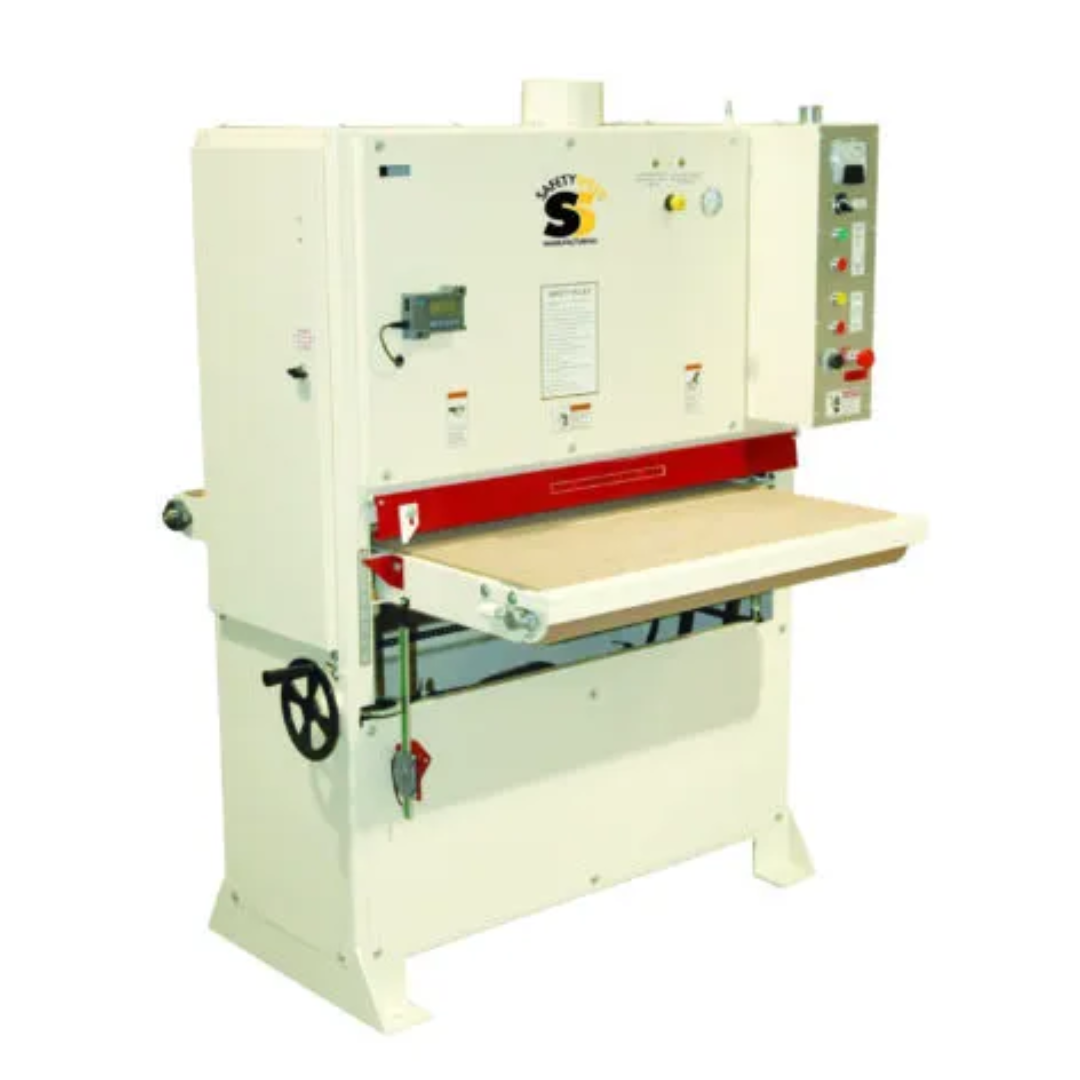
Safety Speed 3760 Wide Belt Sander
Price: $15,499 | Type: Wide Belt Sander
The Safety Speed 3760 is a professional wide belt sander with industrial sanding head, conveyor table, and precision control panel. Built for high-production sanding of wood panels and solid lumber.

Safety Speed 43″ Wide Belt Sander
Price: $21,499 | Type: Wide Belt Sander
The Safety Speed 43″ Wide Belt Sander delivers 43″ sanding capacity for large panels and wide boards. Ideal for cabinet shops and furniture manufacturers needing high-volume consistent sanding.
Corded, cordless or wide belt for your work?
Ask our team to match a type and power level to stripping paint, flattening lumber or resurfacing decks.
Also browse: Sanding Machine