

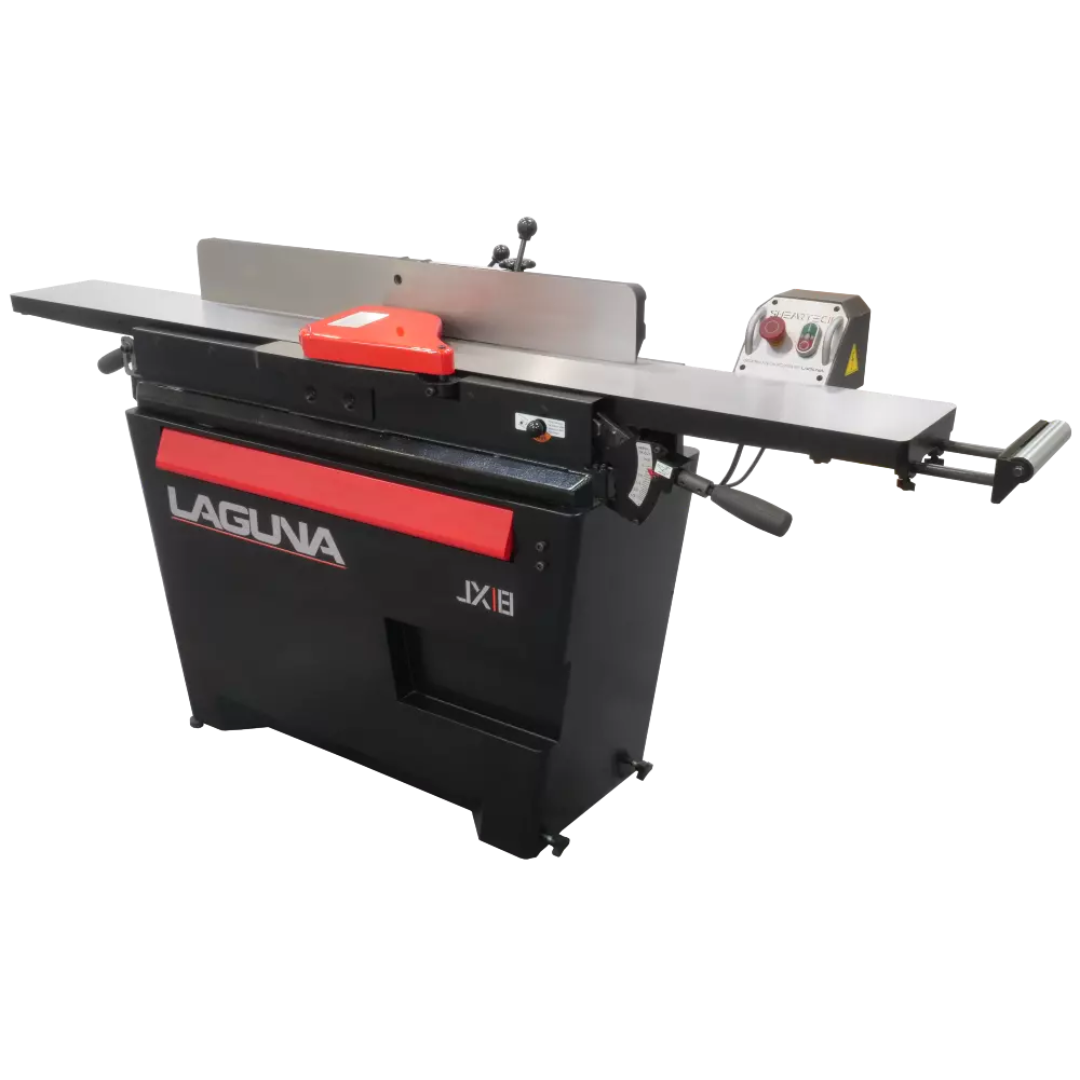
Best 8" Jointers: What to Look For and Which Models Deliver
An 8-inch jointer is the inflection point where a machine stops being a convenience and becomes a production workhorse. A 6-inch jointer covers most furniture and cabinet work, but the moment you start handling 8-inch-wide stock, flattening slabs, or processing high volumes of rough lumber, the 6-inch table becomes a bottleneck. The 8-inch class removes that constraint without the floor-space and cost penalty of a 12-inch industrial machine.
This guide covers what separates a good 8-inch jointer from an average one, how helical cutterheads change the performance equation, and which specific models are worth buying right now.
In This Guide
- Why 8" Matters for a Jointer
- What to Look For in an 8" Jointer
- Cutterhead Types: Straight Knife vs. Helical
- 8" Jointer Comparison Table
- Laguna JX|8 QuadTec II Jointer Review
- Laguna JX|8 ShearTec II Jointer Review
- Jointer Widths Compared from 6 Inch to 12 Inch
- Benchtop Jointers to Compare by Width
- 8" vs. 6" vs. 12" Jointers: Which Do You Need?
- Frequently Asked Questions
- Conclusion
Featured Jointers

Laguna
$699.00
Benchtop planers like this one pair with a jointer: it has the improved QuadTec cutterhead and a 2 HP motor in a compact footprint. Once the jointer flattens one face, it brings boards to a matching thickness.

RIKON
RIKON 25-135H 13" Portable Planer with Helical Style Cutterhead 2-Speed Feed Rate
$899.99
Portable and 13 inch wide, this planer has a six row helical-style cutter head, 26 HSS insert cutters and a 2-speed feed rate. Each insert is sharpened on two edges and can be rotated, which keeps upkeep simple behind a jointer.

Laguna
$4,129.00
Production shops are the target for this thickness planer, which has a 5 HP motor and a ShearTec II carbide cutterhead. It suits a busy shop where a wide jointer feeds a planer all day, so check your power and floor space first.

Castaly
Castaly 15" Planer with Stand WP-0015
$3,399.00
Floor space matters with this 15 inch planer, which sits on its own stand and has a rigid cast iron table, sealed ball bearings and dual feed speeds. Pair it with a jointer to flatten and then thickness boards.
Why 8" Matters for a Jointer
The width rating on a jointer is not a target — it is a hard ceiling. An 8-inch jointer can flatten and edge-joint any board up to 8 inches wide in a single pass. That is enough to cover virtually every furniture component, cabinet rail and stile, and door panel you will encounter in a production shop working dimensional hardwood lumber.
The practical advantage over a 6-inch jointer is most visible in three situations. First, wide boards — anything over 6 inches requires multiple overlapping passes on a 6-inch machine, and overlapping passes introduce registration errors on wider stock. Second, rough-sawn hardwood with significant warp — a longer, wider table controls more of the board during the pass, reducing snipe and taper on long pieces. Third, edge jointing for glue-ups — wider stock requires more fence contact to stay square, and a longer fence on an 8-inch machine provides better support than what is typically available on 6-inch machines.
What to Look For in an 8" Jointer
Table Length and Cast Iron Quality
The combined length of the infeed and outfeed tables determines how accurately long boards are referenced during the jointing pass. A combined table length of 60 to 72 inches handles boards up to about 8 feet without significant unsupported overhang. Tables should be genuine cast iron, ground flat after casting — aluminum or composite tables flex under load and are difficult to keep coplanar. Look for a machine where the tables are adjustable independently (outfeed set parallel to the cutterhead arc, infeed set to the desired depth of cut) and where adjustment is made with dedicated gibs or handwheels rather than a screwdriver and locknut. A table that can be trued without disassembly saves hours of setup time at the end of every board.

Fence Design and Adjustability
The fence on an 8-inch jointer needs to be heavy enough that it does not flex when a board is pressed against it at the feed rate required for hardwood. A fence that deflects even 0.5 degrees under pressure makes square edge-jointing impossible. The best fences on 8-inch machines are single-piece cast iron or heavy extruded aluminum with positive stops at 90 degrees and 135 degrees, and a cam-lock that holds angle under load. The fence should tilt inward (for chamfering) and lock without needing to be tightened with a wrench every time.

Motor Power and Speed
An 8-inch jointer needs enough motor to maintain cutterhead speed under load. Underpowered machines bog down in dense hardwood, which causes the cutterhead to slow mid-pass and produce chatter marks. For an 8-inch machine, a minimum of 1.5 HP on a dedicated 240V circuit is the practical floor; 2 HP is the standard for professional machines, and most professional 8" jointers run the cutterhead at 4,000–6,000 RPM.

Dust Collection
An 8-inch jointer produces significantly more chip volume than a 6-inch machine at the same feed rate. A 4-inch dust port is the minimum for effective chip evacuation on an 8-inch cutterhead; some machines include a chip deflector or integral dust chute that directs chips toward the port more efficiently. Machines with a fully enclosed base and a well-positioned port collect the majority of chip production at normal feed rates.
Cutterhead Types: Straight Knife vs. Helical
The cutterhead is the component that most directly determines surface quality and ongoing maintenance cost. Straight-knife cutterheads use two or three long blades spanning the full width of the cutterhead. They are inexpensive to manufacture and produce acceptable results on straight-grained wood, but are sensitive to tear-out on figured or reversing grain. Setting straight knives is a skilled, time-consuming task — each knife must be positioned to the exact same height as the others, and the process requires a dial indicator or similar tool.
Helical cutterheads use dozens of small carbide insert knives arranged in a spiral around the cutterhead. Each insert makes a shearing cut rather than a chopping cut, which dramatically reduces tear-out on difficult grain. When a knife dulls, the insert is rotated 90 degrees to present a fresh edge — no removal, no resetting. Helical heads cost more upfront but produce better results and lower ongoing maintenance costs.
QuadTec vs. ShearTec: What's the Difference?
In the Laguna JX|8 product line, two helical cutterhead configurations are available. The QuadTec II uses square carbide inserts, which is the standard insert geometry for helical cutterheads. The ShearTec II uses rhomboid (diamond-shaped) carbide inserts set at a steeper shear angle, which produces a finer slicing action on highly figured or reversing grain. The ShearTec II costs more and the cut quality is superior on demanding stock.

Is a Helical Cutterhead Worth the Cost?
For most professional and serious hobbyist woodworkers, a helical cutterhead is worth the modest additional cost. The surface quality on difficult grain — burled walnut, figured maple, quartersawn oak — is noticeably superior, and the reduced setup time for knife changes pays for the price difference over the life of the machine.

8" Jointer Comparison Table
| Model | Cutterhead | Table Length | Motor | Best For |
|---|---|---|---|---|
| Laguna JX|8 QuadTec II | Helical (QuadTec II) | 72" | 2 HP / 240V | Professional shops, dimensional hardwood, production volume |
| Laguna JX|8 ShearTec II | Helical (ShearTec II) | 72" | 2 HP / 240V | Figured hardwoods, fine furniture, highest surface quality |

Laguna JX|8 QuadTec II Jointer Review
The Laguna JX|8 QuadTec II is the professional-grade 8-inch helical jointer for woodworking shops that need production capacity without moving up to a 12-inch machine. The 72-inch combined cast iron table length is long enough to handle most furniture-scale boards without unsupported overhang. The QuadTec II helical cutterhead runs at 5,000 RPM, which combined with the 2 HP motor provides consistent cutting speed through hard maple, white oak, and other dense domestic hardwoods.
Setup is straightforward. The outfeed table adjustment uses a handwheel with a lock, which makes it possible to dial in the table height precisely without loosening and retightening multiple lock bolts. The fence tilts inward to 135 degrees and locks firmly at 90 degrees without deflection under working pressure. Dust collection through the 4-inch port at the base keeps the work area clean at normal feed rates.
The QuadTec II insert geometry handles straight-grained stock with no visible tear-out, and performs well on moderately figured material. For shops where most of the work is in dimensional hardwood with predictable grain, the QuadTec II is the right choice — the surface quality is excellent and the maintenance is minimal. Best 8" jointer for the money at the professional level.

Laguna JX|8 ShearTec II Jointer Review
The Laguna JX|8 ShearTec II uses the same 72-inch cast iron table and 2 HP motor as the QuadTec II but with a ShearTec II helical cutterhead that uses rhomboid carbide inserts set at a steeper shear angle. The practical effect is a noticeably cleaner surface on highly figured grain — burled walnut, curly maple, quartersawn white oak — where even the QuadTec II can produce minor tear-out on the most difficult passes.
For fine furniture makers and custom cabinetmakers who regularly work with the most demanding figured hardwoods, the ShearTec II is the right machine. The surface quality coming off the jointer is closer to what a hand plane produces on difficult grain, which reduces finishing time. The machine otherwise handles exactly like the QuadTec II — same table system, same fence, same motor. The best 8" helical jointer for maximum surface quality.

Jointer Widths Compared from 6 Inch to 12 Inch
Here are the RIKON jointers from our store that the article's picks cover, lined up by width. Look at cutter head design and table length first, since width sets the boards you can flatten.
| Model | Price | Key feature | Best for |
|---|---|---|---|
| RIKON 20-800HSP 8" Benchtop Jointer w/ Helical Style Insert Cutter head | $749.99 | 8 inch width, 6 row helical-style head with 16 carbide cutters | Slabs and wide boards that outgrow a 6 inch jointer |
| RIKON 20-600HSP 6" Benchtop Jointer w/ Helical Style Insert Cutter head | $529.99 | 12 HSS insert cutters with a quick depth setting scale, 6 inch width | Furniture and cabinet work on narrower boards |
| RIKON 20-1000H 10" Benchtop Jointer w/ Helical Style Insert Cutter head | $899.99 | 10 inch width with cast iron tables, 34 to 54 inch long | Larger projects that need extra width and bed length |
| RIKON 20-1200H 12" Benchtop Jointer w/ Helical Style Insert Cutter head | $999.99 | 12 inch width, 24 insert cutters on a 6 row helical-style head | Processing lots of rough lumber at the widest cut here |
Read each jointer's width and cutter head in the key feature column, then choose the one that covers the widest board you flatten regularly.
Benchtop Jointers to Compare by Width
Each benchtop jointer below comes from our store and spans the 6, 8, 10 and 12 inch widths. Check the table length and the cutterhead type before you settle on a width.
1. RIKON 20-800HSP 8" Benchtop Jointer w/ Helical Style Insert Cutter head — $749.99
Built around a 6 row helical-style cutter head with 16 carbide 2-edge insert cutters, this is the 8 inch model. Table extensions grow the work surface from 30-1/2 inch to 51-1/2 inch, which helps with long boards. View more >
2. RIKON 20-600HSP 6" Benchtop Jointer w/ Helical Style Insert Cutter head — $529.99
Narrow furniture and cabinet parts are the sweet spot for this 6 inch version, which has a 6 row helical-style cutter head with 12 HSS 2-edge insert cutters and a quick depth setting mechanism. View more >
3. RIKON 20-1000H 10" Benchtop Jointer w/ Helical Style Insert Cutter head — $899.99
Step up to 10 inch width when your boards outgrow a smaller jointer. It has 20 insert cutters in a 6 row helical-style head and machined cast iron tables. View more >
4. RIKON 20-1200H 12" Benchtop Jointer w/ Helical Style Insert Cutter head — $999.99
Widest of the group at 12 inch, with 24 insert cutters and tables that extend from 34 inch to 54 inch long. It sets the upper end of the size comparison in this guide. View more >
8" vs. 6" vs. 12" Jointers: Which Do You Need?
A 6-inch jointer handles the majority of furniture and cabinet work. If most of your boards are under 6 inches wide and you are not processing high volumes of rough-sawn lumber, a 6-inch machine covers the work at lower cost and with a smaller footprint. The limitation appears when edge-jointing boards for wide panels, when working with stock that is more than 6 inches wide, or when the volume of work makes the narrower capacity a recurring bottleneck.
A 12-inch jointer is an industrial machine. The floor space, electrical requirements (typically 3-phase), and cost put it outside the range of most professional shops unless the work specifically requires it — wide slab work, high-volume rough lumber processing, or dimensional material consistently in the 8 to 12 inch width range. For the majority of furniture and custom cabinet shops, the 8-inch class is the right endpoint.
The 8-inch jointer makes sense when boards are frequently wider than 6 inches, when the production volume makes a 6-inch machine a bottleneck, or when rough-sawn stock requires a machine with enough table length and motor to process efficiently. For boards routinely over 8 inches wide, a 12-inch jointer or a router sled is the correct solution — overlapping passes on even a good 8" machine introduce registration errors on very wide boards.

Frequently Asked Questions
What is the difference between a 6-inch and an 8-inch jointer?
The cutterhead width determines the maximum board width that can be jointed in a single pass. A 6-inch jointer handles stock up to 6 inches wide; an 8-inch jointer handles stock up to 8 inches wide. Beyond cutterhead width, 8-inch machines typically have longer tables (better support for long boards), heavier fences, and more powerful motors than 6-inch machines in the same product tier.
Do I need a helical cutterhead?
A helical cutterhead is not strictly required, but it is strongly recommended for any shop processing significant quantities of hardwood. Straight-knife heads require skilled knife setting, are prone to tear-out on difficult grain, and produce more noise during operation. Helical heads are quieter, produce better surface quality on challenging stock, and require only rotating a dulled insert rather than resetting a knife.
What is the difference between the QuadTec II and ShearTec II?
Both are helical cutterheads with carbide insert knives. The QuadTec II uses square inserts, which is the standard geometry. The ShearTec II uses rhomboid inserts set at a steeper shear angle, which produces a finer cut on highly figured or reversing grain. The surface quality improvement on figured wood is significant, and the ease of maintenance makes the modest price premium worthwhile for most serious woodworkers.
What electrical service does an 8-inch jointer require?
Most professional 8-inch jointers, including both Laguna JX|8 models, run on single-phase 240V. This is standard residential and light commercial service available in most shops. The motor draws approximately 12-15 amps at full load, so a dedicated 20-amp 240V circuit is the standard installation.
How long does it take to set up an 8-inch jointer?
Initial setup — leveling the machine, aligning the outfeed table to the cutterhead arc, and squaring the fence — typically takes 1 to 3 hours. On a helical-head machine like either JX|8, knife setting is not part of the initial setup or ongoing maintenance. After initial setup, routine maintenance consists of cleaning, lubricating the table surfaces, and rotating or replacing insert knives as they dull.
Can an 8-inch jointer replace a thickness planer?
No. A jointer flattens one face of a board and squares one edge. It cannot produce a second face parallel to the first at a consistent thickness — that is the job of a thickness planer. The two machines are used in sequence: jointer first (flat face, square edge), then planer (parallel face at target thickness). Neither machine replaces the other.
Conclusion
An 8-inch jointer becomes a production workhorse once you handle wide stock, so compare cutterhead type and the models you are considering before you buy. Shop our jointers collection to find the right fit.
Safety and standards references: OSHA woodworking eTool: jointers and OSHA 1910.213 woodworking machinery requirements.
Related Reading
Is an 8 inch jointer the right step up?
Our team can compare helical and straight knife cutterheads against the slabs and rough lumber you plan to mill.