


In This Guide
- What Is a Cordless Reciprocating Saw?
- What to Look for in a Cordless Recip Saw
- Top Cordless Reciprocating Saws
- Battery Platform: Why It Matters
- Tips for Getting More From Your Recip Saw
- Reciprocating Saw Power Sources Compared
- Reciprocating Saws for Demo and Remodel Work
- Frequently Asked Questions
- Conclusion
Featured Reciprocating Saws

CS Unitec
CS Unitec JP901 Air Reciprocating Saw
$1,397.25
Compressed-air reciprocating saw rated for material up to 3/8 inch thick. Air power replaces batteries entirely, so the battery platform question in this guide does not apply. Check your compressed air supply before choosing.

CS Unitec
CS Unitec Air Reciprocating Saw – The CHEETAH
$1,785.50
Air-powered reciprocating saw from CS Unitec's Saws line, coming with 2 blades. With no battery involved, it sidesteps the platform question this guide raises for cordless saws. Confirm your compressed air supply before you order.

CS Unitec
CS Unitec Hydraulic Reciprocating Saws
$4,068.50
Powered by hydraulics rather than a battery, this CS Unitec reciprocating saw is listed under Safety Tools and Saws. It is a different route from the cordless saws this guide covers. Confirm the hydraulic source you will use before ordering.
What Is a Cordless Reciprocating Saw?
A cordless reciprocating saw — also called a recip saw or Sawzall (a Milwaukee brand name that's become generic) — is a power saw that moves its blade back and forth in a rapid reciprocating motion to cut through materials. Unlike a circular saw, a recip saw can cut in tight spaces, at odd angles, and through embedded nails. Unlike a jigsaw, it trades precision for raw power and speed.
The cordless version runs on a lithium-ion battery pack rather than a power cord, making it ideal for job sites without convenient power access, demolition work where you're moving constantly, or any application where a trailing cord is a hazard. Modern 18V–40V battery platforms have largely eliminated the performance gap between cordless and corded recip saws for most professional use cases.
What to Look for in a Cordless Recip Saw
Power and Stroke
- Voltage: 18V–20V for most work; 36V–40V for heavy demolition and thick stock
- Stroke length: 1.125"–1.5"+ for faster, more aggressive cuts
- SPM (strokes per minute): 0–3,000 SPM with variable speed gives the most control
Usability Features
- Brushless motor: longer tool life, better efficiency, more power per charge
- Orbital action: faster through wood; disable for metal cutting
- Tool-free blade clamp: fast blade swaps without a wrench
- Adjustable shoe: pivots for angle cuts, extends blade life by shifting contact zone
- Anti-vibration: reduces fatigue on long cuts or overhead work
Top Cordless Reciprocating Saws


Battery Platform: Why It Matters
When buying any cordless power tool, your battery platform choice is one of the most important decisions you'll make. Each major brand runs a battery ecosystem where batteries are shared across tools within the same voltage family.

Tips for Getting More From Your Recip Saw
- Use the right blade for the material. Match TPI to material: fewer teeth for wood, more for metal.

- Keep the shoe firmly against the workpiece. Floating it off the surface causes the saw to bounce.
- Use orbital mode for wood, straight mode for metal.

- Slow down for metal. Lower SPM produces less heat and better control.

Reciprocating Saw Power Sources Compared
For demo and remodel work, this table lines up the reciprocating saws from our store that the picks cover. Look at how each saw is powered first, since that decides where you can use it.
| Model | Price | Key feature | Best for |
|---|---|---|---|
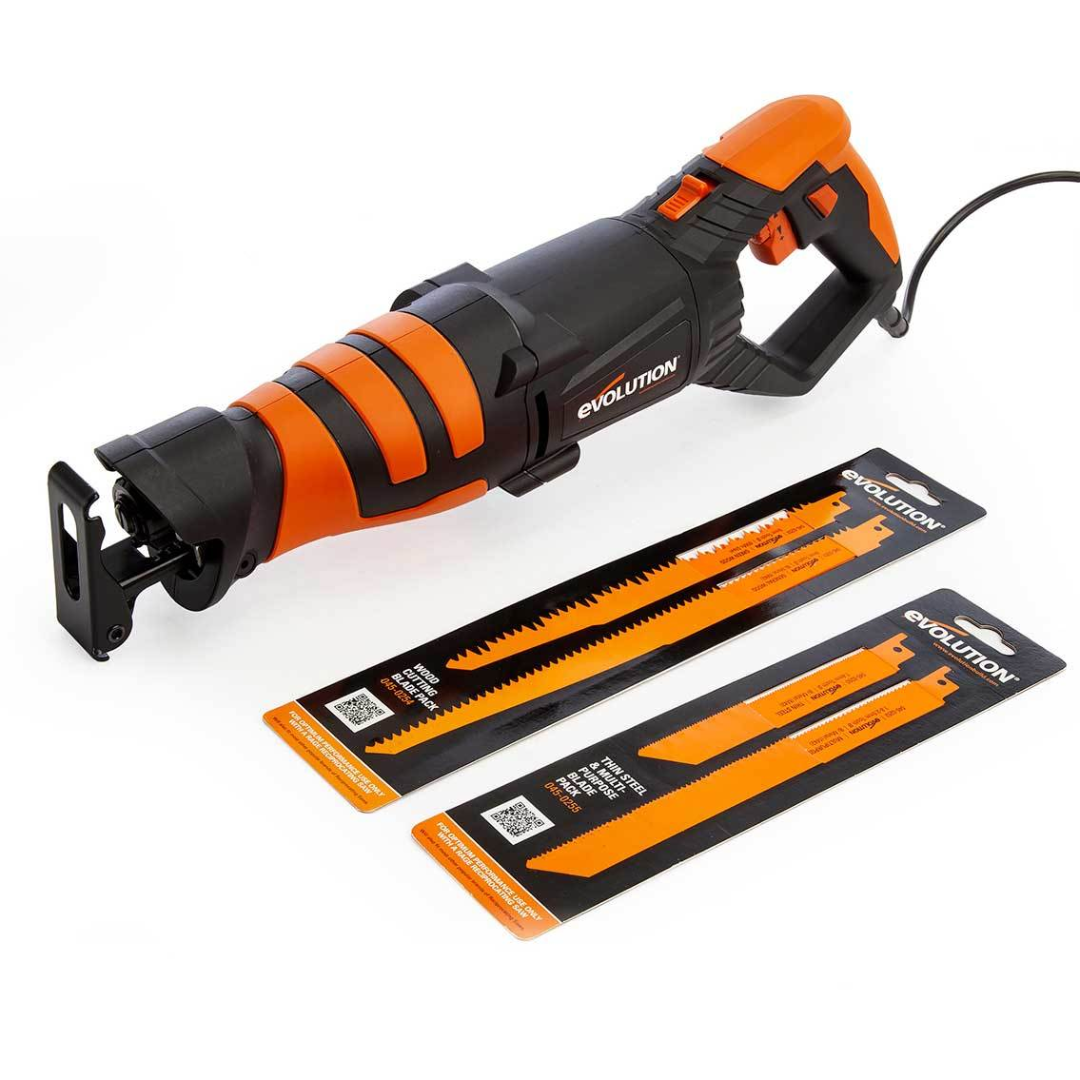
| Evolution Power Tools Reciprocating Saw with 4 Blades R230RCP | $153.83 | Variable speed with a handle that rotates 180 degrees | Crews cutting for landscaping, maintenance and construction |
| CS Unitec Electric Reciprocating Saws | From $1,281.00 | Spade or D handle options, up to 2200 strokes per minute | Contractors who want a choice of 3 saw configurations |
| CS Unitec Air Reciprocating Saw CS75 | $2,900.00 | Compressed-air powered saw with a carrying case and clamp | Cutting material up to 3/4 inch thick on air power |
Match the power source, stroke speed and cutting capacity in each row to your demo or remodel job, and to the tools and air supply on your site.
Reciprocating Saws for Demo and Remodel Work
Reciprocating saws in our store come in electric, air-powered and hydraulic designs. This guide stresses battery platforms for cordless work, so check each saw's power source against your site before choosing.
1. Evolution Power Tools Reciprocating Saw with 4 Blades R230RCP — $153.83
General-purpose cutting is covered by this corded saw's 7 Amp motor and 2,800 SPM, with variable speed to match the job. View more >
2. CS Unitec Electric Reciprocating Saws — From $1,281.00
Spade or D handle styles, up to 2200 strokes per minute and three configurations, for demo and remodel cutting with an electric saw. View more >
3. CS Unitec Air Reciprocating Saw CS75 — $2,900.00
Pneumatic reciprocating saw rated for material up to 3/4 inch thick, sold with a carrying case and clamp, a fit for crews working on compressed air. View more >
Frequently Asked Questions
What can a cordless reciprocating saw cut?
With the right blade, a cordless reciprocating saw cuts wood (including lumber with embedded nails), pipe (PVC, copper, cast iron), rebar, drywall, fiberglass, tree branches, and sheet metal.
What voltage is best?
For most homeowners and light contractors, 18V–20V provides plenty of power. For heavy-duty sustained demolition, 36V or 40V delivers noticeably more consistent power.
Is brushless worth it?
Yes, especially if you plan to use the saw frequently. A brushless motor runs cooler, uses battery power more efficiently, and typically lasts significantly longer than a brushed motor.
When should I use orbital mode on a recip saw?
Use orbital mode for wood, where it cuts faster, and switch to straight mode for metal. For metal you should also slow down, because a lower SPM (strokes per minute) produces less heat and better control.
Conclusion
A great cordless reciprocating saw gives you the freedom to demo, remodel and cut pipe or branches without an outlet, and the battery platform matters as much as the saw. To see current models and pricing, browse our reciprocating saws collection.
Safety and standards references: OSHA hand and power tools standards and OSHA 1910.243 guarding of portable powered tools.
Explore the category: Power Tools and Power Saws. Related collections: Cordless Reciprocating Saws.
Related Reading
Shop Professional Band Saws at Iron Line Tools

Ellis 1600 Mitre Band Saw
Price: $5,299 | Type: Mitre Band Saw
The Ellis 1600 is a professional-grade horizontal/vertical mitre band saw with 10" round cutting capacity. Precision miter cuts from 0-60 degrees, heavy-duty construction. Built in the USA and backed by Ellis's legendary reliability.

Maksiwa BMS.1600.IR Sliding Panel Saw
Price: $6,399 | Type: Sliding Panel Saw
The BMS.1600.IR is a high-precision sliding panel saw for shops that need accurate cuts on sheet goods and solid wood. A sliding table handles full panels while the precision fence system delivers repeatable rips and crosscuts.
Demo, remodel or pipe cutting without a cord?
Battery platform and feature choices get easier when you talk to our team about your jobs.
Also browse: Band Saws & Panel Saws