

In This Guide
- Types of Sanding Machines Explained
- Best Sanders for Furniture
- Best Sanders for DIY Beginners
- Best Electric Sanders for Wood
- Sanding Machines Compared for Furniture Work
- Sanding Machines for Furniture Makers and DIY
- How to Choose the Right Sander
- Sanding Tips for Better Results
- Frequently Asked Questions
- Conclusion
Featured Sanding Machine

Safety Speed
Safety Speed 3760 Wide Belt Sander
From $15,499.00
At 37 inch by 60 inch, this Safety Speed wide belt sander is industrial scale and American-made, built to reduce manual sanding and lift shop productivity. Consider it when your plan includes production panels.

Proxxon
$178.20
Proxxon's TG 125/E disc sander has a 5 inch disc running from 1,150 to 3,600 rpm and an aluminum table that tilts and takes a miter gage. It works on wood, metals and plastics, a flexible disc option for mixed projects.

RIKON
RIKON 50-120 6" x 48" Belt / 10" Disc Sander
$649.99
Need a belt-first machine? The belt support fence on the RIKON 50-120 can be removed for access along the whole belt, and it pairs a 6 inch by 48 inch belt with a 10 inch disc. Worth a look for larger projects.

Virutex
Virutex Rotary Orbital Sander RTE146L: High-Performance Sanding 4600399
$300.15
A dual-action sander, the Virutex RTE146L combines rotary and orbital movement for fast material removal and fine finishing in a single tool. That suits furniture work, where you often go from heavy removal to a smooth final surface. Check which pad and abrasives it uses before you buy.
Types of Sanding Machines Explained
Before buying a sander, it helps to understand how each type works and what it's actually designed to do. Using the wrong sander for a job doesn't just produce poor results — it can damage the workpiece or waste hours of effort.

Random Orbital Sander — The most versatile. Combines a spinning disc with a random orbital path to prevent swirl marks. Works on flat surfaces and handles both aggressive stock removal and fine finishing. Every serious woodworker and furniture restorer should own one.

Detail Sander (Mouse Sander) — Uses a small triangular pad that vibrates rapidly. The pointed tip reaches corners and tight spaces. Lower-powered than orbital or belt sanders; shines on detail work and finishing passes.

Belt Sander — High-power, aggressive. A continuous loop of sandpaper over two rollers. Designed for fast material removal — stripping paint, leveling rough lumber. Not a finishing tool.

Sheet Sander (Finishing Sander) — Uses rectangular sheets of standard sandpaper. Vibrates in a small orbital motion. Slower than random orbital; works well for fine finish sanding on flat surfaces and corners.

Oscillating Spindle Sander — A vertical abrasive spindle that rotates and oscillates up and down. The right tool for cleaning up curved cuts, inside contours, and irregular profiles.

Drum Sander (Benchtop) — Uses a cylindrical abrasive drum to surface wide panels to a consistent thickness. Designed for flattening glued-up tabletops, cabinet doors, and wide boards.

Best Sanders for Furniture Refinishing
Best All-Around Sander for Furniture
Random Orbital Sander
For furniture refinishing, the random orbital sander is the single most useful power sander you can own. It handles both stripping stages (with 60–80 grit paper) and finishing stages (with 150–220 grit paper), works on curved and flat surfaces, and leaves no directional scratch pattern.

Best for: Flat panels, tabletops, drawer fronts, cabinet doors, large furniture surfaces
Best Detail Sander for Furniture
Mouse Sander / Detail Sander
Furniture has corners. Chair rails, leg profiles, frame joints, carved details — a random orbital sander simply can't reach these areas. A mouse sander fills this gap efficiently. Use fine grits (120–220) for furniture detail work.

Best for: Corners, edges, carved details, chair legs, trim work, window frames
Best Sanders for DIY Beginners
Start with a random orbital sander. It's the most forgiving, versatile, and widely applicable sander available. A 5-inch corded random orbital from DeWalt, Makita, or Bosch in the $40–$80 range covers the vast majority of DIY sanding tasks a beginner will encounter.

Add a mouse sander next. Once you've run into corners and tight spaces that your orbital can't reach, a detail sander solves the problem at a low cost.
Consider a multi-tool later. An oscillating multi-tool with a sanding attachment is useful for getting into spaces even a mouse sander can't access.
Best Electric Sanders for Wood
Rough lumber prep: A belt sander with 40–60 grit removes mill marks and surface roughness quickly on flat stock.
Panel flattening: For glued-up panels, a random orbital sander with 60–80 grit followed by a finishing pass at 120–150 grit gives good results on most hardwoods.

Finish sanding: The final passes before applying stain, paint, or clear finish are done with a random orbital sander at 150–220 grit.
Detail and edge work: Profile edges on furniture and cabinet work are best finished by hand or with a detail sander.

Sanding Machines Compared for Furniture Work
Furniture makers and DIY users get a table of the sanding machines the guide suggests. Scan the Key feature column to see right away which ones run a belt, a disc or an orbital pad.
| Model | Price | Key feature | Best for |
|---|---|---|---|
| RIKON 50-1305 1" x 30" Belt / 5" Disc Sander | $149.99 | Efficient 1/3HP motor, 5 inch disc, improved dust removal | Small furniture and craft projects |
| Virutex LRE46L Orbital sander (120 V) 4600299 | $323.15 | Balanced orbital build for polishing and fine sanding | Fine sanding furniture with smooth results |
| Proxxon Belt Sander BS/E | $179.10 | Variable belt speed from 12 to 25 ft/s, light and compact | Detail belt work in modeling and tool making |
| RIKON 50-114 4" x 36" Belt 8" Disc Sander | $279.99 | 8 inch disc, direct drive, belt frame adjusts horizontal to vertical | Shaping and finishing wood with fine control |
| RIKON 50-161VS 1" x 30" Belt 6" Disc VS Sander | $229.99 | Variable speed dial for belt and disc, 1 inch by 30 inch belt | Small crafts needing a dialed in sanding speed |
Pick the sanding action that fits your project, then read across to the motor, speed control and size that suit the work.
Sanding Machines for Furniture Makers and DIY
Browse sanders from our store that fit the beginner, furniture and woodworking sections of the buying guide. Think about your biggest workpiece first, since it sets the belt and disc size.
1. RIKON 50-1305 1" x 30" Belt / 5" Disc Sander — $149.99
Think home crafts, furniture and repair work: this 1 inch by 30 inch belt and 5 inch disc sander runs on a 1/3HP motor. A bench option for a first stationary sander. View more >
2. Virutex LRE46L Orbital sander (120 V) 4600299 — $323.15
Furniture refinishing calls for fine, smooth passes, and this orbital sander has electronic speed control plus a dust collection system for polishing and fine sanding. View more >
3. Proxxon Belt Sander BS/E — $179.10
User-friendly and light, this belt sander fits tight spaces and runs at 12 to 25 ft/s with variable speed. A reasonable first handheld belt sander for DIY work. View more >
4. RIKON 50-114 4" x 36" Belt 8" Disc Sander — $279.99
Direct drive power turns a 4 inch by 36 inch belt and 8 inch disc, giving fine control for shaping and finishing wood. A step up from handheld sanders. View more >
5. RIKON 50-161VS 1" x 30" Belt 6" Disc VS Sander — $229.99
Hobby crafts, toys and repairs suit this 1 inch by 30 inch belt and 6 inch disc sander, which has variable speed for dialing in the pace. Its small motor removes material quickly. View more >
How to Choose the Right Sanding Machine
Define the work you actually do. Large flat surfaces benefit from a random orbital or belt sander. Curved parts need a spindle sander or detail sander. Fine furniture finishing calls for a random orbital at fine grits.
Corded vs. cordless: Corded sanders deliver consistent power. Cordless offer freedom of movement and no cable management issues — a real advantage for furniture work. If you already own a major battery platform, matching your sander to your existing batteries eliminates extra cost.
Dust collection: All quality sanders include a dust port. Connecting to a shop vacuum substantially reduces airborne dust. Wear an N95 respirator during extended sanding sessions.

Sanding Tips for Better Results
- Sand progressively through grits: Don't skip grits. Start coarse (40–60) and work up through 120, 150, and 220.
- Change sandpaper before it wears out: Worn sandpaper stops cutting and generates heat instead of removing material.
- Keep the tool moving: Holding a sander stationary creates visible depressions.
- Sand with the grain for final passes: A final hand-sanding pass with the grain at 220 grit removes any remaining cross-grain scratches.

Frequently Asked Questions
Which sander should I buy first?
For most DIYers and woodworkers, the first sander to buy is a 5-inch random orbital sander. A mid-range corded or cordless model from DeWalt, Makita, or Bosch in the $60–$100 range is a good starting point.
What is the best sander for refinishing furniture?
A random orbital sander handles the majority of the work. Add a detail sander for corners and edges. For heavy paint buildup, start with a belt sander before switching to the orbital.
What type of sander do I need for wood furniture?
A random orbital sander combined with a detail sander covers nearly every sanding task in furniture refinishing, painting, and restoration.
What grit should I use for the final sanding before finishing?
Do the final passes before stain, paint, or clear finish with a random orbital sander at 150 to 220 grit. Work up through the grits in order, and don't skip any along the way.
Conclusion
The right sanding machine depends on whether you are refinishing furniture, starting out or working wood every day, so match the type to the job before you buy. When you are ready to buy, explore our sanding machines collection and find the right fit.
Safety and standards references: OSHA woodworking eTool: sanders and OSHA woodworking eTool: wood dust.
Related Reading
Shop Sanders at Iron Line Tools

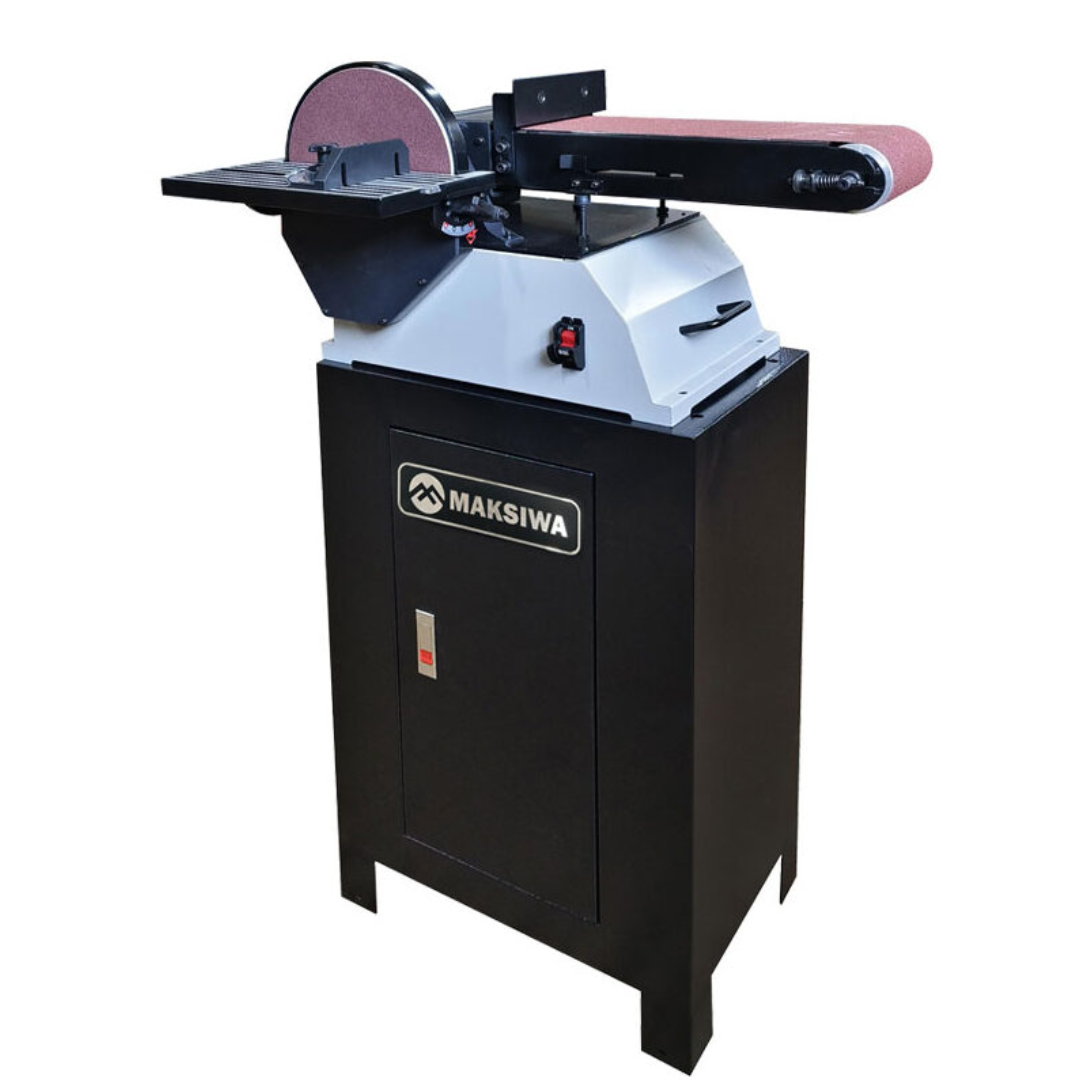
Maksiwa LDF Combination Belt and Disc Sander
Price: $899 | Type: Belt & Disc Sander
The Maksiwa LDF combines a belt sander and disc sander in one compact machine. A versatile benchtop sander for shaping, smoothing, and finishing wood in any shop.

Safety Speed 3760 Wide Belt Sander
Price: $15,499 | Type: Wide Belt Sander
The Safety Speed 3760 is a professional wide belt sander with industrial sanding head, conveyor table, and precision control panel. Built for high-production sanding of wood panels and solid lumber.
Refinishing furniture or sanding every day?
Beginner or daily user, our team can match the machine type to your work before you commit to a purchase.